 Parks On The Air (POTA) has exploded in popularity, with most of the activity on the HF bands. That makes sense — HF gives you the long-distance contacts and the big pileups. But don’t overlook the VHF bands, especially 2m FM. Two meter FM is simple, highly portable, and often an easy way to knock out a few contacts when you’re in a park.
VHF works well for Summits On The Air, because you are operating from a summit: Height Above Average Terrain and all that. You might have that same advantage from some parks but certainly not always.
Here are three VHF scenarios that are common with POTA. These aren’t theoretical — they’re real-world approaches that you may want to try in the field.
VHF-Only POTA
This scenario is not real common but I have hunted a few activators doing this. Typically, they find a high spot in a park and get on the air with 2m and 70cm FM. The challenge is that you have limited range with VHF and you need to make 10 QSOs to qualify as a POTA activation. Being close to a population center helps.
This approach can be simple and fun. Just toss a dual-band handheld in your pack and head to the park. Or drive your vehicle equipped with a VHF/UHF mobile radio, with more power, to the park. One variation on this is to operate a VHF contest from a park. The VHF contest brings out the activity, and you get to make contacts while portable from a park.
Combining SOTA and POTA
These two programs have significant overlap, so combining them is a great option. Many SOTA summits are located inside POTA parks, so you can get credit for both programs with one activation. VHF works well here because Height Above Average Terrain dramatically improves your range.
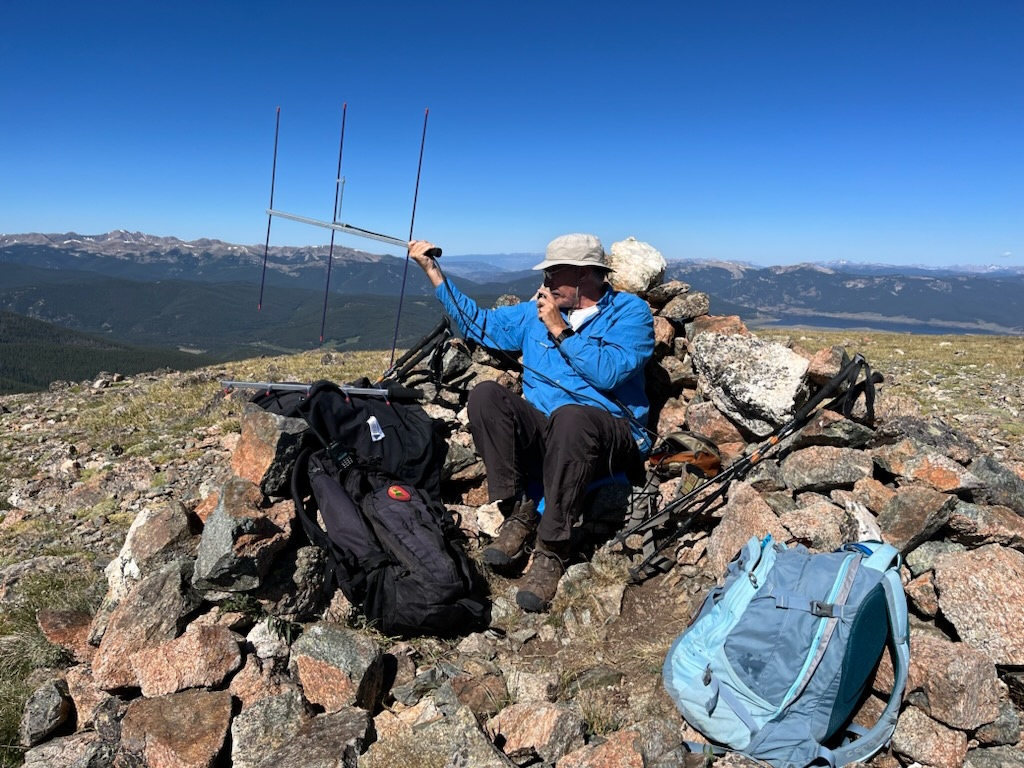
From a summit you can usually work enough stations on 2m simplex with just a handheld radio. However, see The Truth About VHF SOTA. Four contacts, which need to be with four different stations, will get you the SOTA activator points. The POTA rules require 10 QSOs, but you can count a station each time you work them on a different band/mode pair. Most stations that have 2m FM also have 70cm FM, so that it is easy to double up by asking hunters to change bands. You might be able to extend this idea further. For example, you can count the same station four times by working them on 2m FM, 2m SSB, 70cm FM, and 70cm SSB. It all depends on the gear you and the hunter station have available.
Keep an eye on the activation zone rules. SOTA won’t count contacts inside the summit activation zone, while POTA is more flexible (including park-to-park credit even if you’re both in the same park).
I’ve done many of these combo activations with VHF/UHF gear.
VHF as an Add-on to an HF Activation
You’re already in the park with your HF station set up — wire antenna, picnic table, battery, the whole works. Why not grab a handheld and make a few extra contacts on 2 meters? Or use your mobile station to do the same thing.
This is low-effort and often effective. While you’re calling CQ on 20m or 40m, just monitor 146.52 MHz on the HT or occasionally throw out a quick “CQ POTA” on 2 meters. You’ll often pick up local stations or other activators who are monitoring the simplex frequency.
I’ve done this many times during HF POTA activations. The HF station is doing the heavy lifting for distance, but the HT gives me quick, easy local contacts with almost zero extra setup. It’s especially handy on days when HF conditions are poor.
A Few Operating Tips
- Frequency: Start with 146.52 MHz — the national 2m simplex calling frequency. Another good option is the North America Adventure Frequency (NAAF), 146.58 MHz.
- Repeaters: Remember that repeater contacts are not allowed. However, you can announce your POTA activation on a repeater and ask for hunters to work you on simplex.
- Antenna: The stock rubber duck is okay for very local work, but a better whip (like the RH-660) or a small handheld Yagi makes a huge difference. Or maybe you want to set up a mast with larger antenna.
- Power: Your 5 watt handheld may be sufficient in many cases but running more power always helps, especially for marginal contacts.
- Mode: FM simplex is the workhorse. It’s what most hams are equipped for and it works reliably.
- Spotting: Use the POTA app or website to let people know you’re on VHF.
- Group activations: If you’re activating a park with a partner or group, it’s common (and allowed) to work each other on 2m FM right at the start. Maybe do 70cm while you are at it.
VHF isn’t going to replace HF for POTA, but it’s an excellent complement — and sometimes the best tool for the job. It’s simple, fun, and lowers the barrier to getting out and activating.
Next time you head to a park, throw an HT in the bag. You might just find that 2 meters becomes one of your favorite POTA bands.
73 Bob K0NR
Hi Bob, It was serveral years ago, but we did have a QSO on 2m. You were somewhere with your wife on a hi peak in the southern California desert. I was on Means Dry Lake for the desert race King of Hammers, seems like maybe January. I turned on my HT not thinking anyone would be there, but there you were many many miles away. Thank you! for that memory ! best Ken KK6OEX
Ken, yes, I remember this.
K0JJW and I were on Ryan Mountain in Joshua Tree NP, doing a SOTA activation.
It was Feb 6, 2020. (OK I had to look up the date.)
Thanks for the memory.
73 Bob K0NR
I have activated a park several times on 2m SSB
And almost a SOTA on 2m FM. The broadcast towers really raised the noise floor
John ve3ips
Still trying on 1296 but all these appliance operators using 9700s for 2m repeaters are a joke
Good job.
Did you have to arrange skeds for the 2m SSB POTA activation or is there enough SSB activity in your area?