Once again, I am in the middle of teaching a Technician license class and I notice that some of the exam questions seem off target. I look at the exam through the lens of “what does a licensee need to know to get started at the Technician level?” My approach is more pragmatic than purist. Here are some specific examples of bad questions: Frequency limits for HF beacons [T1A06], reverse function on a VHF/UHF transceiver [T2B01], radiogram questions [T2C10] [T2C11], transverters [T7A06], mode switch on amplifier [T7A09]. Maybe these are not “bad” questions, but they aren’t the most important things a new Tech needs to know.
Most Technicians are going to get started with simple VHF/UHF equipment, focused on local or regional communication. Tech’s do have operating privileges on the HF bands, with CW, Phone, and Data modes on the 10m band. They also get some CW privileges on 80m, 40m, and 15m. While CW is an attraction for some newbie licensees, most Technicians are interested in phone and maybe data (digital). So that points them to 10m as their only HF option. The thing about 10m is that it can be an absolute blast to operate or the band can be painfully dead for long periods of time. Note that we are past the peak of the solar cycle and headed downhill to the quiet time for 10 meters.
Some History
Way back in the olden days when the dinosaurs roamed the earth, the entry level license was the Novice license. This license provided CW privileges on the HF bands and required passing a 5 WPM Morse code test.
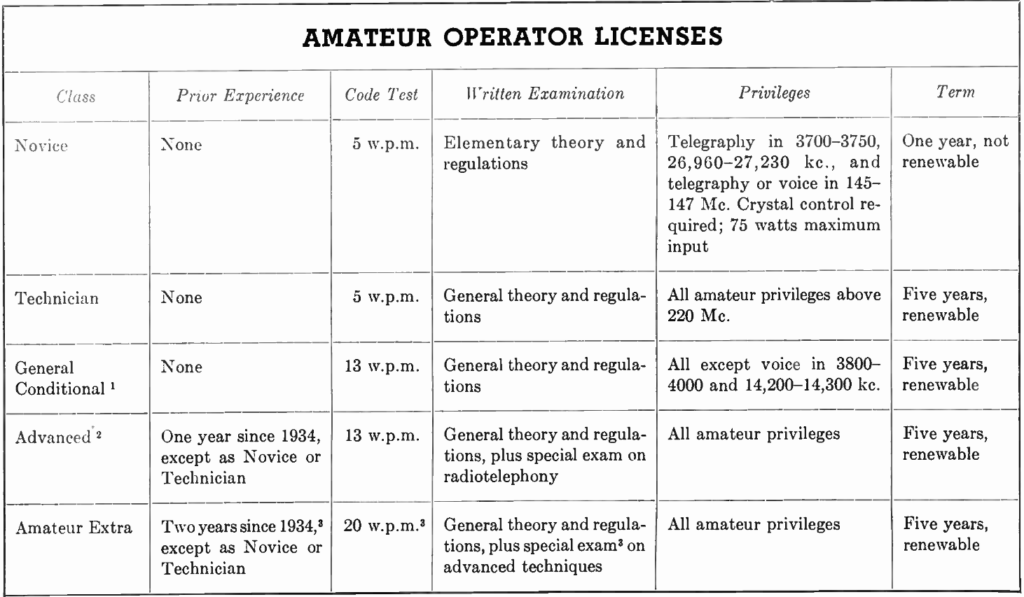
Note that the Novice license had CW and phone privileges on the 2m band. The 2m phone privileges were removed in 1968 as part of the “incentive licensing” changes. (In retrospect, this seems like a bad idea.) Also note that in 1952, Technician licenses had all privileges above 220 MHz, but nothing below. When introduced, the Technician license was explicitly designed as a special-purpose experimenter’s license focused on VHF/UHF and higher frequencies. It was not intended as a general entry-level license like the Novice; it targeted technically-inclined people who wanted to explore and develop equipment and techniques on the bands above 220 MHz.
With time, Novice licensees gained 220 MHz to “enhance” their privileges, and Technicians were given the 6m and 2m bands. In 2000, the current licensing structure of Technician-General-Extra was implemented, and Novice licenses were no longer issued. By 2007, the Morse Code requirement was completely eliminated, with Technician licensees receiving the same Novice HF privileges. (I am glossing over some of the details, but this captures the main progression.)
Some important observations are:
- The Technician license was conceived as a “techie” license, not a beginners license. It had VHF/UHF privileges but no HF privileges.
- The Novice license was the beginner license, with some basic HF (CW) privileges (and in the beginning, 2 meters!)
- The Novice exam was very basic compared to today’s Technician exam. It was intended to be an easy entry point, requiring some study but not too much.
- Over time the Technician license evolved into the entry level license while carrying along the technical content from its techie roots.
- The changes to the Novice and Technician license privileges have been ad hoc and incremental, resulting in what we have today.
The Technician License Today
The Technician license today offers all amateur privileges above 50 MHz (at an allowed power level of 1500 watts PEP). Technicians also have CW, Data, and SSB on the 10m band, along with the slices of CW “Novice” privileges on 80m, 40m, 15m, 10m. Some folks assume that a Technician can also run data emissions on 80m, 40m, and 15m, but that is incorrect.
The Technician license today is not a good on-ramp for a new amateur radio licensee. Or maybe I should say that it works (lots of people pass their Tech exam every year), but it is not optimized for attracting new people into the amateur radio service. The exam includes questions on the ionosphere, HF propagation, HF beacon stations, international communications, etc. These are things that most newbie Tech’s are not going to need to know, getting started with relatively local VHF/UHF communications. But these topics are in there because the Tech license privileges include HF. At the same time, the Technician exam retains a lot of technical topics from its origin as the Techie license.
A Better Licensing Structure
If I were in charge of Amateur Radio licensing (hey, it could happen), I would implement a more streamlined licensing structure that provides a more effective licensing progression. It would still have three levels of licensing:
- Communicator License: All amateur privileges above 50 MHz, with a power limit of 100 watts PEP. No HF privileges. This license is intended to be an on-ramp, not a barrier to entry. The technical depth of the exam would be more like the original Novice exam and focus on the key things that a new licensee needs to know (call signs, operating procedures, band plans, etc.)
- General License: Keep the existing operating privileges. However, it is important that this license remains a reasonable step up from the
TechnicianCommunicator license. Towards that end, the license exam should be tuned to focus on the new topic areas associated with the General privileges (HF operating, propagation, etc.) The current General exam repeats much of the Technician material, which can be dropped. - Extra License: No changes in privileges or exam content.
Transitioning to this new structure would be a challenge. Taking away operating privileges has never been popular for obvious reasons. A likely approach would be to grandfather in all Technician licensees with existing privileges but not issue new licenses (similar to the Novice and Advanced licenses today.) Or we could add in the Communicator license as an additional license class, while retaining the Technician license. But the FCC is looking for ways to simplify their rules and regulations and either of these approaches would increase regulatory complexity for many years.
Unless I am named FCC Chairman, I don’t think this is going to happen. What I’d really like to see is a fresh look at Part 97 licensing, working from first principles that prioritize getting people into the hobby and advancing their knowledge over time.
These are my thoughts. What do you say?
73 Bob K0NR
This was an interesting article. I am a Technician and I got my license back in Dec. 2025. I still have not used my 10m privileges, but I am on local 2m repeater nets nearly every day. I agree that the Tech license covers a lot that is not really necessary for a newly licensed ham. I could see the argument that some of the information serves as a primer for stepping up to General class, but I know that it is a barrier to younger people getting their licenses. Although I found the sections on electronics, antennas, propagation and the ionosphere pretty fascinating, I think a 12 or 13 year-old will develop an interest in these things by actually using the radio. Those topics could feel a bit overwhelming to a younger person who just want to get on the air and get some hands on experience.
Thanks, Adam KM7DNJ
I actually feel the best way to increase interest in amateur radio in general and getting people to upgrade would be to give the entry level license class a small amount of HF Digital and Phone privileges in addition to the the CW privileges they now have. For Phone, a very small segment on 12M and17M, and for Digital, a very small segment on 30M. This would let them have a small taste of the operations they are missing when 10M is at its low point but not so much freedom that they have no reason to upgrade.
Tim N9PUZ
Tim,
I can see the benefit of having a taste of HF in the Technician license privileges.
And if that is going to be the strategy, then give them some privileges that are useful throughout the 11-year solar cycle.
And not just CW.
Bob K0NR
For the record, I started as a Novice, enjoyed the “Novice Enhancement” features thoroughly, and went right up through Technician and General. (The Extra privileges aren’t of sufficient allure to make Extra’s exams worthwhile, but I might do it just as an intellectual exercise.)
If you want to give Technicians “…then give them some privileges that are useful throughout the 11-year solar cycle” then give them a portion of the 40m and 15m bands, perhaps the existing Novice/Technician segments — small but adequate for the “taste” of HF. Maybe also space in the 10m but that’s arguable with it not being very useful at sunspot lows. (I was originally going to suggest a slice of 20m but that’d raise hell with much of the General and Extra crowd.)
Yes, 20 meters is hallowed ground, to be protected at all costs. 🙂
I was licensed in 1984 as a teenager, and I thought the amateur radio on-ramps, Novice and Technician, were broken back then. Novice seemed like a throwback to the 1950s, with such minimal privileges, all CW until they later added the 10 meter phone segment which was useless in all but a few years at the solar maximum. Technician, while granting some really great VHF, UHF, and microwave privileges, in reality is/was just a license to get on 2 meter repeaters, which is another lousy entry point into amateur radio in my opinion. I think N9PUZ’s idea of allocating WARC band privileges is a great idea. A slice of 40 meter phone would get a lot of new licensees hooked as well.
If you want to change amateur radio licensing, petition the FCC directly. There’s no need to ask or wait for ARRL to take the lead on regulatory matters like this these days. If you really want to shake things up, also petition for amateur radio license management to be divested to a new non-profit organization, saving the FCC some non-zero amount of administrative costs each year. They might just take us up on that.
Thanks for the comments, Goody.
I appreciate your perspective.
I’ve been having so much fun above 50 MHz for decades now, I can’t relate to the notion that the Tech license is just about 2m repeaters.
73 Bob K0NR
Agreed; as I mentioned, the Tech license does give one great VHF, UHF, and microwave allocations. How many Techs venture outside of 2 meters and/or repeaters, like you have? I don’t know what that percentage may be and I doubt anyone knows, but I have sensed in the past that it’s a low number. Of course with the resurgence of 6 meters, and now FT8 on that band, there probably are more Techs on 6 than in previous decades, and this is admittedly out of my purview. But I digress. I think my basic problem with the Technician license these days, and the Novice license in the past, was that they didn’t really give a new amateur a good slice of and experience on HF phone. I think your proposed Communicator license is going in the wrong direction with eliminating HF privileges. Is there any more technical depth needed to get on HF versus VHF/UHF? 6 meters is much like HF, just different propagation nuances, and not to belabor the repeater argument, but 2 meter FM is very easy to get equipped for and on the band. HF with a wire antenna is technically trivial to accomplish as well. Why have an on ramp that is exclusively VHF and above? Perhaps dual on-ramps are the way to go, one for HF and another for VHF and above, and the Extra exam encompasses both. One could enter the hobby as an HF Communicator or a VHF/UHF+ Communicator and advance to Extra after that.
As a 1970’s Technician, I talked on repeaters, but not ‘just.’ I eventually used all bands 50 through 10700 MHz, FM, SSB, and CW. I did not use my HF CW privileges.
From your list, I would at least keep the “reverse” switch question on the test. If most new techs just work the repeaters as you they should at least know how those VHF/UHF radios work.
Years ago, I was leaving a ham meeting, listening to the local repeater. Two friends leaving the meeting who just got their licenses started agreeing to move off the repeater to simplex (a good practice). But they chose 148.00 MHz.
It was not a time to teach over the air about the occupied bandwidth of an FM signal. I did break in and say that they would be outside the band when they spoke, and suggested a coordinated simplex frequency of 147.570 MHz. I seem to recall they agreed.
I’d like to see more privileges on HF for technicians. At minimum all modes from 10m on up would be nice. The hope is it would help create some interest in manufacturing more gear to operate digital/ssb voice on 10m/6m/2m/70cm. Perhaps also restricted segments of the 12m, 15m and 17m bands targeting digital modes. The thought process here is the antennas required to operate on these bands are smaller and more likely to be appealing/accessible/allowed for more operators. 100w and below could be a pragmatic compromise for the extra rights on the bands. Cheaper entry level HF gear probably wouldn’t hurt either. :/
I agree with the fact that the question pool needs to be more focused on what Technician’s really need to know, including Band Plans, etc., but I think the licensing structure itself is fine the way it is.
Thanks for the comments.
I wonder how many Technicians get on 10 meters? It appears to be a low percentage but I don’t have the data to back that up. I’ve been amazed at how many Generals I encounter, that have not figured out how to get on HF. There are some significant barriers there:
https://www.k0nr.com/wordpress/2018/09/getting-on-hf-fiddle-factor/
This discussion reminded me that the ARRL made a proposal to the FCC in 2018 that would have given Techs some phone and digital privileges on 80m, 40m, 15m, & 10m.
See https://www.arrl.org/Technicianenhancement or RM-11828
The FCC has not taken any rule-making action on it.
Currently the biggest barriers to participating in the most popular activities on ham radio, FT8 and POTA is the general test and the cost of radios.
I’d love for techs to be able to use digital on any bands they already have CW privileges for. Perhaps only at QRP levels.
While QRP can be challenging, that challenge encourages experimentation. In addition, QRP lowers the barrier of cost because they tend to be cheaper. A new market of new hams would likely increase the number of QRPs that are available.
Now maybe I’m naive and that will be a disaster that will cause a flood of new people on the already crowded FT8 calling frequencies and an epidemic of activators raising antennas into powerlines; or it could be a raving success and the hobby grows. I don’t know. I can’t predict the future.
It does seem inconsistent to provide Technicians CW privileges but not digital on the HF bands.
I taught tech, general and extra classes for years and gave up in frustration. At the start, the 90% plus new hams, regardless of the license, became active. At the end, 90% of the new hams, regardless of license level, never pick up a microphone / key / ht / keyboard. I also found those that did or expressed a desire to get on the air, would not do basic research. Rather they wanted someone to show them, over and over. I got very frustrated with new hams, of all ages, looking at their phone on an unrelated topics, as I tried to explain a subject.
“Fixing” the tech license, i.e. communicator license, might be a help. Certainly doing nothing isn’t working.
Michael,
I am thankful that most of my students have been pretty good. But I have had students that were not expending any energy, before or after they get a license. I try to remain biased towards helping but at some point I am compelled to write them off.
(They are basically burning my time instead of theirs.)
Bob