For the RF/microwave enthusiasts out there, you may recall the old HP Reflectometer Calculator that does conversions between SWR, Return Loss and calculated mismatch uncertainty.
Well, fast forward to the 21st century and this same functionality can be found in an iPhone ap. Agilent Technologies has a free ap available on iTunes that does these calculations and some other things like decibel conversions.
Check it out at here or just search for microwave calculator on iTunes.
The Colorado FM Sprint is a short and simple VHF contest that runs in parallel with the ARRL June VHF QSO Party. Basically, it’s a chance to have some fun on the VHF bands for not-so-serious contesters.
This contest is held concurrently with the ARRL June VHF QSO Party, with compatible rules and operating procedures. The purpose of this contest is to:
· Promote the use of FM VHF/UHF simplex
· Provide an opportunity for radio amateurs to test the limits of their stations using FM VHF/UHF and to experiment with ways to improve their stations
· Practice deploying portable and mobile operation as a means of identifying effective locations for temporary relay stations
· Provide a simple and enjoyable radio contest experience (“Have fun!”)
Time:
Sunday, June 13, 2010; 1200 to 1600 Mountain Time (1800 to 2200 UTC)
Objective:
To work as many stations as possible using FM simplex on the 146 MHz, 222 MHz and 440 MHz bands in as many different VHF grids as possible.
Frequencies:
Operate on FM simplex frequencies consistent with the Colorado Council of Amateur Radio Clubs (CCARC) band plans with special emphasis on using ARES designated frequencies.
(Consistent with the ARRL Rules, 146.52 MHz is not allowed to be used in the contest.)
Suggested Frequencies:
2 Meters: 146.58, 146.55, 146.49 MHz
222 MHz: 223.5 MHz
440 MHz: 446.0, 446.025, 446.100 MHz
Do not operate on repeater frequencies or 146.52 MHz, the National Simplex Calling Frequency.
Remember to be a considerate operator and share the frequency with other operators.
Contest Exchange
To complete a contest QSO, you and the other station must copy each other’s callsign and 4-digit Grid Locator. You may optionally exchange Name and ARES District.
We finished up the second and last day of our 2-day Ham Radio Technician License Class. The class ended with a VE test session, which was done by one of the local VE teams. We had 19 out of 21 students pass Element 2, qualifying them for a Technician Class License, for a 90% success rate. A handful of the students gave the General test a try and some passed that, too. We were very pleased with the level of interest in the class and the success rate on the exams.
Our learning objective was to have the students pass the Tech exam and know enough to be able to get on the air and operate a radio on the bands above 50 MHz.
The basic approach we used was to have two all-day classes, held on two consecutive Saturdays. We carefully developed a schedule that got us through all of the material and made sure we kept the class moving through it. We had originally looked at a one-day ham class but decided that was just too much material for one day. On the other hand, we did not want to go the traditional route of meeting once a week for 8 or more weeks. We didn’t think the instructors or the students would last that long! In the end, we chose an intense two-day approach, but made it clear to the students that they had to study the book in advance to be successful with this compressed approach.
We used the Gordon West Technician License guide, which is a very focused text, which ties the material directly to the exam questions. We also recommended the ARRL Ham Radio License Manual as another good reference book. The ARRL book provides a broader context and includes material that is not required by the Technician exam.
One important point: I found this to be a very fun and motivating activity. It forced me to take a fresh look at amateur radio and really think about how to efficiently convey the material. Seeing a group of students get excited about ham radio gave me a spark of energy. Think about this if you are looking for some way to get re-energized in ham radio.
We have a waiting list for our next class, so it seems we need to do this again…soon.
We’ve been looking at optimizing the performance of the D-STAR repeater here in Monument (W0TLM, 446.8875 MHz), so I’ve been searching the web for information on what other groups have uncovered. Not surprisingly, there has been some creative reverse-engineering and re-engineering of the ICOM D-STAR repeaters.
The results of the June VHF contest have been published online and in the December issue of QST. I operated from our cabin in DM78, near Trout Creek Pass with temporary antennas up for 50 MHz and 144 MHz (3-element Cushcraft Yagi on 50MHz and a 2M9 on 144 MHz) It was mostly a two band effort in the low power single operator category, with a few additional contacts on 440 MHz FM.
VHF contests are mostly a regional competition since the scores depend so much on adjacent operating activity. Here’s the scores for the Colorado Single Operator Low Power category:
#
Call
Score
QSOs
Mult
Class
Section
1
N0POH
73,225
419
145
A
CO
2
K0COM
38,532
322
114
A
CO
3
N0HF
29,718
254
117
A
CO
4
K0NR
28,197
238
117
A
CO
5
N0YE
14,112
154
56
A
CO
6
KB0YH
13,855
163
85
A
CO
7
W0EPC
7,812
126
62
A
CO
8
WB5PJB
6,050
97
55
A
CO
9
K0CS
4,928
88
56
A
CO
10
K0UK
1,316
47
28
A
CO
11
KC0VFO
1,140
53
19
A
CO
12
W0PSS
621
26
23
A
CO
13
AB0SF
440
22
20
A
CO
14
N0HIO
352
22
16
A
CO
Congrats to Wayne N0POH for leading the Colorado Section (and the Rocky Mt Division).
My 28k score is less than the 39k I scored in 2008 (See Awesome June VHF Contest). I have shifted my focus in the contest to picking up new grids, especially on 144 MHz. I qualified for VUCC on 6M, 10 GHz and Satellite years ago but have never confirmed the required 100 grids on 2 Meters. If I was after the best contest score, I’d be trying to add higher bands to the portfolio, especially 1.2 GHz.
AMSAT has recognized that they need to get some new hardware flying in space and is now focused on getting a small LEO satellite developed. AO-51 (originally called ECHO) has been a very popular satellite and one of the few clear successes from AMSAT in recent years. It appears that the AMSAT engineering team has recognized this and wants to emulate that success.
>From AMSAT HQ SILVER SPRING, MD.
October 18, 2009
To All RADIO AMATEURS
BID: $ANS-291.01

The Board of Directors has adopted the Engineering Task Force
recommendation that low-cost launch options be immediately pursued.
The AMSAT engineering team will develop a 1U CubeSat design effective
immediately. Tony Monteiro, AA2TX, Vice-President of Engineering said,
"We are recommending an approach that gets AMSAT back up in space with
new satellites by leveraging the skills and technology we have today."

The new AMSAT CubeSat's initial capability is planned to add to the
popular low-earth orbit FM transponder fleet allowing hams to continue
to use their existing handheld and portable antenna systems. This also
allows an accessible entry path for new satellite operators to get
started. The existing FM satellites are starting to show their age.

The flight version of ARISSat-1 has been developed to fit into the
CubeSat model. AMSAT's flexible Software Defined Transponder (SDX),
simplified IHU, power control subsystem, external interfaces to ex-
perimental payloads and cameras will now allow a modular approach to
mission design using proven subsystems and components. The ARISSat-1
mission planned in 2010 will be the initial flight test of AMSAT's
modular satellite.

Here are some of the highlights ...

+ AMSAT will develop comparable AO-51 level of performance packaged
  into a 1U CubeSat. This includes a U-V transponder, V telemetry,
  U command receiver, IHU, power control. This can be done with our
  modular design.

+ This will be a U/V FM Transponder, not done before in a 1U CubeSat,
  which can be worked with a HT and a simple antenna. CubeSat power
  limitations are planned to be addressed through research and devel-
  opment of deployable solar-cells.

+ AMSAT will make our open-design satellite modules and technology
  available for other satellite teams to build into their missions.

+ This new approach will provide a reliable radio link for future
  CubeSats allowing university teams to concentrate on their scientific
  objectives.

+ The modular nature of the AMSAT CubeSat system will allow add-on
  missions utilizing several different types of modulation and band-
  width. These can be pursued with future low-cost CubeSat launch
  opportunities.

AMSAT President, Barry Baines, WD4ASW Annual Meeting Powerpoint
Presentation has been posted at http://www.amsat.org

[ANS thanks the AMSAT Board of Directors for the above information]

/EX
AMSAT has often struggled with where to focus its energy, having a strong desire to get a High Earth Orbit (HEO) satellite deployed, but failing to pull it off. Also, there is considerable tension between doing something relatively simple (like an FM bird) and more advanced capability (linear transponder and advanced digital modes). Many of the techies in AMSAT want to do the next cool thing technically, and I do appreciate that. That desire sometimes drives things a bit too hard and has generated some very complex satellite designs. I am an AMSAT member but I am not in the loop on all the internal AMSAT politics. (Be thankful for that, I think.)
I have had a lot of fun with the FM LEO satellites, activating and chasing grids. It is like a scheduled DX opening… you know when the “band” is going to open (for about 10 minutes) and you better work them fast. It has some of the same problems as working DX in that the single channel pile ups on the satellite can be very frustrating. I managed to check the box on Satellite VUCC and I activated a number of rare grids (e.g., FK52 as PJ4/K0NR).
Would I rather have a super whizzy HEO bird that sits overhead for hours supporting a wide swath of frequencies and all kinds of neat digital modes? You betcha. But it seems that we don’t have the capability to pull that off.
In a previous blog posting, I wrote about the construction of a portable VHF/UHF crossband repeater. I published the results of this project in my FM/Repeater column for the Fall 2008 issue of CQ VHF Magzine. I’ve adapted portions of the article to provide an update here.
To deal with the issues of identification and control, I decided to use a repeater controller to control two independent 2M/70 cm transceivers. Most repeater controllers are set up for conventional repeater control with a fixed receiver and fixed transmitter. What I needed was a controller that incorporated the concept of two independent transceivers that could be linked together, independently controlled and independently identified. The NRHC-6 Bridging Repeater Controller is designed to handle this specific case of connecting two transceivers. The block diagram of this crossband repeater system is shown in Figure 1.
Figure 1. Repeater system block diagram
I used a pair of FT-7800R transceivers which have a packet port on the rear panel that provides a convenient interface point for the repeater controller. This port has the required transmit audio, receive audio, PTT line and squelch line. The squelch line indicates the condition of the receive squelch, including the effects of CTCSS decode if enabled in the transceiver. (Not all transceivers behave this way… some only provide carrier squelch even if CTCSS decode is enabled.) Table 1 shows the signals available from the packet port and how they are used in the repeater interface.
Table 1. FT-7800R Packet Port
Pin
Label
Description
Repeater Interface
1
PKD (Data In)
Packet Data Input
Transmit Audio
2
GND
Signal Ground
Ground
3
PTT
Ground to Transmit
PTT
4
RX9600
9600 bps Packet Data Output
5
RX1200
1200 bps Packet Data Output
Receive Audio
6
PKS (SQL)
Squelch Control
CAS
The NHRC-6 controller has a versatile feature set that requires some programming to make it work. It supports two radio ports which can be configured to handle two back-to-back simplex radios. The controller has DTMF control, which can be accessed from either radio port. The five saved setups are handy for storing away specific repeater configurations. Each radio port can have its own courtesy tone and CW identifier, along with the usual set of hang timer, ID timer, timeout timer, etc. The crossband repeater can be turned on and off remotely using DTMF on either band.
Figure 1 shows two separate antennas, one for 2 Meters and one for 70 cm. In most cases, I use one dualband antenna and a 2M/70 cm duplexer to allow the two radios to feed the antenna. I also keep the radios set at less than full power to minimize the heat dissipation problem.
Figure 2. The crossband repeater in a 19-inch rack mount case.
This crossband repeater is housed in a portable case that has standard 19-inch rack hardware (Figure 2). The two transceivers are mounted to a 19-inch shelf using their normal mobile mounts. The NHRC-6 controller has its own 19-inch rack mountable chassis. The case has a front and rear panel covers that snap on, protecting the equipment during transit. The system runs off of 12 VDC. I did not include an AC power supply inside the case. Depending on the location, I simply connect the repeater to a 12 volt car battery or a compact AC switching power supply.
I’ve used this repeater as a standalone UHF repeater by adding a small mobile duplexer to provide transmit/receive isolation. Of course, in this case, the two transceivers both operate on the 440 MHz band with 5 MHz offset. I’ve also used it as a crossband repeater, usually to extend the range of a 2 Meter repeater.
Amateur radio has a deep tradition of providing emergency communications during all kinds of disasters. Of course, some emergencies are more urgent and serious than others.
The Golf November Tango frequency is an important frequency to always have programmed into your radio. Established as 146.55 MHz ( FM simplex, no CTCSS), the GNT Frequency is the critical logistics channel for certain types of incidents (to use ICS terminology).
This all started when three ham radio operators found themselves stranded on the shore of Lake Michigan. Well, actually they were not so much stranded as just sitting there watching the waves roll in. Without warning, they found themselves getting thirsty without any liquid refreshment in sight. Rather than make the long, treacherous walk back to the beach house, a 2M FM transceiver was employed to make the critical call. Fortunately, the wives of these dehydrated amateurs were also FCC licensed amateur radio operators monitoring the designated GNT frequency.
Without delay, communication was established with the beach house and the critical resupply of Gin and Tonic was delivered. There was some thought that the guys on the beach were just being lazy, but the requested GNTs were quickly dispatched anyway.
After that incident, 146.55 MHz was established as the GNT Frequency for all of North America.
The interest in D-STAR continues to grow in Colorado. I have responded to a request to talk about D-STAR at the Mountain Amateur Radio Club (MARC) meeting on Wednesday night. It will be a basic introduction to the mode/technology along with a demo of D-RATS. I don’t think I am an expert on the topic so I asked Elliot KB0RFC to assist. Between the two of us, we have enough experience with D-STAR to handle the topic well.
The MARC club is a fun group, so stop by if you get a chance!
Bob Witte (KØNR) and Elliot Linke (KBØRFC) will be presenting a program and demonstrating the basics of D-Star, the new amateur radio digital mode that can be used for both voice and data, at our MARC Meeting at 7 pm this Wednesday, Sept. 16th, at the Woodland Park Library. I hope you will make plans to attend!
Steve (WG0AT) has done it again with a great video of the Colorado 14er Event. Take a look at the saga of two guys and two goats scrambling their way to the top of Mount Humboldt (with the exclusive GoatCam technology). This new adventure features Peanut and Rooster, the brain power behind the Old Goats Hiking Team. This video captures the spirit of the 14er event, the premier mountaintop radio event.
One of our local radio groups has put a 70 cm D-STAR repeater on the air here in Monument. Here’s the announcement from Elliot KB0RFC:
The W0TLM B repeater and gateway are on the air in their new PERMANENT home in monument near hwy 105 and I 25, coverage reports are needed. All gateway functions are operating please feel free to link to the repeater, or just call around.
The repeater is a joint effort between the Tri-Lakes Monument Fire radio association, the Tri-Lakes Monument Fire Department Communications Auxilary, And the Tri-Lakes Monument Fire Protection District. The purpose of this repeater is to support emergency communications in northern El-Paso County. we will do what we can to create an environment conducive to training and support for actual emergency events.
We run a net on 447.725- 100.0hz tone every Monday night except the last Monday of the month where we have our monthly meeting at Tri-Lakes Fire station 1. All are welcome We hope to be participating in the CO-D-STAR net soon. W0TLM++B and W0TLM++G are on 446.8875- please check it out!
Please email any questions to kb0rfc@arrl.net
Elliot Linke
KB0RFC
I got a chance to try D-STAR out from a remote perspective when I was out in the San Francisco Bay area. I got on the W6YYY repeater in Oakland on 440.03750MHz and chatted with Elliot KB0RFC back in Monument. This is way cool!
OK, you may be thinking “I can do that with EchoLink or IRLP”, which is true (and that is also way cool). The benefits of D-STAR are still emerging, but one big difference is that each transmitted packet has callsign routing. One feature that I see as useful is the callsign squelch mode. I can keep my radio squelched expect for people specifically calling me. Other advantages of the “all digital” network are starting to surface, so stay tuned on that.
There are several D-STAR repeaters popping up in Colorado. The group leading the way is the Colorado D-STAR Association in the Denver area. The Cheyenne Mountain Repeater Group has a system on the air in Colorado Springs, currently in a test phase (limited coverage) on 446.9125 MHz (KC0CVU B). A group in Boulder is also working on a system but I am not sure of the status of that effort.
We rounded up the usual collection of suspects to operate from Pikes Peak in the Colorado 14er Event. Our crew included me, Joyce K0JJW, Ken WA6TTY, Stephen KZ0Q, Steve KD0BIM, Stan WA0Z and Matt KC0LBA.
Since Pikes is a “drive up” mountain in an event where most radio operators hike in, we tried to compensate by covering as many bands as possible. We had 4 stations on the air:
2M FM
50 MHz (mostly SSB, some FM)
222 MHz FM, 440 MHz FM
HF (20 Meters – Mostly SSB, some CW)
Antenna tear down: Bob K0NR, Stephen KZ0Q and Steve KD0BIM
This had to be the best weather for the event in years, with no one reporting being chased off the summit by approaching storms. This is odd considering the stormy weather patterns we have seen this year.
Most of the 2M FM contacts used callsign KD0BIM, everything else used the club callsign K0YB.
Summary of Pikes Peak Log:
Band      QSOs    14ers          Comments
146 MHz    83       13    Best DX: K4S Mt Sunflower and N0KQY in Kansas
50 MHz 21 1 Only 14er: KQ6EE on Elbert
222 MHz 3 1 Only 14er: KQ6EE on Elbert
440 MHz 7 3
HF (20M) 17 1 Only 14er: N0B on Humboldt
Total: 131 13
We operated for about 4 hours, averaging about one QSO every 1.8 minutes. Pretty good rate for this event, based on past experience.
We clearly missed some of the 14ers that were on the air. Based on my count, there were 16 summits activated during the event:
I woke up yesterday to the idea that it really is August 1st and that July is now history. I understand how that happens… I just don’t know how it happens so freeking fast! If August is here, then it is time for the premier mountaintop ham radio event: The Colorado 14er Event.
What is that, you ask? It is ham radio guys having fun in the mountains, where Height Above Average Terrain takes on a new meaning.
Amateur Radio operators from around Colorado will be climbing many of Colorado’s 14,000-foot mountains to set up amateur radio stations in an effort to communicate with other radio amateurs across the state and around the world. Radio operators with 14er climbing experience who plan to climb a 14er should log their name and intended peak at the HAM 14er Yahoo group.
I will be operating from the summit of Pikes Peak with a crew of other ham radio operators, using club callsign K0YB.
Last year we had a California operator (N6IZ) get on (yes, they have mountains there, too) and work one of the Colorado summits (N0B), for the first 14er-to-14er interstate QSO. See the goathiker (WG0AT) video for the full story:
We expect to have some California 14ers on the air again this year. Not only that, the K4S team in Kansas is planning to ascend the highest point in the state: Mount Sunflower at 4039 feet !
I’ve been thinking a bit about “Trail Friendly Radios” for VHF in preparing an article for QRP Quarterly. I came across this video about choosing radios for use in the Summits on the Air (SOTA) program. SOTA is a fun program from Europe that has found some interest in North America. The basic idea is an awards program that encourages operations from the various summits in a region. This has some similarity to the Colorado 14er Event and its associated awards.
One of my toys these days is a Jeep Wrangler (TJ) which we use for playing in the mountains. I finally got around to installing some ham radio equipment in it a few weeks ago. I mostly wanted to have good old 2 Meter FM – the amateur radio utility mode – in the vehicle. These days, it makes sense to include 70 cm (440 MHz) as well.
The Jeep Wrangler
The first priority was to pull the old AM/FM receiver and put in a new Sony CDX-GT430. Crutchfield supplied excellent installation instructions and soon I had the center portion of the Jeep dash pulled out and the receiver installed. This work gave me valuable experience in pulling the Jeep’s dashboard apart. Not surprisingly, the Wrangler disassembles quite nicely with just a few screws here and there and a handful of those snap-in-place trim fittings to undo.
Sony AM/FM/CD Receiver installed
The next job was to get a dual-band Yaesu FT-7800R 2M/70 cm transceiver installed. This is a one-frequency-at-a-time dualbander, very easy to use with all the required FM features. Originally, I thought I would just bolt the unit down in a convenient spot and call it good. As I surveyed the Jeep, I realized that I could do much better using the detachable control head approach (using YSK-7800 separation kit). The control head was mounted to the main plastic piece that covers the center of the dash using a pair of angle brackets from the hardware store. The radio box went under the back seat… somewhat protected from weather when the top is down and definitely not in the lower part of the Jeep floor. With the hardtop off, a hard rain can cause a small lake to accumulate inside the Wrangler. (I know from experience.)
Yaesu FT-7800R control head
The most challenging decision turned out to be what antenna to use and where to put it. Mobile antennas are always a trade off between radiating effectiveness, ease of installation and overhead clearance. The Wrangler has a removable hardtop, made of fiberglass. This presents two problems: the fiberglass makes for a lousy ground plane and there will be times when we go topless. So a roof mount was not looking very attractive. Another choice was on the spare tire mount, which hangs off the back of the vehicle. I’ve seen a few installations like this that look good. It looked like a more complicated installation and I was not sure how well the antenna would radiate off the back of the vehicle.
Side view of FT-7800 control head with microphone installed
In the end, I chose to mount a short dual-band antenna on the hood near the driver’s side, using an NMO-style mount with one of the L-shaped trunk mount brackets. This is not the best location for antenna efficiency but it would be “good enough” for most use. The antenna is a 1/4-wave on 2 Meters, about 19 inches long, also tunes to 70 cm. The low profile has the added advantage of not getting pounded down by tree branches on the back roads. And I can take the hard top off without changing the antenna configuration. Did you spot the antenna in the first photo?
Dualband 2M/70 cm NMO antenna
The Jeep had a obvious rubber plug that I poked through to get the DC power and antenna connections through the engine firewall. Per the usual guidance from the transceiver manufacturer, I connected the power cable directly to the 12-volt battery (with fuses in line). The antenna seems to pick up a bit of ignition noise due to the close proximity to the engine, but it is tolerable.
Things have gotten quite busy at work, which is why I haven’t posted anything recently. The spare time I have has gone towards getting ready for Hamcon Colorado, as I have signed up to do two presentations and a few other tasks. Here’s some items that are worth mentioning that spewed out of the internet.
I haven’t seen the new Star Trek movie yet but Saturday Night Live did a skit relating to it. Also, the classic Shatner “Get a Life” skit is out on youtube. Both of these can be viewed here.
Speaking of youtube, the Society for Geek Advancement (huh?) has a video that features all of your favorite geek celebrities. Is “Geek Celebrities” an oxymoron?
The FCC posted some recent enforcement letters concerning amateur radio cases. Go Laura Smith! Included in this list is a nastygram to the idiots at Xcel Energy which is having trouble tracking down power line noise problems in Northglenn, Colorado. As the ARRL section Technical Coordinator, I had some involvement in this incident — all I will say is that it’s difficult to tell whether Xcel is incompetent or just irresponsible. Hard to say.
Speaking of the FCC, they have really gotten caught with their pants down in their analysis and handling of Broadband over Powerline (BPL). Thanks to the ARRL for keeping after them and getting the suppressed FCC documents via the Freedom of Information Act. Here’s a good article about it from an non-ham-radio source, ars technica.
I stopped by the DTV.gov site that has information concerning the migration to Digital TV in the US. I was surprised to find that they added quite a bit of detail about when TV stations are switching over. Also, they have an interactive map that gives you estimated TV signal strength in dBm at an arbitrary location. (Yes, real live technical information !)
Here’s some things I found spewing forth from the Internet:
When Charles Simonyi was operating amateur radio station NA1SS from the International Space Station (ISS), I was looking around for the right frequencies to use, including doppler shift. I came across a really good web site on contacting the ISS. Check it out if you are interested in the topic.
According to Amateur Radio Newsline, the Indy cops that got in trouble for using ham radio gear for tactical communication were using modified Yaesu FT-2800 2-Meter Transceivers. With these radios opened up, they can operate outside the ham band on adjacent VHF frequencies. According to ARNewsline:
Some conversations were heard in the VHF police bands, at the bottom of the 2-meter band and on frequencies assigned to the MURS radio service.
MURS stands for Mult-Use Radio Service, an unlicensed radio service defined by the FCC. There are 5 MURS channels available: 151.820, 151.880, 151.940, 154.570 and 154.600 MHz. These unlicensed channels would be a convenient location to hang out without the potential of interfering with anything important. However, a modifed amateur radio transceiver is not certified for use per Part 95 of the FCC rules.
I have not found any other information on the VHF police frequencies being used. Some departments maintain their licensing for VHF channels after adopting the newer 800 MHz radios. Modified amateur radio equipment is not certified for use on police channels. It sounds like these police officers were also using the low end of the 2-meter ham band. Even if they are licensed, it would be an inappropriate use of the frequencies. And a dumb one….of course someone is going to hear them and figure out what is going on.
You may have heard about Stephen Colbert from the Colbert Report getting his viewers to vote for his name on the new ISS module. It seems that he got the most votes but NASA declined to name the module after him (like that was going to happen). They came up with the alternative of naming a treadmill after him….all in good fun. The video is available on the Comedy Central web site.
On the K3NG Report, there was a funny post about the demise of phone operation on the ham bands, which is caused by the lack of testing for phone operating skill during the licensing process.
On the KB6BU Ham Radio Blog, there is an interesting post about the HP-35 calculator…a classic electronic product and an elegant design. The IEEE named the HP-35 and Hewlett-Packard Company as the recipient of the Milestone in Electrical Engineering and Computing award.
As I sit here looking out the window, I see snow piling up on the back deck. Yep, spring time in the Rockies with a winter snow warning on Easter. It seems like a good time to take a look at upcoming amateur radio events this summer.
Here’s my starter list, with a definite bias towards Colorado, VHF, mountaintopping and radio contests:
Hamcon Colorado ( AKA the ARRL Rocky Mountain Division Convention) in Estes Park – May 29-31. This is a wonderful event that comes to Colorado once every three years. As the gateway to Rocky Mountain National Park, Estes Park is a great vacation spot, so don’t miss it!
ARRL June VHF QSO Party This is The Big One for VHF activity – June 13-15. June usually has very good propagation on 50 MHz, so we’ll usually have a band opening or two on 6 Meters during the contest. If you are new to VHF contesting, see the article How to Work a VHF Contest.
ARRL Field Day– June 27-28. We are still not sure if this is a contest or not but the truth is you can make it whatever you want it to be! Arguably the most well-known and publicized amateur radio event. See my previous post.
CQ Worldwide VHF Contest – July 18-19. This is The Other VHF Contest during the summer, sponsored by CQ Magazine. This contest is gaining in popularity and is focused on the two most popular VHF bands: 6 Meters and 2 Meters. Hey, CQ, if you want people to take this contest seriously update the web site with the 2009 rules!
The Colorado 14er Event – August 9. Focused on operating from the summits of Colorado’s 14,000+ foot mountains, this is The Premier Mountaintop Radio Event. Check out the web site for full details….if you aren’t up to the mountaintop operating, then set your goal on working as many summits as you can from a more convenient location. Join the ham14er yahoo group to discuss and learn about the event.
The Colorado QSO Party – Sept 5-6. This contest is a fun event that focuses on activating the various counties in Colorado. Consider setting up mobile or portable to activate a rare one or two!
Marburg, 27 March 2009 – On March 25, 2009 the AMSAT-DL team in Germany attained a major milestone in their mission to send a spacecraft to Mars. The team used their mission control station at the IUZ Sternwarte Observatory in Bochum to transmit a radio signal to Venus. After approximately 5 minutes delay and after traveling nearly 100 million kilometers the reflected signal from the surface of Venus was received. This was the first time a German station has received echoes of signals from other planets.
You may be aware that it is a common feat for radio amateurs to bounce signals off the moon and hear the return signal. Hardcore VHF enthusiasts contact each other on the VHF and higher bands by using the moon as a reflector. (Sometimes I kid them that using the moon as a “repeater” is cheating. Of course, it is nothing like that.) This mode is called Earth-Moon-Earth (EME) or simply Moonbounce. The path loss is high, around 250 to 310 dB, so high gain antennas and power amplifiers are required. EME is still on My List of Things to Do and I hope to get around to it someday.
If EME is an accomplishment, then consider the challenge of Earth-Venus-Earth (EVE). The original press release is in German but the information is available in English on the Southgate Amateur Radio Club web page. The signal traveled almost 100 million kilometers which results in a round trip delay of about 5 minutes. This is over 100 times the distance for EME. The frequency used was 2.4 GHz, with an FFT analysis used to pull the signal out of the noise (with an integration time of 5 minutes). I have not seen an analysis of the path loss, so we’ll just use call it ginormous.
Why did AMSAT-DL decide to do this? Well, they want to prove out the feasibility of communications before they launch their spacecraft towards Mars!
I am a bit of a test equipment junkie….it has something to do with working in the electronic measurement business for most of my career. There are many great pieces of test equipment out there but every once in a while, one comes along that really captures the imagination. Over the weekend, I got my hands on the new FieldFox RF Analyzer from Agilent Technologies. This analyzer is a combination 2-port network analyzer, cable tester and spectrum analyzer in one compact package. Add in an external sensor and it measures RF power, too. [Disclosure: I am employed by Agilent.]
With a base price of $7600, this instrument is probably out of the price range of most radio amateurs. However, the RF engineers and technicians out there in the electronics industry will appreciate its measurement capability and value.
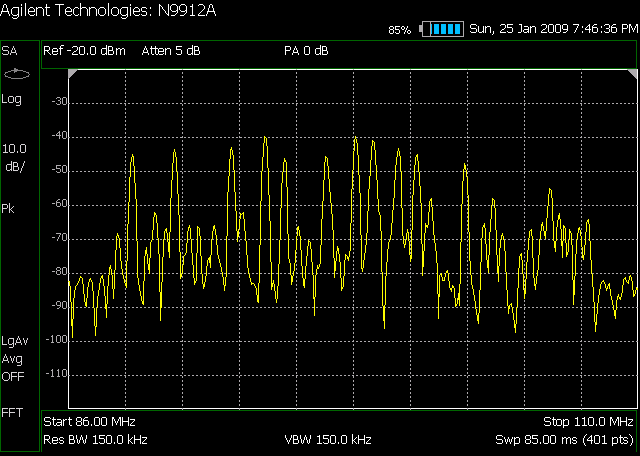
The first thing I did was connect it up to my vertical antenna used for 2 Meters and 70 centimeters. I was able to check a few things on the antenna system and monitor some signals. Funny thing, when I tuned to the 2 Meter ham band, I didn’t see any transmitters on the air <sigh>. So I switched over to the FM broadcast band and did a scan of 86 to 110 MHz. The spectral lines you see sticking up are the FM broadcast transmitters in my area.
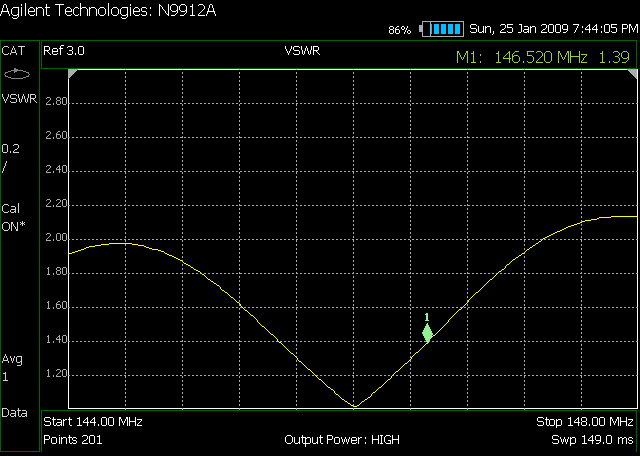
Then I checked the VSWR of the antenna system (as seen looking through the end of the cable). The sweep below shows the VSWR of the antenna system versus frequency. The center of screen is 146 MHz and the marker is set at 146.52 MHz. The VSWR doesn’t quite stay under 2.0 over the entire band.
Then I switched to the Cable Tester mode and displayed Distance to Fault (DTF). The DTF display shows the return loss of the cable as a function of the distance along the cable. (The FieldFox analyzer can correct for the propagation velocity but I did not have this feature turned on. So the distance shown is in error by that amount.)
The bump in the middle of the display is about 60 feet down the line, which corresponds to where an inline surge supressor is installed. Apparently, there is a small “impedance bump” in the line at that point. At the right hand side of the display, around 110 feet is an impedance change due to the antenna. If I had a good 50 ohm load on the end of the cable, we would not see this blip. The DTF measurement is a broadband measurement so anything that is not a good 50 ohms across all frequencyes (such as a high Q antenna) shows up as an impedance blip.
These results are not bad but I expected the impedance of the antenna system to be better than this. If I can hang onto the analyzer for a few more days, I’ll be sure to investigate the antenna system more carefully. Nothing like having the right test equipment to make useful and accurate measurements.


 We finished up the second and last day of our 2-day
  We’ve been looking at optimizing the performance of the D-STAR repeater here in Monument (
 The results of the June VHF contest have been
  AMSAT
AMSAT

 Amateur radio has a deep tradition of providing emergency communications during all kinds of disasters. Of course, some emergencies are more urgent and serious than others.
 I woke up yesterday to the idea that it really is August 1st and that July is now history. I understand how that happens… I just don’t know how it happens so freeking fast! If August is here, then it is time for the premier mountaintop ham radio event:


 Things have gotten quite busy at work, which is why I haven’t posted anything recently. The spare time I have has gone towards getting ready for
  As I sit here looking out the window, I see snow piling up on the back deck. Yep, spring time in the Rockies with a winter snow warning on Easter. It seems like a good time to take a look at upcoming amateur radio events this summer.
 Every once in a while, I stumble onto something that just makes me think “holy cow, how did they do THAT?”