Getting on HF: The Fiddle Factor

We’ve had a steady stream of new licensees come into our radio club driven mostly by our highly-successful Technician license class. Many of these licensees have gone on to get their General license so they can have fun on the HF bands. I’ve given advice and aid to a variety of people as they get their HF station set up and I’ve come to appreciate that for Average Joe Ham this is a big step. I’ve also noted some recurring problems that get in the way of success on the HF bands, which I’d like to explore here. Recently, I asked my twitter followers for input and got some great ideas from them, too. Thanks!

A basic wire antenna for the high frequency (HF) bands.

Here’s what I came up with as the four main barriers to success on HF.

Antenna restrictions

The first barrier that pops up are antenna restrictions which can come in the form of zoning regulations, protective covenants (homeowners associations), spouse’s opinion, potential objections from neighbors and your own sense of aesthetics.  Any of these can limit the type and size of antennas you can or will install. More to the point, this can be a showstopper for some folks. They may decide that they simply can’t have an HF antenna on their property.

Of course, HF antennas tend to be large due to the longer wavelengths used (compared to simple VHF antennas). But there are some compact antenna designs that use magnetic loops, loading coils, etc.

RFI

The second issue that often pops up is radio frequency interference (RFI) from sources such as power lines and consumer devices. These issues can be very frustrating because you have to do two things: identify the source of the noise and eliminate it. If the problem is power line noise, your local utility is supposed to be capable of finding and correcting the problem. Some are better than others. Consumer devices are a huge problem due to the common use of high-speed digital circuits. If the interfering device is in your home, that makes it a bit easier to deal with…if it’s somewhere in the neighborhood, then its harder to diagnose and fix.

My twitter followers mentioned that solar electric systems often radiate RF energy (and they are a growing trend). Here in Colorado, we are seeing more problems with cannabis grow operations that use RF-ugly industrial grow lights.  But Part 15 consumer electronics are a big and growing problem…too often they are little RFI generators.

Cost

I hesitate to add cost to the list but I do think it’s a factor. A starter HF station costs something like this (your mileage may vary): $750 for a new transceiver (think Yaesu FT-450 class), $100 for a power supply, $100 for wire antenna (homebrew) and coax => ~$1000.  Yes, you can buy used gear and get this cost down…maybe to half ($500)?

Comparing this to a Baofeng HT purchase ($30), it is a lot more money. However, it is on the same level as other significant consumer electronics purchases such as a high end smartphone or mid-range notebook PC. As someone correctly pointed out to me, the utility of a notebook PC is very clear…you will get value out of it…but success with HF is still a gamble. What if you spend $1k on an HF station and never have any success with it?

Now let’s say the lot is not that big and there are only a few supports available to hang the antenna. Now you need to fiddle with the antenna design to perhaps shorten it and compromise how it is being hung. So we have an additional fiddle factor which results in an F2 (or F squared) situation.
Now suppose we decide to use a more finicky antenna design…perhaps a magnetic loop or a multiband dipole. (A magnetic is inherently narrowband, so you have to tune it for the specific operating frequency. A multiband dipole will need to be tuned for each band of operation and they usually interact.) This adds another fiddle factor bring us to an F3 level challenge. Next we consult our homeowners association rules and find out that there are physical restrictions on how we can mount an antenna…and they might be vague and arbitrary. This gets us into F4 territory.
Now put yourself in the position of a radio ham getting on HF the first time. These issues, especially the fiddle factor, can really get in the way of successful radio operating. In my next post, I’ll look at some ways of dealing with these issues.
73 Bob K0NR

Colorado 14er Event (2018)

August 4 & 5, 2018
Saturday and Sunday
www.ham14er.org

Amateur Radio operators from around Colorado will be climbing many of Colorado’s 14,000-foot mountains and Summits On The Air (SOTA) peaks to set up amateur radio stations in an effort to communicate with other radio amateurs across the state and around the world. Join in on the fun during the 27th annual event and see how many of the mountaintop stations you can contact. The covers the entire weekend but many mountaintop activators will hit the trail early with the goal of being off the summits by noon due to lightning safety concerns.

Now including Summits On the Air (SOTA), which adds over 1700 potential summits! If you aren’t up to climbing a 14er, there are many other summits to choose from (with a wide range of difficulty). See the Colorado SOTA web page at w0c-sota.org

Radio operators who plan to activate a summit should post their intent on the ham14er Yahoo Group. To subscribe to the “ham14er” email list, visit the Yahoo groups site at http://groups.yahoo.com/group/ham14er/ . Also, be sure to check out the event information at http://www.ham14er.org  It is also a great idea to post an ALERT on the SOTAwatch.org website.

Frequencies used during the event
Activity can occur on any amateur band including HF and VHF. The 2m fm band plan uses a “primary frequency and move up” approach. The 2m fm primary frequency is 147.42 MHz.  At the beginning of the event, operators should try calling on 147.42 MHz. As activity increases on that frequency, move on up the band using the 30 kHz steps. Don’t just hang out on 147.42 MHz…move up! The next standard simplex frequency up from 147.42 MHz is 147.45 MHz, followed by 147.48 and 147.51 MHz.

Frequency (MHz) Comments Frequency (MHz) Comments
147.42 Primary 2m FM Frequency, then up in 30 kHz steps  7.032 40m CW Frequency
147.45 Alternate 2m FM frequency  7.185 40m SSB Frequency
147.48 Alternate 2m FM frequency 10.110 30m CW Frequency
147.51 Alternate 2m FM frequency 14.060 20m CW Frequency
446.000 Primary 70 cm FM frequency 14.345 20m SSB Frequency
446.025 Alternate 70 cm FM frequency 18.092 17m CW Frequency
1294.50 Primary 23cm FM frequency 18.158 17m SSB Frequency
144.200 2m SSB calling frequency 21.060 15m CW Frequency
50.125 6m SSB calling frequency 21.330 15m SSB Frequency
28.060 10m CW Frequency
Other Bands/Modes Standard calling frequencies and/or band plans apply. 28.350 10m SSB Frequency

Warning: Climbing mountains is inherently a dangerous activity.
Do not attempt this without proper training, equipment and preparation.

More operating information here: www.ham14er.org

Sponsored by The Colorado 14er Event Task Force

Download:  Colorado 14er Event Flyer 2018

FT8 Adoption: The New Cool Thing

The new cool digital mode for amateur radio is FT8, made possible by Joe Taylor/K1JT and the WSJT software. At first, FT8 seemed like just the next digital mode to try but it is turning out to have a bigger impact than that. Jeff/KE9V recently posted about the popularity of FT8 here:

FT8 is so far out in front that other digital modes are a foregone conclusion. CW only remains relevant because of its popularity in contests. Even phone, the Holy Grail of wannabe HF operators everywhere, is a nearly forgotten mode compared to FT8.

This reminded me of some of the classic research on adoption of new innovations. What are the factors that cause a new thing to really take off versus languish on the shelf? How do these apply to the quick adoption of FT8?

Diffusion of Innovations

In Diffusion of Innovations, E. M. Rogers lists five factors will influence how quickly a new innovation gets adopted:

Relative Advantage: The degree to which the innovation is superior to ideas it supersedes.

If an innovation is clearly superior to the present way of doing things, people will be more likely to adopt it without too much concern about its usefulness. If it’s not clearly better, people will tend to question whether it is worth the trouble of changing.

Compatibility: The degree to which the innovation is consistent with existing values, past experiences, and the needs of the user.

If an innovation is similar to existing practice and blends in well with user needs and expectations it is more likely to be adopted.  If it requires change on the part of the user or represents an inconsistency with the user’s past experience, it may be rejected.

Complexity:  The degree to which the innovation is relatively difficult to understand and use.

The more complex something is, the more likely people will reject it because “it’s just too much trouble.”  Understandable ideas will tend to be considered more carefully and are more likely to be adopted.

Trialability:  The degree to which an innovation may be tried on a limited basis (in other words, without committing to full-scale, total operational change.)

The easier it is for an individual or organization to try something out without being fully committed, the more likely they will give a new innovation a try.  If the innovation can only be tried with full-scale change and great expense, it will tend to get rejected.

Observability:  The degree to which the results from the use of an innovation are visible and easily communicated to users and other decision-makers.

If the results of an innovation are difficult to measure or see, rejection is more likely.  If the results are clearly visible, then the adopting individual or organization can more easily correlate the results to the innovation.  Generally, a decision-maker wants to be sure that the intended results can be measured, otherwise how can the innovation be evaluated?

Adoption of FT8

It is very clear that FT8 has a strong relative advantage to other modes. Just listen to the many comments from hams like “the band conditions are really bad but I’m still making contacts.” One could argue that FT8 is not that compatible with existing operating habits (think CW or SSB) but the mega-trend of using “sound card modes” is a huge enabler. For some time now, hams have been using the PC platform as a digital signal processing engine, using the sound card to handle the analog-to-digital conversion (and back). Perhaps this traces back to PSK31 as one of the major forces that caused hams to connect their transceivers to their computer. In that sense, FT8 is very compatible with existing sound-card-enabled stations, making it strong on compatibility and trialability. Just load up the WSJT-X software and give it a try. Of course, observability is strong too…now I’m making QSOs when I wasn’t before.

There is a bit of a learning curve with FT8, which could be a barrier to adoption. You need to learn the software and fiddle around with the settings to make it work. But for many hams, this is not a barrier but a fun challenge to take on. Most of us like to try new things, as long as they aren’t too frustrating.

The final point I’ll make is that the popularity of FT8 reinforces my contention that Ham Radio Is Not For Talking. FT8 is all about making a radio contact and does not enable conversations. Sure, most hams like to talk (usually about radios) but when the bands are poor they like making radio contacts via FT8. Making QSOs is king.

Those are my thoughts. What do you think?

73, Bob K0NR

Phone Contesting Tips For DX Contests (AE6Y)

Proper use of a phonetic alphabet can be very helpful when working phone under marginal conditions. I’ve written a basic article on phonetics over at HamRadioSchool.com, so you might want to review that. I recently came across an article by Andy/AE6Y on some tips and tricks to use during contests. He does a super job of explaining why the ITU phonetic alphabet isn’t always the best choice. I don’t usually reprint other author’s work on this blog but somehow this article really got my attention. Reprinted here with permission. – Bob K0NR

Phone Contesting Tips For DX Contests

Andy Faber, AE6Y
3/29/18

This article is prompted by the recent WPX SSB contest, in which I worked thousands of guys from Aruba as P49Y, which engendered much reflection (and teeth-gnashing, to be sure) about how U.S. hams can be best understood from the DX end.  I’m not addressing this to relatively clear-channel domestic contests but to the situation where you are trying to get through to a DX station that may be hearing a pileup, plus noise, ear-splitting splatter from adjacent stations and all of the other sonic annoyances that make many contesters prefer CW. If there is no pileup and you know the DX station can hear you completely clearly, then you’ll get through regardless, but if not, here are some suggestions:

First, be sure you are calling on his exact frequency.  In CW contests, it can be helpful to separate yourself from the pack by calling off frequency, but that’s not true in SSB.  Off-frequency stations sound distorted and are hard to understand.  The DX station may well come back to a weaker, but more intelligible station that is on frequency, even if you are louder.  In order to work you, he has to figure out which way to adjust the RIT, and then go ahead and do it. A tired operator on the other end may just not bother, until he has worked everyone else.

Second, make sure your audio is clean.  It is so much easier to understand clear audio, even if it is weaker than a louder, distorted signal.  KH7XS mentioned in his 3830 posting that this year there particularly seemed to be over-processed signals coming from South America, and I noticed the same thing.  It used to be that the Italians who were the worst offenders, but they seem to be better now.  This weekend, the Cubans were particularly hard to understand. The prize for the easiest audio to understand goes each contest to the hams from the British Isles.  The G’s, M’s and their derivatives invariably have very clean (and usually nicely treble) audio that can be understood even when the signal doesn’t budge the S-meter.  On several occasions I chose a weak but clear Brit over a loud, but distorted, competitor.

Ok, so you have a clean signal and are calling on frequency, now how do you get the information through, both your callsign and your contact number (for WPX)?

Here are some tips:

If you are loud enough and have an easily recognizable call, you can skip phonetics.  So this weekend, when K1AR called, he was easy to pick out, same for K3UA, K3ZO, N6AA, and a few others. But for most guys, and when in doubt, use phonetics.  Endless bandwidth has been expended on the subject of phonetics, and people have differing opinions on the topic, but here are my thoughts from being on the DX end:

The first thing to understand is that the standard, “recommended” international alphabet works dismally in marginal conditions.  The words are too short, and some don’t have unique sounds. Generally speaking, the one-syllable words just get lost, while the two syllable words are better, and the longer ones are even better.

Thus, one-syllable words like “Fox”, “Golf” and “Mike” are horrible.  Some of the two-syllable ones are OK (e.g., “Hotel” and “Quebec”), but others, such as “Alpha” and “Delta”, or “X-ray” and “Echo”, “Kilo” and “Tango” sound very similar, so are easily confused.  I worked a guy with the suffix XXE, and had to get a number of repeats until he finally said “X-Ray X-ray Ecuador,” which did the trick.

There are two basic cures for these problems. The first is only to use these crummy phonetics the first time as a trial.  If the DX station asks for a repeat, say your call twice, once with the standard phonetics and once with different ones.  Don’t just keep repeating your call the same way.  Something in either the way you say it or the way the DX hears it is creating ambiguity.  If you keep repeating the call the same way it may well be that part of it is just hard to decipher, and it may not get any easier.

If the DX station is a good English speaker then custom phonetics may work, such as “King George Six…” In fact when I thought a KK4 station was a K4, he used a very effective phonetic, “King Kong Four…” WA2JQK uses “Jack Queen King” in domestic contests, but that won’t work well for non-native speakers.  The Wyoming station N7MZW uses “Many Zebras Walking” sometimes domestically, but I noticed he was using normal phonetics in WPX.

The second approach is to switch to the geographical phonetic alphabet.  This features longer and more distinctive-sounding words, which are much easier to understand.  For example if your suffix is, say, HLF, then you can say “Hotel Lima Fox,” then try “Honolulu London Florida.” When I give my call with last letter “Yankee” and get asked for a repeat it works much better to say “Last letter Yankee, last letter Yokohama.” Many of the geographic phonetics work particularly well for speakers of Romance languages like Spanish and Italian (e.g., terms like “Guatemala”, “Nicaragua”, and “Santiago”). There are a few letters for which there are not good geographic equivalents.  Obviously, “X-ray” is one of them. For “Echo”, “England” is sometimes used, but “Ecuador” is better.  Although “London” and “Lima” are both geographic terms, “London” is much better.  And “Denmark Mexico” is many times superior to “Delta Mike.”

Numbers in the callsign can also cause trouble.  What if the station comes back to “K3” instead of “K6”? In general, just try to repeat the number, but if he still doesn’t get it, you can try counting, e.g. “Kilo Six, 1, 2, 3, 4, 5, 6.” Or for us West Coasters, “Kilo Six in California, West Coast” can be useful.

Which brings me to the subject of numbers in exchanges like WPX.  I commented in a 3830 post a few years ago that the English numbers that everyone uses are just too ambiguous, most of them being plain too short.  I recommended using some Spanish numbers, like “cuatro” and “ocho”, but that suggestion went nowhere, so I hereby drop it, unless you are trying to get through to a native Spanish or Italian speaker.  In fact, In WPX, I just couldn’t understand a number from a CO8 station with terrible audio. I kept asking, “your number 424?”, “your number 242?”, “your number 224”, etc. Normally, one doesn’t confuse “two” and “four,” but this guy’s audio was driving me crazy and I wasn’t sure how well he was understanding me either.  Finally I had the presence of mind to ask in Spanish, and when he said “dos cuatro cuatro,” he was in the log.  If he had said that in the beginning I would have understood him in spite of his maladjusted audio.

One source of confusion for the DX station is not knowing how many digits there are, particularly later in the contest when a number can have 1, 2, 3, or 4 digits.  There are a couple of ways to help. For example: suppose the DX station thinks he hears “[garble] six six” and he asks: ”your number six six?” If your number is just 6, you can say to be helpful “Negative. My number zero zero six, number six.” Adding the word “number” in front of the digit indicates there are no missing digits.  If your number is 66, just say “Roger, roger.” If it’s 56, say “Negative, number five six, fifty–six.” If it’s 256, say, “Negative. Number two five six, two fifty-six (or even “two hundred and fifty-six”). I know we were taught that it is incorrect to say “two hundred and fifty-six,” and we should just say “two hundred fifty-six,” but using the “and” makes it more intelligible.

In general, it’s usually best to say your number twice, in two different ways.  For example it’s often hard to discern, “two three” from “three three”. So you can say: “five nine, two three, twenty-three,” since “twenty” and “thirty” sound very different.  Similarly if your number is 15 and you say “one five”, that might be confused with “one nine”, so say “one five, fifteen.” If it’s late in the contest and you might be expected to have a three-digit number you can say “zero two three, only twenty-three”. And if you have a one digit number late in the contest, it’s best to add zeros, saying, e.g., “zero zero nine, number nine”, not just “nine.”

I hope these tips from the DX end are helpful.  They should be even more useful in the next few years, as declining sunspots forcing us increasingly into the QRM alleys of 20 and 40 meters.

ZF2NR: Another Slacker DXpedition

Operating from countries outside the US can be a lot of fun. I just completed another another Slacker DXpedition, this time to the Cayman Islands. The formula for this type of operation is simple: identify an interesting vacation spot that is also considered DX, travel there with friends & family, take along some compact radio gear and get on the air. A key point is to not overdo the radio operating or the friends & family will veto any radio activity on future trips.

Licensing for the Cayman Islands is relatively easy if you hold a US FCC amateur radio license. Complete info can be found on the OFREG web site. Licensing for the Caymans is typical of many Caribbean countries: fill out the application form, send it to OFREG by email along with a copy of your US license, passport and $25US. Visitor call signs have the prefix ZF2 and you can request your favorite two-letter suffix. That’s how I got ZF2NR.

I was issued a Class A license which has all operating privileges. My spouse Joyce/K0JJW holds a US General Class license and was issued a Cayman Class B license, which has limited HF privileges (no phone on 40m, 20m, or 17m). So keep that in mind if you have a General Class license. [Update: ZF1EJ told me that this was an error, she should have been issued a Class A license.]

Grand Cayman is in grid EK-99 and is IOTA NA-016.

My equipment strategy was the same as my V29RW operation on Antigua (see V29RW: Slacker DXpedition to Antigua).  The basic kit is a Yaesu FT-991 driving a  end-fed halfwave (EFHW) wire antenna for the band of interest. Never underestimate the power of getting a halfwave antenna up into the air. The FT-991 fits in my carry-on bag and it covers all bands from HF through 70cm.

There is a 2m repeater (146.76 MHz) on Grand Cayman that works quite well. We received a friendly welcome on the repeater from Phil ZF1PB and several other Cayman hams.

Vacation Home

Our group rented a nice vacation home near Rum Point on the north side of Grand Cayman. This place is right on the water with an excellent sand beach. Denny KB9PDF/ZF2PF and I put up the EFHW 20m antenna supported by my SOTAbeams pole strapped to a palm tree. This setup worked quite well and we soon had a nice pileup of stations calling us on 20m. We did have some issues with local noise sources, the worst of which was traced to some dimmer switches in the house. This is one of the problems with a portable setup like this…you never know what RFI problems you’ll encounter. Later in the week, we put up a 40m EFHW and made a few contacts on that band, too.

Denny KB9DPF/ZF2PF watches as Bob K0NR/ZF2NR operates 20m ssb at the vacation home.
The view from the vacation home. Look closely and you can see the SOTAbeams pole attached to a palm tree supporting the 20m EFHW antenna.

ZF1A

Bruce/K0BJ suggested that I check into using the Cayman Amateur Radio Society club station (ZF1A) which they make available to visiting hams. I connected with Eden/ZF1EJ who confirmed that the station was available later in the week. Again, I did not want to overdo the radio thing, so we settled on operating at ZF1A during the middle of the day on Wednesday.

The HF log periodic antenna at ZF1A.

This turned out to be a great move. ZF1A has multiple towers with some very capable antennas. Like I always say: Never underestimate the power of using a large directional antenna on top of a big tower.  Eden/ZF1EJ met us at the station (it is literally in his backyard) and helped us get situated. Our operating strategy was simple: use the highest HF phone band that had good propagation and work as many stations as possible. We were also prepared to use FT8 if things were really bad but that was not needed. It turned out that 15m was dead but 17m was open into North America and Europe, so we did most of our operating there.

Bob/K0NR operating as ZF2NR at the ZF1A club station

Here’s a short video to give you a taste of the pileup.

I did work some of the folks back home, which was a treat: K0AV, W0CP, K0BJ, W0RLY, W0GAS, WG0AT, KD0RQU. I had noticed that Steve/WG0AT was doing a Summits On The Air (SOTA) activation on Crooked Top Mountain (W0C/SP-090) and I gave him a call. Being QRP, his signal was very weak at my location but he could hear me with no problem.

Here’s the QSO audio that Steve recorded on his end:

Satellites

We worked two OSCAR satellite passes (AO-91, AO-92) using a pair of handheld radios and an Arrow 2m/70cm yagi antenna. The pair of handhelds gave us full-duplex capability: I ran the 70cm uplink on my HT while Denny ran the downlink on 2m. No surprise to find the FM satellites quite busy and a bit frustrating to work. I logged these stations from ZF2NR: KI0G, K3SV, TI2CDA, TI4DJ, HP2VX.

Results

My ZF2NR log shows 376 HF QSOs, most of them made by me. Joyce K0JJW/ZF2JW braved the pileup to make a few contacts. Denny/KB9DPF had some additional contacts as ZF2PF.  QSL to our home callsigns.

I’ve loaded the ZF2NR log into Logbook of The World.

Band Mode QSOs
   7 LSB    5 
  14 USB   65
  18 USB  306
 Total    376

In retrospect, I realized that we had the antenna pointed north most of the time and we probably should have looked in other directions. In particular, we only worked a few South American stations.

Most important is that a good time was had by all. Thanks to everyone that worked us while we were in the Cayman Islands.

73, Bob K0NR/ZF2NR

2017 Colorado 14er Event with SOTA

Amateur Radio operators from around Colorado will be climbing many of Colorado’s 14,000-foot mountains and Summits On The Air (SOTA) peaks to set up amateur radio stations in an effort to communicate with other radio amateurs across the state and around the world. Well, last year we celebrated the 25th annual event so this year it must be the 26th. We are continuing the all weekend approach on August 5 and 6. However, many mountaintop activators will hit the trail early in the morning with the goal of being off the summits by noon due to lightning safety concerns.

We still have the very cool 25 Year Anniversary t-shirts (and other great stuff) available at http://www.cafepress.com/wg0at

The 14er event includes Summits On the Air (SOTA) peaks, which add over 1700 now 1805 potential summits! If you aren’t up to climbing a 14er, there are many other summits to choose from (with a wide range of difficulty). See the W0C SOTA web page at w0c-sota.org

Radio operators who plan to activate a summit should post their intent on the ham14er Yahoo Group. To subscribe to the “ham14er” email list, visit the Yahoo groups site at http://groups.yahoo.com/group/ham14er/ . Also, be sure to check out the event information at http://www.ham14er.org It is also a great idea to post an ALERT on the SOTAwatch.org website.

Frequencies used during the event
Activity can occur on any amateur band including HF, VHF and UHF. The 2m fm band plan uses a “primary frequency and move up” approach. The 2m fm primary frequency is 147.42 MHz. At the beginning of the event, operators should try calling on 147.42 MHz. As activity increases on that frequency, move on up the band using the 30 kHz steps. Don’t just hang out on 147.42 MHz…move up! The next standard simplex frequency up from 147.42 MHz is 147.45 MHz, followed by 147.48 and 147.51 MHz. We try to stay off 146.52 MHz, the National Simplex Calling Frequency to avoid overload, but if you need to make a call there, go for it…and be brief.

Frequency (MHz) Comments Frequency (MHz) Comments
147.42 Primary 2m FM Frequency, then up in 30 kHz steps 7.032 40m CW Frequency
147.45 Alternate 2m FM frequency 7.185 40m SSB Frequency
147.48 Alternate 2m FM frequency 10.110 30m CW Frequency
147.51 Alternate 2m FM frequency 14.060 20m CW Frequency
446.000 Primary 70 cm FM frequency 14.345 20m SSB Frequency
446.025 Alternate 70 cm FM frequency 18.092 17m CW Frequency
144.200 2m SSB calling frequency 18.158 17m SSB Frequency
50.125 6m SSB calling frequency 21.060 15m CW Frequency
1294.50 23 cm FM calling frequency 21.330 15m SSB Frequency
Other Bands/Modes Standard calling frequencies and/or band plans apply. 28.060 10m CW Frequency
28.350 10m SSB Frequency

Warning: Climbing mountains is inherently a dangerous activity.
Do not attempt this without proper training, equipment and preparation.

Sponsored by The Colorado 14er Event Task Force

Download the one-page flyer for the event: Colorado 14er Event Flyer 2017

2017 Mt Herman Winter Activation

On Saturday, we returned to the Most Radio Active Mountain in Colorado, Mount Herman (W0C/FR-063), for a combination VHF contest, SOTA activation and winter hike. Our radio crew consisted of Steve/WGØAT, Caleb/W4XEN, Joyce/KØJJW and me. I’ve worked Steve forty times on various summits and often when he was activating Mount Herman, but this is the first time we did an activation together. What a treat be on the same summit as the Goathiker! Not only that, Peanut goat came along to supervise the entire operation.

Bob K0NR installs the SOTA flag under the supervision of Peanut (photo: wg0at)

My objective for the day was to chalk up another VHF SOTA activation, while also making some Qs in the VHF contest. For most SOTA activations, I just focus on 2 meters. During a VHF contest, I bring more gear to cover the other bands. The main rig for SSB/CW was my FT-817 driving an Arrow II dualband yagi for 2m and 70 cm. For 6m, I used an inverted Vee dipole supported by a crappie pole. I also had two FT-1D handheld radios listening on 146.52 and 446.0 MHz.

I made 21 contacts on 6m, 2m and 70cm, with 7 grids/mults and a Single Operator Portable score of 164. Not that great of a contest score but it was only a few hours of operating. From a SOTA perspective, this is an attractive number of VHF QSOs in a relatively short time.

Surprisingly, even during a VHF contest, most of the contacts were on FM with the usual SSB contest stations rather scarce. It was very handy to be able to use 146.52 MHz for the contest, finding a number of casual contesters on that frequency.

The high point of the day was working Jay W9RM on the other side of the state in DM58 using 2m CW on 144.210 MHz. The distance was about 170 miles on a path that went over or through several mountain ranges. Not too bad for QRP. (Oh, I guess it doesn’t hurt that W9RM has a serious weak-signal VHF station: 2M-5WL yagi at 50 feet.)  This contact demonstrates the advantage of CW and SSB on 2 meters. Most VHF SOTA action is on FM due to the convenience of a 2m FM HT. But FM has poor weak-signal performance so much better range can be achieved with both CW and SSB. When is the last time you made a 170 mile QSO with an FM handheld?

Caleb W4XEN running a pileup on 20m phone

This was the first SOTA activation for Caleb/W4XEN. Judging by the smile on his face, it won’t be his last one either. While I played on VHF, Steve did his usual thing on HF using CW, using a KX3 to drive an end-fed antenna. Caleb did a bit of both HF and VHF, managing to get a nice pile up going on 20m SSB, using a Yaesu FT-450 driving a BuddiStick antenna. Joyce made a few contacts on 2m FM but mostly took pictures and occasionally tossed GORP in my direction.

Bob K0NR and Steve WG0AT on their first ever joint SOTA activation (photo: k0jjw)

On my last winter activation, my iPhone quit in the cold, so I did not want to rely on it for logging this time. I had a clipboard with my paper log on it, also holding the dual-paddle key. The key moved around a bit and my Morse code sending was sloppy.  I don’t work a lot of CW for SOTA but it does come in handy at times, so I’ll be looking at improving my setup.

The 6m inverted Vee worked out OK but it was a little inconvenient to run the coaxial cable to the apex of the antenna. I’ll be looking to swap that antenna out for an end-fed half wave, which is so common on the HF bands for SOTA.

Steve brought along a large umbrella for use as an instant-up wind shelter. That looks like a practical way to block the wind.

Steve WG0AT operating his KX3 under the protection of the innovative hiking umbrella

The weather was not great…we had a few patches of blue sky but it was mostly overcast and cold (probably 25 degrees F). We lasted about 2 hours before the cold started to take its toll, then we scooted on down the mountain.

Peanut goat and Caleb W4XEN. (photo: wg0at)

Thanks to Joyce, Steve and Caleb for a great day playing radio in the mountains.

73, Bob KØNR


Update 5 Jan 2018

It turns out I placed well in the January VHF Contest – Single Op Portable category. Of course, I was the only entry in the Rock Mt Division for this category. Here’s the award certificate.

NPOTA: Grand Teton, Yellowstone and Rocky Mountain

arrl_npTo celebrate the 100th anniversary of the National Parks Service, the ARRL is sponsoring National Parks On The Air (NPOTA) during 2016. Joyce KØJJW and I happened to have a trip planned to visit several of the National Parks, so it was great opportunity to take along some radio gear and operate portable from the parks.

teton-mountains
Grand Teton National Park

First stop was the Grand Teton National Park (NP23) in Wyoming. I operated from Signal Mountain, which is also a Summits On The Air (SOTA) peak. See my previous blog posting: SOTA plus NPOTA on Signal Mountain.

buffalo
Two of the 3700 buffalo that inhabit Yellowstone NP

We continued on to Yellowstone NP (NP57), where we saw lots of wildlife: buffalo, elk, deer, bear and antelope. (Click on any of the photos to get a larger image.)

yellowstone-npota
NPOTA station operating in Yellowstone NP.

As described in the Signal Mountain post, my portable station was a Yaesu FT-991 driving an end-fed halfwave antenna on 20m. I used a SOTABEAMS pole to support the antenna, lashing the pole to whatever posts I found available. It was not too difficult to find a suitable parking spot close to mounting post. I was prepared to operate on other bands but 20m seemed to be the best choice based on current band conditions. I made 48 contacts on 20m ssb in about 30 minutes.

As we headed back home to Colorado, we visited Rocky Mountain National Park (NP48). We entered the park from the west side and crossed over to the east entrance via Trail Ridge Road. Love that drive! But first we stopped on the west side to do another NPOTA activation. Again, 20m phone was the operating mode and I made 33 contacts with stations across the US and Canada.

elk
Rocky Mountain NP elk.

We took our time leaving the park around dusk so that we could spot some elk. The strategy paid off as we saw more than 20 elk in various locations.

Our top priority was enjoying the parks and viewing wildlife so we did not spend a huge amount of time doing NPOTA activations. Still, we activated three of our favorite National Parks, making 121 QSOs. We also worked in two SOTA activations on the trip as a bonus. All in all, it was a great trip with some fun ham radio activity included.

The SOTA and NPOTA logs have all been submitted (SOTA database and Logbook of The World, respectively.)

73, Bob K0NR

SOTA plus NPOTA on Signal Mountain (W7Y/TT-161)

Signal Mountain (W7Y/TT-161) is now my favorite spot in the Grand Teton National Park. The summit is well-marked on the Grand Teton NP map, on the east side of Jackson Lake. It has a paved road to the top and it provides excellent views of Jackson Hole and the surrounding mountains. Oh, and it’s a great location for ham radio.

On this summit, I did a combination Summits On The Air (SOTA) and National Parks On the Air (NPOTA) activation. Well, sort of. It turns out that when I packed for the trip, I included my usual SOTA gear, which is all VHF. For NPOTA, I loaded up my HF DXpedition gear that needs a pretty hefty power source. These means that the HF stuff uses my car battery, so it is not SOTA-compliant. Oh well.

img_1698
Bob K0NR works stations on 2m fm for a SOTA activation.

For the SOTA activation, I used the Yaesu FT-1DR and my 3-element Arrow yagi antenna to work a handful of stations on 146.52 MHz. I was a little concerned about finding enough stations listening on 52, but once again a little bit of patience payed off and I made my four QSOs.

img_1707
Bob K0NR using the “back of the SUV” operating position. The 20m end-fed half-wave antenna is supported by a SOTABEAMS pole.

Then I set up the NPOTA station to activate Grand Teton National Park (NP23). My equipment was a Yaesu FT-991 driving an end-fed half-wave for 20m from LNR Precision. I’ve tried a number of different portable antennas over the years but have found that a half-wave radiator up in the air is a pretty effective antenna. This could be a center-fed dipole antenna but that can be a challenge to support, depending on the physical location.

The end-fed half-waves (EFHW) from LNR Precision are easily supported using a non-conductive pole such as the 10m SOTABEAMS pole. The top two sections of the pole are too thin to support much of antenna, so I have removed them. This makes my pole about 9 meters in length which is still long enough to support a 20m halfwave.  (The antenna angles out a bit as shown in the photo but its pretty much vertical.) I attached the pole to a fence post using some hook/loop straps. I don’t fiddle with the length of the antenna, I just let the antenna tuner in the FT-991 trim up the match. This is the same configuration I used in Antigua (V29RW), where it worked great.

The FT-991 is a great little radio for this kind of operation. The SUV we were driving is not set up for HF operation so I just located the radio in the back of the vehicle and plopped down on a folding camp chair. For power, I clipped directly onto the vehicle battery with fused 10 gauge wires.

I started by making a few calls on 20m ssb. As soon as I was “spotted” on the usual web sites, I had a good pileup going. I worked 40 stations in about 40 minutes, so averaged one QSO per minute overall. Thanks to everyone that worked me; all contacts have been uploaded to Logbook of The World.

Oh, and it was a lot of fun.

73, Bob K0NR

How About an Updated FT-817?

The Elecraft KX2 made a big splash with QRP enthusiasts at the Dayton Hamvention this year. HamRadio360 had some good coverage of the product introduction. Basically, the KX2 is a shrunken version of the KX3, covering the HF bands 80m through 10m.

The Yaesu FT-817ND
The Yaesu FT-817ND

There were rumors circulating that Yaesu would introduce a replacement for the FT-817ND, but that turned out to not be true. It is a good rumor because the original FT-817 was introduced way back in 2001 (according to Wikipedia). Also, Chris Wilson NØCSW was actively soliciting inputs for an 817 replacement at the Central States VHF Conference last summer.

A while back, I did a comparison of the FT-817 and the KX3 (big brother to the KX2). I evaluated the two radios from a VHF/UHF point of view. The FT-817 is the only portable single-radio solution for 50 MHz, 144 MHz and 432 MHz. The KX3 includes 50 MHz standard and 144 MHz is an option. The KX2 leaves out the VHF bands completely to achieve a smaller size.

What’s Next for the FT-817?

Its always fun to speculate on what might be coming in new gear. I expect Yaesu will maintain its position as the QRP transceiver that covers HF/VHF/UHF. It has a long history of delivering cost-effective “do everything” radios. We can look to recent product introductions from Yaesu to get a hint of what might be coming.

The FT-2DR, FT-400DR and FT-991 have all adopted larger touch-screen displays so we can probably expect that for the 817 replacement. However, this will challenge the existing form factor…you can’t just drop a larger display into the existing 817 design. The three newer radios include the System Fusion C4FM digital mode…at this point, I don’t think Yaesu would introduce a VHF/UHF radio without it.

Which raises another question: will the new radio also include a GPS receiver? This capability is a good complement to the C4FM mode in a portable radio. The FT-991 requires you to enter your location manually, which the FT-2DR and FT-400DR use a built-in GPS. But it adds circuitry and complexity so I am going to guess they will leave that out.

I am expecting (hoping?) Yaesu will improve the battery life of the transceiver. (Receive standby current is spec’d at 450 mA.)  Even if they don’t improve the current drain, newer battery technology could be used to improve operating time. Also, depending on the form factor changes, it may be wise to dedicate more space for a physically larger battery.

Yaesu will probably improve the overall receiver performance, including advanced DSP features. Many 817 users have complained about the lack of coverage of 162 MHz weather radio in the US. On the transmit side, a little more output power would be nice…maybe match the KX3’s 10 watts on HF. Yaesu could really make the VHF crowd happy (in the US) if they included the 222 MHz band.

Take One Tablet

The radio will surely have a computer I/O port with USB being the most flexible choice. There is an opportunity to innovate a bit here by coupling the radio with Android and iOS tablets. I could see a really nice app that handles logging, CW, PSK31, RTTY, bandscope, and other advanced features. This could take the pressure off having a larger display and loading tons of features into the radio. The most convenient I/O would be wireless, most likely Bluetooth or maybe WiFi.  Many of the SOTA and QRP operators already take along a smartphone or tablet for logging and other tasks, so it would be a good fit to that market. The key to this idea is careful human factors design and tight integration with the radio. Do I expect this from Yaesu? Not really. So surprise me and knock my socks off.

Those are my thoughts. Your turn.

73, Bob KØNR

Announcing: 25th Annual Colorado 14er Event

14erLOGOsmallAmateur Radio operators from around Colorado will be climbing many of Colorado’s 14,000-foot mountains and Summits On The Air (SOTA) peaks to set up amateur radio stations in an effort to communicate with other radio amateurs across the state and around the world. Join in on the fun during the 25th annual event and see how many of the mountaintop stations you can contact. This year the event is expanded to include the entire weekend, August 6 & 7. However, many mountaintop activators will hit the trail early with the goal of being off the summits by noon due to lightning safety concerns.

See the very cool 25 Year Anniversary t-shirts available at http://www.cafepress.com/wg0at

The 14er event includes Summits On the Air (SOTA) peaks, which add over 1700 potential summits! If you aren’t up to climbing a 14er, there are many other summits to choose from (with a wide range of difficulty). See the W0C SOTA web page at w0c-sota.org

Radio operators who plan to activate a summit should post their intent on the ham14er Yahoo Group. To subscribe to the “ham14er” email list, visit the Yahoo groups site at http://groups.yahoo.com/group/ham14er/ . Also, be sure to check out the event information at http://www.ham14er.org  It is also a great idea to post an ALERT on the SOTAwatch.org website.

Frequencies used during the event
Activity can occur on any amateur band including HF and VHF. The 2m fm band plan uses a “primary frequency and move up” approach. The 2m fm primary frequency is 147.42 MHz.  At the beginning of the event, operators should try calling on 147.42 MHz. As activity increases on that frequency, move on up the band using the 30 kHz steps. Don’t just hang out on 147.42 MHz…move up! The next standard simplex frequency up from 147.42 MHz is 147.45 MHz, followed by 147.48 and 147.51 MHz.

Frequency (MHz) Comments Frequency (MHz) Comments
147.42 Primary 2m FM Frequency, then up in 30 kHz steps  7.032 40m CW Frequency
147.45 Alternate 2m FM frequency  7.185 40m SSB Frequency
147.48 Alternate 2m FM frequency 10.110 30m CW Frequency
147.51 Alternate 2m FM frequency 14.060 20m CW Frequency
446.000 Primary 70 cm FM frequency 14.345 20m SSB Frequency
446.025 Alternate 70 cm FM frequency 18.092 17m CW Frequency
144.200 2m SSB calling frequency 18.158 17m SSB Frequency
50.125 6m SSB calling frequency 21.060 15m CW Frequency
21.330 15m SSB Frequency
Other Bands/Modes Standard calling frequencies and/or band plans apply. 28.060 10m CW Frequency
28.350 10m SSB Frequency

Warning: Climbing mountains is inherently a dangerous activity.
Do not attempt this without proper training, equipment and preparation.

Sponsored by The Colorado 14er Event Task Force

Here’s the event flyer in pdf format: Colorado 14er Event Flyer 2016

DX, Artificial Scarcity and The List

dxEconomists see scarcity, supply and demand as fundamental forces in a market. Items that are scarce demand a higher price while items that are easy to obtain tend to have a lower price.  A diamond is an example of something that is relatively scarce (and in demand) so it commands a high price. In contrast, wood is generally available and is much less expensive than diamonds.

Then there’s the concept of artificial scarcity. If some items can be made scarce (or even just appear scarce), the price will tend to increase. For example, if I own all of the banana trees on an isolated island, I could reduce the available supply of bananas and command a higher price from all of the banana eaters there. Or maybe I start screening bananas for quality and I put a special sticker on them to brand them as special. The special bananas can demand a higher price, because they are more scarce.

bananaWe have a case of artificial scarcity in ham radio, called the DXCC list. This list defines what is considered a separate country when chasing DX. (Actually, the correct term is entity, not country.) For example, Hawaii (KH6) and Alaska (KL7) are considered separate entities even though they are part of the United States. (See Is Alaska a Country?) For someone chasing DXCC entities, because Alaska is on The List, a radio contact with Alaska becomes more desirable. It’s kind of like putting a “premium sticker” on a banana to indicate that it is special.

In my imagination, the DXCC list resulted from a bunch of hams sitting around drinking beer and bragging about how many countries they had worked. One guy, Larry says he just worked Hawaii, bringing his total to 125 countries. His buddy Leroy says, “You can’t count Hawaii because it’s part of the US of A.”  To which Larry says, “You bet I can count Hawaii…and Texas too. It’s a whole ‘nuther country.” Clearly, we are going to need an official list to keep track of what counts as a country.  A more credible version of how the list got established is captured in this article from the October 1935 QST.

Of course, the two main factors that drive scarcity of DXCC entities is the ham radio population and ease of access. Radio contacts are easy to make with entities that have an active ham population. If an entity doesn’t have many active hams but is easy to get to, someone will probably put that location on the air once in a while.  On the other hand, some locations are unpopulated and really difficult to get to. These are not only on The List, they are on The Most Wanted List.

Kingman Reef (KH5) was just deleted from The List, instantly changing it from one of the most desired contacts in amateur radio to a big giant Why Bother. You see, there used to be 340 countries on the list but now there’s only 339. Kingman Reef will now be considered part of Palmyra/Jarvis, so it still has value for DXCC, just a lot less.

As I write this article, there is a major DXpedition (VKØEK) operating from Heard Island, an unpopulated island near Antartica. The only reason those guys are there is that Heard Island is on The List. Take a look at their web site and you’ll see how much time and energy has gone into activating this lonely island. Drop it from the list and suddenly a radio contact with this location is a lot less in demand.

So try to keep this all in perspective. There are lots of radio contacts out there to be made, some more interesting and desirable than others. It is appropriate and necessary that we have the DXCC list, to provide consistency in how we count countries, I mean entities. But really, it all traces back to Larry and Leroy arguing about who worked the most countries.

Thanks to the dedicated DXpeditioners that put these rare locations on the air.

73, Bob K0NR

V29RW: Slacker DXpedition to Antigua

Recently, I had another opportunity to take ham radio along on vacation to a Caribbean island, this time to Antigua. This was not a super-gonzo turbo-charged DXpedition. I just worked in some radio action in between snorkeling and beach walking. This is referred to as a “holiday style” DXpedition, or maybe it’s just the slacker approach.

qsl card beach
V29RW QSL Card

Radio Equipment

The radio gear needed to fit easily into my luggage. After all, we’ve got snorkel gear to take along. I wanted to put out a healthy signal from the island, so I rejected the idea of running QRP, opting instead for a 100W transmitter. Ultimately, I chose to take a Yaesu FT-991 which is full-power and full-featured but still relatively compact. It easily fit into my carry-on bag along with some other items. Having a built-in antenna tuner was a real plus and it was also good to have the 2m and 70 cm bands.

operating position
Patio operating position with FT-991 and logging computer

Choosing an antenna was a critical item. My first thought was to take my Buddistick antenna which covers the HF bands I was interested in working: 20m, 17m, 15m and 10m. I used that antenna from the Virgin Islands and it was really handy for taking to the beach. This time I wanted something bigger under the theory that size does matter. On the other hand, I wasn’t going to take full size yagis for each of the bands. I finally settled in on using End-Fed Half Wave (EFHW) antennas for the 4 bands (from LNR Precision). This gave me a simple half-wave antenna on each band with no coils, no traps, nothing funny going on. These antennas radiate well and have decent bandwidth…any SWR degradation can be tweaked up quickly using the FT-991 antenna tuner.

antenna pole
End-fed half-wave antenna supported by SOTABeams pole

Steve WGØAT suggested I use the SOTABEAMS 30-foot mast to support the EFHW antennas. It is an incredible mast that collapses to 26.5 inches, small enough to fit into my bag. This antenna set up is common with the SOTA activators: EFHW supported by some kind of lightweight pole. I also tossed in a 19-inch magmount antenna for 2m and 70cm. (I did find a good repeater on on 147.0 MHz but did not spend much time on it.)

end fed half wave
Close up of the EFHW antenna matching network

Rounding out the kit was an Astron switching power supply, a 25-foot length of RG-8X coaxial cable, a Heil Traveler headset and a few patch cords. I found it tempting to keep throwing more stuff in the bag so I adopted the backpacker mentality of taking just what I needed and not much more. For computer logging, I chose N1MM Plus software, with the log type set to “DX”.

I have to confess that I did manage to break the 30-foot mast early in the trip. The house was on a hill and we always had a strong breeze coming through. One day it flexed the mast enough to break it. This was quickly repaired with duct tape. After that, I did not use the 3 top sections of the mast which reduced the amount of sway in the wind (and stress on the mast).

On The Air

Bob K0NR
Bob KØNR operating as V29RW in Antigua

My operating time was a bit sporadic and my operating strategy was simple: work the highest band (of 20m, 17m, 15m and 10m) that had some decent propagation to somewhere. Antigua is not extremely rare but it seemed to attract attention. Typically, I called CQ, worked a few stations and then a big pileup would develop. I made lots of QSOs with stations in North America, South America and Europe. I also made a few contacts into Africa but none with Asia. Signal reports were generally good (S9 +), so the antennas were doing the job.

All in all, I was pleased with the contacts I made, given the slacker effort. I especially enjoyed working 17m, a band I have not spent that much time on. The propagation is similar to 20m but noticeably less jammed with signals.

  Band  QSOs DXCC
    14   309   36
    18   162   13
    21    21   10
    28    91    6
 Total   583   65

QSLs for V29RW should be sent to my home callsign: KØNR (direct or via the bureau). Logbook of the World contacts have already been confirmed. Instant gratification, baby!

73, Bob KØNR, V29RW

Licensing info: It was relatively easy to get a ham radio license in Antigua, based on my US license (fees were $30 US). See this web page.

16 Mar 2016: V29RW QSLs have been sent out via US mail based on cards received

2016 SOTA Activity Days

Bob summitSummits On The Air (SOTA) operating events are a great way to promote activity and create opportunities for summit-to-summit radio contacts. Here’s the 2016 calendar, an update of the 2015 list suggested by Guy N7UN. Many of these dates are aligned with VHF events but there will be HF activity as well.

IMG_1836Of course, any day is a good day for SOTA activity.  The August 6-7 weekend looks to be the alignment of the planets with four events happening around that weekend. Early August usually offers excellent conditions for hiking the highest peaks in Colorado, so come on out and play.

For more info on VHF SOTA, see How To Do a VHF SOTA Activation.

Get off the couch, put on your hiking boots, grab your backpack, grab your radio but most important: get on the air!

73, Bob K0NR

HF Slacker Operation for CQ WW SSB

The CQ Worldwide DX SSB contest was last weekend and I applied my signature HF Slacker™ operating methodology to this event. Most of the HF gear I have is kept at our cabin in the mountains but I had to be at the house this weekend due to some commitments. I decided to apply Field Day principles and rig up whatever I could with equipment on hand.

FT-847I dug out the Yaesu FT-847 transceiver, an MFJ antenna tuner and a half-size G5RV antenna to configure a basic HF station. Using a fishing pole to cast a steel washer over a tall tree in the back yard, I rigged up the antenna between the tree and the house. The G5RV is a compromise antenna…I’d much rather have something like a trap or fan dipole. But it’s what I had on hand, so I made it work. The impedance presented by this antenna is all over the map, so a decent antenna tuner is a must.

G5RV editI started out on 15m with a few contacts to Europe and Central America. Later I moved up to 10m and made even more contacts there. I was mostly searching around for the best DX but still working a few stateside stations. Later in the afternoon, the bands swung towards the west and I managed to work KH7CW and JR3NZC before going QRT for the day.

Sunday morning brought more propagation, first to Europe, then the Caribbean and South America. The high point was working AHØBT in the Mariana Islands and VK2GGC in Australia. AHØBT was not real strong, maybe S5 at my location so I thought I’d struggle to punch through the noise and QRM on the band. However, it only took a couple of calls to make the contact. That’s what I like about the 10m band!

I used the N1MM logging program during the contest. A snapshot of the log is shown below.CQ WW SSB 2015 K0NR LogI only worked the contest intermittently on Saturday and Sunday, maybe 5 or 6 hours total operating time. Still, I managed to work 49 countries and 30 CQ Zones. That’s half way to DXCC on one weekend with a very basic HF station. Radio contests stimulate activity and DX contests bring out the DX. I point this out to encourage others to give it a try, even if they don’t have huge antennas on a tower and a linear amplifier.  Almost all of my contacts were on 15m and 10m, which tend to be more productive when conditions cooperate. Twenty meters gets jammed with high power stations so it is often tough going for the little pistols.

 Band     QSOs     Pts  Zone  Country
    14       2       3    2    2
    21      30      70   13   21
    28      52     136   15   26
 Total      84     209   30   49
Score: 16,511

Another weekend of having fun messing around with radios. Even if I’m an HF Slacker™. 🙂

73, Bob K0NR

Colorado 14er Event: Mount Antero (W0C/SR-003)

For the 2015 Colorado 14er Event, Joyce K0JJW and I activated Mount Antero (W0C/SR-003) on the 2m and 70 cm bands. Alan NM5S joined us on the summit, operating mostly HF plus some 2m fm.

We took our Jeep Wrangler up the moderate 4WD road and parked at 13,800 feet. This makes for a very manageable hike to the 14,269 foot summit. Of course, you can always choose to start the hike from lower on the mountain, but you’ll end up walking along the road. This web site provides a good overview of the 4WD road.  The 14ers.com web site and summitpost.org are additional sources of summit info.

Here’s a short video of our operation on the summit.

Here’s the K0NR log on the 2m band, fm and ssb:

August 2, 2015 K0NR Log, time in UTC
15:09     144MHz     FM     K0JJW     
15:13     144MHz     FM     W0CP     
15:16     144MHz     FM     KC5JKU     Mt Elbert 
15:17     144MHz     FM     KD0WHB     Grays Peak
15:21     144MHz     FM     N0XDW      Pikes Peak
15:37     144MHz     FM     KD5HGD     Mt Elbert 
15:42     144MHz     FM     KD0MRC     
15:42     144MHz     FM     KE0DMT     
15:44     144MHz     FM     NQ0L       Franktown 
15:45     144MHz     FM     KE0EUO     Mt Democrat 
15:46     144MHz     FM     K7SO       Mt Democrat 
15:50     144MHz     SSB    KD0YOB     W0C/PR-005 
15:53     144MHz     SSB    W0BV       Buena Vista
15:53     144MHz     SSB    K0YV       Buena Vista
15:57     144MHz     SSB    W0STU      Monument
16:06     144MHz     FM     KD0WHB     Torreys 
16:13     144MHz     FM     KI6YMZ     Mt Elbert 
16:19     144MHz     FM     KE0EKT     Mt Elbert 
16:29     144MHz     FM     WZ0N     
16:29     144MHz     FM     KE0DAL     
16:31     144MHz     FM     WO9S     
16:33     144MHz     FM     K0UO     
17:10     144MHz     FM     KD2FHB     Pikes Peak

I used my Yaesu FT-817 driving a 3 element Arrow yagi antenna (shown in video) for both FM and SSB 2m operation. It was a great day on the mountain with quite a few Summit-to-Summit (S2S) SOTA contacts. See you next year on a Colorado mountaintop!

73, Bob K0NR

2015 Colorado 14er Event

Colo14er SOTA logo smallAmateur Radio operators from around Colorado will be climbing many of Colorado’s 14,000-foot mountains and Summits On The Air (SOTA) peaks in an effort to communicate with other radio amateurs across the state and around world. Join in on the fun on the first full weekend in August and see how many of the mountaintop stations you can contact. The prime operating hours are on Sunday August 2nd from 9 AM to noon local time (1500 to 1800 UTC), but activity can occur throughout the weekend.

Now including Summits On the Air (SOTA), which adds over 1700 potential summits! If you aren’t up to climbing a 14er, there are many other summits to choose from (with a wide variety of difficulty). See the W0C SOTA web page at w0c-sota.org

Radio operators who plan to activate a summit should set an “Alert” on the SOTAwatch.org web site. To subscribe to the “ham14er” email list, visit the yahoo groups site at http://groups.yahoo.com/group/ham14er/. Also, be sure to check out the event information at http://www.ham14er.org. For climbing info on the Colorado 14ers, see the excellent resources at 14ers.com.

Frequencies used during the event
Activity can occur on any amateur band including HF and VHF. The 2m fm band plan uses a “primary frequency and move up” approach. The 2m fm primary frequency is 147.42 MHz.  At the beginning of the event, operators should try calling on 147.42 MHz. As activity increases on that frequency, move on up the band using the 30 kHz steps. Don’t just hang out on 147.42 MHz…move up! The next standard simplex frequency up from 147.42 MHz is 147.45 MHz, followed by 147.48, 147.51, 147.54 MHz.

Frequency (MHz)
 147.42 Primary 2m FM Frequency, then up in 30 kHz steps
 223.5 Primary 222 MHz FM frequency
 446.000 Primary 70 cm FM frequency
 446.025 Alternate 70 cm FM frequency
 52.525 Primary 6m FM frequency
 144.200 2m SSB calling frequency
 50.125 6m SSB calling frequency
 14.060 20m CW Frequency
 14.345 20m SSB Frequency
 18.092 17m CW Frequency
 18.158 17m SSB Frequency
 21.060 15m CW Frequency
 21.330 15m SSB Frequency
 28.060 10m CW Frequency
 28.350 10m SSB Frequency
 Other Bands/Modes:
 Standard calling frequencies and/or band plans apply.

Warning: Climbing mountains is inherently a dangerous activity. Do not attempt this without proper training, equipment and preparation.

Sponsored by The Colorado 14er Event Task Force

We Call It “Tech Field Day”

For Field Day this year, the Tri-Lakes Monument Radio Association (WØTLM) is planning a one day event that combines our Tech Day training activities with normal Field Day radio operating. This Tech Field Day will have a strong emphasis on radio education and training, including an opportunity to make contacts on the HF bands under the supervision of an experienced radio ham.

click to expand
click to expand

Sat June 27th, 2015 (8:00 AM to 5 PM)
Location: Black Forest Fire Station 1
11445 Teachout Road, Colorado Springs

Come to our one-day education and radio operating event and learn from informative presentations of amateur radio topics. Operate a high frequency (HF) radio station with the helpful guidance of an experienced radio ham. Learn about emergency communications and public service. Most of all, have a bunch of fun messing around with ham radio stuff!

Time Activity Presenter
8:00 Setup starts
8:30 FM Simplex and Repeaters Bob Witte, KØNR
9:30 Operating SSB on the HF Bands Stu Tuner, WØSTU
10:30 Construction of Dipole Antennas Larry Kral, NØAMP
11:30 Summits On The Air (SOTA) Steve Galchutt, WGØAT
12:00 Start Field Day Operating
13:30 Copper pipe antennas Al Andzik, WBØTGE
14:30 Emergency Power for Ham Radio Mike Hoskins, WØMJH
15:30 Ask an Elmer Panel Bob Witte KØNR and crew
17:00 End of operations – tear down

For more information, visit the W0TLM web site.
73, Bob K0NR

CQ WPX, LoTW and the End of QSL Cards

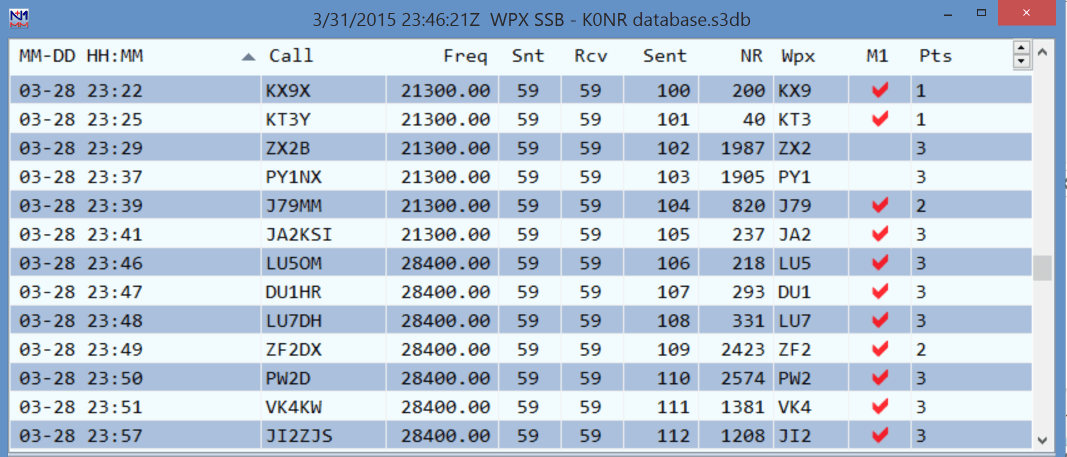
N1MM LoggerLast weekend, I had a fun time working the CQ WPX contest on SSB. I’ve always liked the format of the contest with the callsign prefix as the score multiplier (e.g., K1, K2, W1, W2, VE1, VE2 are all multipliers). Its like every new contact is a multiplier. This contest attracts plenty of DX but unlike some DX contests, everyone works everyone.

Consistent with the contest, the CQ WPX Awards Program issues operating awards based on callsign prefixes. The initial mixed mode (CW, SSB, digital) award requires confirmed contacts with 400 different prefixes. Back in the 20th century, I kept track of my confirmed contacts for WPX but lost interest along the way. I am sure I’ve worked more than 400 prefixes but the challenge was getting them all confirmed. More recently, the ARRL Logbook of the World (LoTW) added support for the CQ WPX Awards, so I started paying attention again, watching my CQ WPX total grow. I am not a big awards chaser but I have found value in using them as a specific goal to motivate me to get on the air.

Right before the CQ WPX contest, I had 380 prefixes confirmed via LoTW, so I figured that if I worked a few new ones during the contest, I could punch through 400 without too much trouble. I used my signature HF slacker approach at the cabin, using the Yaesu FT-950 to push 100 watts of RF power to wire antennas in the trees. For 40m, 20m and 15m, I used a trap-dipole antenna and for 10m I used a newly built ladder-line j-pole mounted vertically.

On Saturday, the propagation on the 10m band was smokin’ hot, strong signals from all continents. The 10m j-pole performed well. It was an absolute blast to easily work into Africa, Europe, South America, Australia, New Zealand and Asia.  The 15m and 20m bands were also very productive. My approach was to tune around, looking for new prefixes to add to my confirmed total. Propagation was not as good on Sunday but still respectable but I only operated a few hours.

After the contest, I submitted my log to the contest web site and loaded my contacts into LoTW (188 QSOs and 157 prefixes). Immediately, I received two new confirmed prefixes. Over the next few hours, I checked back to watch my CQ WPX confirmed total climb on LoTW. It did not take long before it passed through 400 (and the total is still climbing). I will admit that I really liked the instant gratification of seeing my QSOs immediately confirmed.
That’s when it hit me: I am done with paper QSL cards. The amount of time and effort it takes to get 400 paper cards in my hand is just not worth it. It is soooooo 20th century.

Disclaimer: Actually, I still enjoy and use paper QSL cards…but they are just obsolete for chasing awards.