SOTA Activation: Unnamed Summit 12306 (W0C/SR-129)

It is always fun to do the first Summits On The Air (SOTA) activation of a peak. Most of the Colorado peaks have been climbed by someone along the way but there are still many that have never been activated for SOTA using amateur radio.

Bob K0NR SR-129
Bob/K0NR takes shelter from the wind behind the rocks on the summit of 12306.

I noticed that an unnamed summit not too far from our cabin, referred to as 12306 or W0C/SR-129 had not been activated. At first glance, I thought this was because it was difficult to access. Further investigation revealed US Forest Service info on the Hayden Gulch Road (FS 396) that goes to the Hayden Gulch Trailhead at the west edge of the Buffalo Peaks Wilderness area.

Note that this area is closed to motor vehicles seasonally.

Joyce/K0JJW and I approached the trailhead from the west, starting at Granite, CO on Hwy 24, turning east onto FS 397 (marked at the highway) and then quickly looking for signs for FS 396. The San Isabel National Forest map is somewhat helpful but the Latitude 40 recreational map for Salida/Buena Vista is much better.  The road is mostly easy 4WD but it is narrow in many places and moderate difficultly in a few spots. We saw crossover SUVs carefully driving the road with success. It was easy-peasy in our Jeep Wrangler.

The trailhead sign at the edge of Buffalo Peaks Wilderness.

Starting the hike, we followed the Hayden Gulch trail to the east. We actually had to search a bit to make sure we were really on the trail as we left the trailhead, as it was not super obvious. Hint: stay to the north (left) of the trailhead sign.

Our GPS track followed the Hayden Gulch trail into the wilderness area, then diverted north toward the summit.

The trail follows an old road that was likely closed when the wilderness area was formed. Once we cleared the trees (shown accurately on the map above), we left the trail and traveled off-trail towards the summit, trying to follow the contour lines and not lose a bunch of elevation. The hike promised to be very pleasant except that we had 30 to 40 mph winds from the west. This was not enough to stop us but certainly made the hike less enjoyable. The views were spectacular but a little difficult to enjoy with the wind blowing.

Our first view of SR-129 from the Hayden Gulch Trail, just as we emerged from the trees.

The hike was 1.8 miles one-way with about 1000 feet of vertical gain. Once on the summit, we got out the standard VHF SOTA gear: Yaesu FT-90 transceiver, LiFe battery and 3-element Arrow yagi. We both quickly worked Bob/W0BV, Walt/W0CP, Steve/WG0AT and Brad/WA6MM. WG0AT was on his way down from Eagle Rock (W0C/SP-113) so we missed a Summit-to-Summit opportunity with him. (We did work him earlier when he was on the summit but we were not.) WA6MM was a successful S2S contact from Mount Logan (W0C/FR-017).

This turned out to be a successful activation and a fun hike. We both concluded that we need to do it again…with a little less wind.

73 Bob K0NR

Pikes Peak SOTA: Hike from Devils Playground

Stock photo of Pikes Peak with snow on it.

I’ve been up Pikes Peak (W0C/FR-004) a zillion times via the Pikes Peak Highway and the Pikes Peak Cog Railway (currently out of service) doing SOTA activations, working VHF contests, participating in the Colorado 14er Event, maintaining repeaters and escorting visitors from out of town. See my previous post on activating by driving up the mountain: How To Do a SOTA Activation on Pikes Peak.

Joyce/K0JJW and I had Pikes on our SOTA activation list for 2018 but wanted to do a hike to access the summit. The classic climbing route up Pikes is via Barr Trail, a 13-mile trail that ascends 7800 vertical feet. This is a difficult climb for most humans but I will note that serious runners routinely run up the mountain just for fun. See Fred/KT5X’s comments on the SOTA database about running up the mountain and then doing a SOTA activation.

Another hiking alternative on the northwest side of Pikes Peak is the Crags Trail, also known as the Northwest Slopes route. This route starts about 4 miles south of Divide, CO at the Crags Campground. This hike is 7 miles one-way with 4300 vertical feet. This is easier than Barr Trail but still a significant climb.

The hiking route from Devils Playground to the summit of Pikes Peak.

Devils Playground

There is a shorter option that does not get much attention (except from some of the locals). The Northwest Slopes route crosses the Pikes Peak Highway at Mile 16 at a popular spot called Devils Playground. There is a large parking area there and the Northwest Slopes trail can be accessed at this point. Just cross the road, step over a cable fence (intended to block vehicles, not people) and follow the obvious trail to the summit.

Note: currently access to the summit by car is restricted due to summit house construction and Devils Playground is a staging area for free shuttle buses that take visitors to the summit.

This trail is 2.6 miles one way and 1300 feet vertical (mostly uphill but some up and down action). The last quarter mile before the summit is rocky and steep. The trail becomes more difficult to follow at this point but careful attention to the cairns will keep you on the right path. As shown on the map, this trail tends to stay close to the road so you will see vehicles along the way. All in all, this was a nice hike on a good trail.

Once on top, we set up our standard 2m FM station: Yaesu FT-90 and the Arrow 3-element yagi antenna. We quickly had a pileup on 146.52 MHz. It is kind of crazy up there when everyone starts calling because you are hearing everyone but the chasers are not.

Bob/K0NR using the Alinco HT and the PC board yagi to make a 1.2 GHz radio contact.

It was great to work Steve/WG0AT on Mt Herman (W0C/FR-063)  and Brad/WA6MM on Mount Morrison (W0C/FR-092). I also worked Paul/W0RW on 1.2 GHz with my Alinco HT driving a two-element yagi PC-board antenna.  (A quick comparison between the rubber duck and the yagi confirmed that the yagi does have some gain.) We ended up in a bit of a hurry as the clouds moved in but tried to work everyone we could. Our best DX on 2m FM was Dave/N0KM near Del Norte, about 100 miles away. On our way down, the clouds were in and out but no storms or lightning.

All of the usual warnings apply for hiking above treeline: start early and get off the mountain before the storms move in.

73 Bob K0NR

Colorado 14er Event: Mount Princeton (W0C/SR-005)

This photo of Mount Princeton was taken in spring time with plenty of snow still on the summit.

For the Colorado 14er Event, Joyce/K0JJW and I decided to activate Mount Princeton (W0C/SR-005).  I had climbed this summit many years ago, well before Summits On The Air (SOTA) was a thing. Princeton is a majestic peak that towers over Buena Vista and the surrounding area. We see that mountain quite often when we are up at the cabin, so I kept thinking it would be great to activate it for SOTA. Despite it being a popular 14er, it had only been
activated 2 times before (now 4 times with Joyce and me).

Hiking route to Mount Princeton shown on map (click to enlarge).

For complete information on climbing this summit, spend some time studying the 14ers.com web site. You will see references to the upper trailhead and the lower trailhead. A 4WD road leads to the upper trailhead which is where we started our hike at 11,800 feet. The lower (or main) trailhead is way down at the bottom (8900 feet) which makes for a much longer hike.  Also, you end up hiking on the road, which tends to be boring.

The Road

The 4WD road is mostly “easy 4WD” with some challenging spots inserted along the way. It was no problem to drive the road with our Jeep Wrangler. A crossover-style SUV would have trouble in several spots but can probably make it with very careful wheel placement. The road has sections that are very narrow, so be prepared to back up if you meet someone coming from the other direction. We parked very close to the upper trailhead, just pulling off to the side of the road, but there is not much room there. There is a lot more parking near the communications towers shown on the map but you have to hike another mile or so on the road. We made sure we had a parking spot by arriving at the upper trailhead at 5:30 AM; we were the first ones there.

Joyce/K0JJW on the trail to Mount Princeton.

The trail starts out very distinct and is easy to follow. Later, the terrain turns to talus (fields of large rocks) which continues for the entire climb. In some spots, the trail fades and is difficult to follow. Even when you are “on the trail” you get to do a lot of rock hopping. There is a reason they call these the Rocky Mountains. By my GPS app, the distance was 2.1 miles (one way) with 2360 vertical feet.

Summits On The Air

For radio operating, we focused on 2m FM using the Yaesu FT-90 Transceiver with LiPo battery, putting out 30W into a 3-element Arrow yagi antenna. I did have my very first DMR SOTA contact with Terry/KE0HNW, using my Tytera MD-380 handheld on 70 cm. I also made a few calls on 446.0 MHz but never got a reply.

Obligatory summit photo of Joyce/K0JJW and Bob/K0NR.

Here’s my log…Joyce’s is about the same but with fewer QSOs.

UTC   Band  Mode Callsign
15:38 144MHz FM KD0VHD mobile
15:40 144MHz FM KS0E Jefferson
15:42 144MHz FM KI6YMZ Maroon Peak (W0C/WE-002)
15:46 144MHz FM N0MTN Mt Sherman (W0C/SR-061)
15:47 144MHz FM K0ETT Huron Peak (W0C/SR-010)
15:48 144MHz FM WA6MM Mt Bierstadt (W0C/PR-015)
15:49 144MHz FM KN0MAP
15:50 144MHz FM KD0YOB on his way up Mt Flora
15:53 144MHz FM KE0HNW
15:54 144MHz FM KE0RMY
15:55 433MHz DV KE0HNW My first SOTA DMR contact
15:57 144MHz FM W0AJO
16:17 144MHz FM K0BLL Mount Belford (W0C/SR-006)
16:30 144MHz FM W0ASB Mount Antero (W0C/SR-003)
This extra large cairn (trail marker) is placed such that you don’t miss an important turn.

We worked six other mountaintop stations, all of them 14ers. I also worked a few more summits on our way down the mountain but we were outside the activation zone, so I submitted those as a chaser log.

Thanks to everyone that came out to play!

73 Bob K0NR

Technician License Class – Black Forest, CO

Time: Saturday Sept 15 and Saturday Sept 22 (8 AM to 5 PM) 2018

Location: Black Forest Fire Station 1
(intersection of Burgess Rd. & Teachout Rd., Black Forest, Colorado)
Sponsored by the Tri-Lakes Monument Radio Association

The FCC Technician license is your gateway to the world-wide excitement of Amateur Radio, and the very best emergency communications capability available!

  • Earn your ham radio Technician class radio privileges
  • Pass your FCC amateur radio license exam right in class on the second day
  • Multiple-choice exam, No Morse Code Required
  • See live equipment demonstrations
  • Learn to operate on the ham bands, 10 Meters and higher
  • Learn to use the many VHF/UHF FM repeaters in Colorado
  • Find out how to participate in emergency communications

For more background on ham radio, see Getting Started in Ham Radio.

Registration fee: $30 adults, $20 under age 18
In addition, students must have the required study guide:

HamRadioSchool.com Technician License Course
New Edition, effective 2018 – 2022, $22.95

Advance registration is required (No later than one week before the first session, earlier is better, first-come sign up basis until class is full.)

To register for the class, contact: Bob Witte KØNR
Email: bob@k0nr.com

Signal Butte (W0C/FR-165): SOTA Activation

Signal Butte
This view of Signal Butte shows the classic conical shape of the summit.

Signal Butte (W0C/FR-165) is a popular Summits On The Air (SOTA) summit about 8 miles north of Florrisant, Colorado. Joyce/K0JJW and I had this one on our SOTA list for a while now and finally got around to activating it. At an elevation of only 9459 feet, it is not a big mountain but it provides a spectacular 360 degree view of the surrounding area. Signal Butte is within the Hayman Wildfire burn area from June 2002 and you can still clearly see the effects of that fire.

Signal Butte trail map
The well-established trail starts at the end of FS 362A. The red line shows our hiking route as recorded on my GPS app.

To get to the trailhead, consult the USFS Pike National Forest Map. Drive to the trailhead using FS 362, then turning onto FS 362A which leads to a well-used parking area. These roads are easy-peasy 4WD and high-clearance 2WD is probably sufficient.

This is the view of Signal Butte from the trailhead.

The well-constructed trail is only a half mile long and 540 feet vertical, with many tight switchbacks and rock steps. I’d call this a good visitor hike because it will get most people huffing and puffing so they feel like they really did some climbing but then reward them with outstanding views on top.

A look at a typical section of trail with Pikes Peak in the distance.

On the Air

We both operated mostly on 2m FM (146.52 MHz) with the Yaesu FT-90 cranking out 30W into an 3-element yagi antenna. The best DX for the day was Dave/N0KM about 107 miles away in the San Luis valley (DM67vr). Note that our signals had to find their way across several mountain ranges for us to make contact. Who says VHF is only line of sight?

Steve/WG0AT showed up on Mount Herman (W0C/FR-063) for a summit-to-summit SOTA QSO. Then later, Doug/KD5OUG called us from the summit of Mount Evans (W0C/FR-003) for another summit-to-summit contact. Apparently Doug was just playing tourist and decided to pull out his 2m HT and give a call. Thanks to these stations that contacted us: K0LJW, W0RW, WG0AT, KC0PBR, K0MGL, KD0MRC, N0KM, N0EMU, KD0VHD, K0PV, K0PWO, W0BV, WB0TGE, K0GPA, K0TPC, WZ0N, KD0OUG

Signal Butte 2m fm Pikes Peak
Bob/K0NR cranking out the 2m FM contacts with Pikes Peak in the background.

As you can see from the photos, the weather was excellent so we really enjoyed the activation. We both had a great time with it and we will undoubtedly be back. This SOTA summit is highly recommended because of the easy access, reasonable difficulty, established trail and excellent radio and optical horizons.

73, Bob K0NR

Colorado 14er Event (2018)

August 4 & 5, 2018
Saturday and Sunday
www.ham14er.org

Amateur Radio operators from around Colorado will be climbing many of Colorado’s 14,000-foot mountains and Summits On The Air (SOTA) peaks to set up amateur radio stations in an effort to communicate with other radio amateurs across the state and around the world. Join in on the fun during the 27th annual event and see how many of the mountaintop stations you can contact. The covers the entire weekend but many mountaintop activators will hit the trail early with the goal of being off the summits by noon due to lightning safety concerns.

Now including Summits On the Air (SOTA), which adds over 1700 potential summits! If you aren’t up to climbing a 14er, there are many other summits to choose from (with a wide range of difficulty). See the Colorado SOTA web page at w0c-sota.org

Radio operators who plan to activate a summit should post their intent on the ham14er Yahoo Group. To subscribe to the “ham14er” email list, visit the Yahoo groups site at http://groups.yahoo.com/group/ham14er/ . Also, be sure to check out the event information at http://www.ham14er.org  It is also a great idea to post an ALERT on the SOTAwatch.org website.

Frequencies used during the event
Activity can occur on any amateur band including HF and VHF. The 2m fm band plan uses a “primary frequency and move up” approach. The 2m fm primary frequency is 147.42 MHz.  At the beginning of the event, operators should try calling on 147.42 MHz. As activity increases on that frequency, move on up the band using the 30 kHz steps. Don’t just hang out on 147.42 MHz…move up! The next standard simplex frequency up from 147.42 MHz is 147.45 MHz, followed by 147.48 and 147.51 MHz.

Frequency (MHz) Comments Frequency (MHz) Comments
147.42 Primary 2m FM Frequency, then up in 30 kHz steps  7.032 40m CW Frequency
147.45 Alternate 2m FM frequency  7.185 40m SSB Frequency
147.48 Alternate 2m FM frequency 10.110 30m CW Frequency
147.51 Alternate 2m FM frequency 14.060 20m CW Frequency
446.000 Primary 70 cm FM frequency 14.345 20m SSB Frequency
446.025 Alternate 70 cm FM frequency 18.092 17m CW Frequency
1294.50 Primary 23cm FM frequency 18.158 17m SSB Frequency
144.200 2m SSB calling frequency 21.060 15m CW Frequency
50.125 6m SSB calling frequency 21.330 15m SSB Frequency
28.060 10m CW Frequency
Other Bands/Modes Standard calling frequencies and/or band plans apply. 28.350 10m SSB Frequency

Warning: Climbing mountains is inherently a dangerous activity.
Do not attempt this without proper training, equipment and preparation.

More operating information here: www.ham14er.org

Sponsored by The Colorado 14er Event Task Force

Download:  Colorado 14er Event Flyer 2018

Return to SOTA Summit W0C/SP-094

Back in the summer of 2013, I did the first Summits On The Air (SOTA) activation for W0C/SP-094. This is an unnamed summit (10350) near Trout Creek Pass not far from our cabin. Although I did activate it, I only made two radio contacts from the summit (so no activator points awarded). A thunderstorm had moved in and I decided to abandon the effort. Actually, I don’t recall much from that activation other than getting skunked due to weather.

Summit of W0C/SP-094
Joyce/K0JJW on the summit of W0C/SP-094

So today, Joyce/K0JJW and I returned to the summit to set things right. Following Walt/W0CP’s suggestion, we drove the Jeep from the south (Hwy 24) taking FR 305 to FR 376 and parked just off the road at 38.86967, -106.03146. FR 305 is a good 2WD gravel road; FR 376 is easy 4WD (or high clearance 2WD). (Be aware of the seasonal road closures from Dec 1 to April 15.) A winter storm warning was in effect the night before we hiked, so I wondered if the weather was going to win again. As it turns out, we had 3 or 4 inches of new snow on the ground which was not a problem.

SP-094 hiking route
Hiking route shown in blue.

From the parking spot, the hiking route is not critical. Just head for the summit. We decided to swing slightly to the east which gave us a little less slope. It also provided us a nice walk across the top of the ridge that extends out to the southeast. As you can see from the photo, the summit is flat with a reasonable number of trees. Round trip distance is 1.5 miles with 700 feet of vertical. Easy peasy.

Once on top, we called on 146.52 MHz and worked Bob/W0BV, Skip/W9GYA, Jim/KD0MRC, Walt/WZ0N, Dave/N0KM and Ken/WA6TTY. We also made a couple of 446.0 MHz contacts with some of the same stations.

Summit-to-Summit

Earlier, as we left for the trailhead, I got an email from Steve/WG0AT that he was headed up Mt Herman (W0C/FR-063). This sounded like a great summit-to-summit opportunity! I figured we’d need our best 2m fm station, so I got out the Yaesu FT-90 and the Arrow 3-element yagi. I saw him spotted on SOTAwatch so I called him multiple times on 2m fm. Finally, I heard someone else talking to him on 146.52 which caused me to swing the antenna back and forth. Sure enough, I could hear him…barely…with the antenna pointed way south of his location. This often happens in the mountains…the direct path is not always the best path on VHF. I just barely worked Steve and got him in the log.

We stayed on the summit for a while, enjoying the view of Mt Princeton, then hiked down. It was a wonderful activation…much better than the first time.

73, Bob K0NR

Are Recent Technicians Getting on the Air?

Our radio club (Tri-Lakes Monument Radio Association) offers a 2-day Technician license class which has resulted in over 300 new Technician licenses in past years. We also offer a number of activities to help new licensees get started in ham radio. Still, we wonder how many of our newly-minted Techs have actually gotten on the air and are actively using amateur radio.

To assess that, I surveyed 258 people that went through our Technician license class from 2010 to 2017. We’ve actually had more students than that get their license but I don’t have valid email addresses for all of them. To improve the response rate, I kept the survey short at 5 questions.

The response rate was 42% which is quite good for this type of survey. I suspect there is a response bias in that active ham radio folks are probably more likely to reply to this survey. People that have lost interest are less likely to reply. That’s just my opinion; I don’t have data to support that.


Almost half of our Technician class students upgraded to General but only a few went on to Extra. Overall, I see this as a good result but I expected to see a few more Extra class licensees.


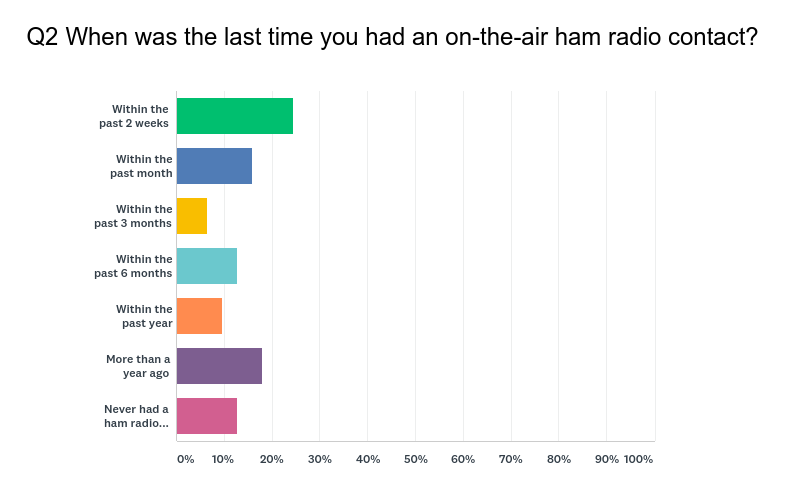
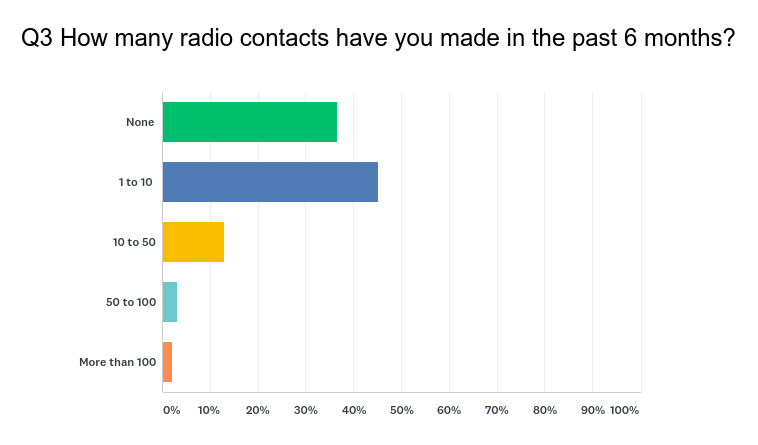
Most of the respondents have been on air recently: 60% of them have made a radio contact in the past 6 months. On the other hand, that means about 40% of not made a contact in half a year. It is disappointing to see that 13% have never made a ham radio contact.


There is quite a range on how active the respondents are with 45% making 10 or fewer contacts in 6 months.


About one half of the survey respondents are members of our radio club. Some of them are also members of other radio clubs in the area. Some of our students travel a long distance, up to 100 miles, to attend this class so it makes sense that they find a radio club near their home.


Most of the respondents reported being active on 2m/70cm FM. About 18% of them are on HF Phone. The total for all forms of HF operating (CW, digital and phone) is not shown on the chart but it is roughly 20%. While roughly half of the respondents have their General or Extra class license, only 20% are actually using the resulting HF privileges.

Conclusions

My broad conclusion is that our radio club should continue to provide opportunities for our members to develop their operating skills and expand their radio operating. I filtered the responses to our club members only to see if our club member responses are any different from the larger group. Basically, our members indicate they are somewhat more active than the rest of the respondents but the overall story does not change.

Obviously, this is a small slice of data relevant to our local situation. It may not apply to other parts of the country.

What do you think?

73, Bob K0NR

WØC Summits On The Air Dinner

It is time for another W0C (Colorado) Summits On The Air dinner!

2017 W0C SOTA Dinner: (left to right) Wayne AD0KE, Brad WA6MM, Caleb W4XEN, Carey KX0R, John N0TA, Curtis KC5CW, Mark N0MTN, Joyce K0JJW, Steve K7PX, Al KH7AL, James KI0KN, Walt W0CP
2017 W0C SOTA Dinner (left to right): Joyce K0JJW, Steve K7PX, Al KH7AL, James KI0KN, Walt W0CP, John N1OIE, Steve WG0AT, Wayne AD0KE, Brad WA6MM, Caleb W4XEN and Carey KX0R.

Last year, we had 15 people get together for an informal dinner in south Denver (Lone Tree): Steve WG0AT, Wayne AD0KE, Brad WA6MM, Caleb W4XEN, Carey KX0R, John N0TA, Curtis KC5CW, Mark N0MTN, Bob K0NR, Joyce K0JJW, Steve K7PX, Al  KH7AL, James KI0KN, Walt W0CP and John N1OIE. It was so much fun meeting people and swapping SOTA stories that we are going to do it again this year.

Wednesday March 21th  at 6 pm
Chili’s, 10460 Park Meadows Dr, Lone Tree, CO 80124-5413

Dinner details:
   No agenda, no organization, just have fun, pay for your meal
Please wear something with your name/callsign (name tag, shirt, cap, etc.) to aid in making connections

Please send this to anyone you know that might be interested.
RSVP back to Bob K0NR: bob@k0nr.com so we have an accurate count for the reservation.

I hope to see you all there!

73, Bob K0NR

Rescue on Uncompahgre Peak (1992)

I came across this story in my archives, written by me way back in August 1992. This was before mobile phones were commonly available, so ham radio turned out to be critical in this incident. Even today, there are many places in the Colorado backcountry where mobile phones don’t work but amateur radio can communicate. My callsign at the time was KBØCY

Something happened on the way to Uncompahgre Peak on August 8, 1992.

Around noon, my brother, my two nephews and I made it to the summit and had just signed the log. I called on 146.52 and contacted Chris, NQ5V, who was somewhere to the east of me (Creede, I think). This must be his summer location, since his callbook address is Texas. We talked about the trail up Uncompahgre, since he was interested in hiking it.

After I signed clear with NQ5V and was about to start down the mountain, a teenage boy came up to me and said he had been sent to “find the guy with the radio” because a girl had been hit by a rock down below and was hurt. I am not sure how they knew I had a radio, other than I used it once on the way up the trail. The story seemed rather sketchy and I was skeptical but asked NQ5V to standby on frequency because we may have a medical emergency. At that time, Arnold, W7JRC, from Cedaredge, CO, came on frequency and said he had a phone nearby. (NQ5V did not have a phone available.) A second, older teenager came up the the trail with more information. He said he was a pre-med student and had search and rescue experience. He had more detailed info which made the story more clear. At this time, I concluded that we had a real emergency and asked W7JRC to call the authorities. I handed my HT to the older teenager and had him describe the victim’s condition to W7JRC. W7JRC had some trouble contacting the police, but eventually got through to the Ouray County Sheriff’s Office. (It turned out we were in Hinsdale County, but we did not know that at the time.)

Jim, NR5Y (also close to Creede, I think) came on frequency and said that he was close to a telephone. I was not always able to communicate with NR5Y, so NQ5V relayed to NR5Y. Since W7JRC was having trouble with getting the telephone call through, I asked NR5Y to also try to place a call. He called the Mineral County Sheriff, who relayed to Hinsdale County. All this time, I was moving down the mountain to try to get closer to the victim without losing my radio contact. About this time, my HT battery went dead, so I switched to my spare (Good thing I had one!) As I moved onto the saddle below Uncompaghre, I lost contact with W7JRC and contact with NQ5V got much worse, but usable. About this time, Doug, NØLAY, came on the air and his signal was very strong at my location which allowed me to stay on low power and conserve my HT batteries. N0LAY apparently came on the air in response to a call from the Hinsdale County Sheriff. N0LAY also had a radio which was on the sheriff’s frequency and relayed information from me to the sheriff’s dispatch.

I had not proceeded down any further because I was certain that I would lose radio contact with NØLAY. The victim had several people with her that had First Aid training and was about 1000 feet below me at the bottom of a cirque. I sent the older teenager back down to the victim with instructions to signal me as to her condition. We both had signal whistles – two whistles meant her condition was the same (stable), three whistles meant her condition had deteriorated. After I got the two whistles back, I felt like things were going to be OK.

About that time, NØLAY relayed that an ambulance had been dispatched to the trailhead and a search and rescue person was on the way up the trail with a trail bike. Also, a helicopter had been dispatched from Montrose. It took us a little while to communicate to the sheriff where the victim was, but we had a pretty good topo map, so we eventually gave them an accurate fix on the location. As I was listening to NØLAY relay, I realized that my Kenwood TH-77A could receive most police frequencies. NØLAY provided me with the frequency and I programmed it into the HT, scanning between 146.52 and the sheriff’s frequency. This allowed us to listen in on what was going on. In fact, many times I was clearly hearing the various parties while they were having trouble communicating.

The S&R guy on the trail bike made it to the accident scene without us noticing him. He had parked his bike about half a mile away from us and had scrambled down to the victim. The first time I was aware of his position was when he transmitted from the accident site. He confirmed that the girl was pretty bashed up, but stable, and needed a helicopter ride out. About this time, the sheriff’s dispatch reported that the helicopter was about 5 minutes out (I think it turned out to be more like 15 minutes away). Soon the helicopter came up on the sheriff’s frequency and I could hear the S&R guy coordinating with the helicopter pilot The two-seater helicopter landed and they put the girl in the second seat. Apparently, she was stable enough to walk to the helicopter with some assistance. The alternative was to put her outside the chopper in a litter. The helicopter lifted off and set back down a few minutes later near the ambulance which was near the trailhead. The two-seater chopper was not a medical evacuation helicopter and the plan was that Flight-For-Life from Grand Junction would pick up the victim at the ambulance location. It turned out that Flight-For-Life was unavailable so they took the victim to a hospital by ambulance (to a local clinic, then Gunnison, I think).

We stayed on the ridge until the chopper headed for home, then we did the same. On the way down, the S&R guy on the trail bike caught up with us and we talked about the accident. He said the girl lost some teeth, had facial cuts, internal bleeding and swelling in the face, but was in stable condition. He said that without the radio report that they would be just getting the initial call at the time he was heading home. That is, we saved about 5 hours on the response time with amateur radio.

I have carried my HT on every 14er hike I have ever done and had considered the possibility of using of using it for emergency communications. I guess I never gave it too much thought because people venturing into the backcountry need to have a self-sufficient attitude. That means being prepared and preventing or handling any emergency situation on your own. But the unexpected happens, and here I was in the middle of a medical emergency. It certainly has caused me to take this emergency communications thing more seriously.

Things I learned that day:

  • Always carry an extra HT battery (or two)
  • Always carry a decent portable antenna (more than a rubber duck)
  • Always carry a good topo map, even if you don’t need it to follow the trail.
  • Make note of what county you are hiking in when in unfamiliar parts of the state. This aids in getting to the right Sheriff’s office. (This is important because the person you contact via radio is likely to be two or three counties away.)
  • My signal whistle (which has caused considerable abuse from a few hiking companions) is actually useful.
  • Extended coverage receive is very useful in emergencies. (I am still thinking about extended transmit — I clearly could have used it in this case.)

I was very pleased that everyone reacted quickly but in a professional manner. The radio amateurs all helped out when they could be stayed out of the way when appropriate. I am sure we can find some things that could have been done better, but I felt like things went well overall.

– Bob KØNR

General License Class: Black Forest, CO Feb 24/Mar 3

Sat Feb 24 and Sat Mar 3 (8 AM to 5 PM) 2018
Black Forest Fire Station
11445 Teachout Road
Colorado Springs, CO 80908


The General License provides access to regional and worldwide communications on the HF bands, greatly expanding your ham radio fun!

• Upgrade from Technician to General Class radio privileges
• Pass your FCC General Class amateur license exam Mar 10*
• Live equipment demonstrations and activities
• Learn to operate on the HF bands, 10 Meters to 160 Meters
• Gain a deeper understanding of radio electronics and theory
• Take the next step with antennas, amplifiers, digital modes

Registration fee: $30 ($20 for under 18 years of age)

Prerequisite: Students must already have their Technician License
Students must have the required study guide:

HamRadioSchool.com General License Course
Second Edition, effective 2015 – 2019, $22.95

* Free FCC exam session on Mar 10 at Black Forest Fire Station 9:30 am.

To register for the class, email: Bob KØNR  bob@k0nr.com

Sponsored by the Tri-Lakes Monument Radio Association

Pikes Peak SOTA (W0C/FR-004) Winter Activation

Joyce/K0JJW and I had intended to hike Pikes Peak this year for a Summits On The Air (SOTA) activation but somehow the plan never came together. I still had my eye on it as a drive-up activation before the end of 2017. The road to the summit is open year round now but closes frequently due to snowstorms passing through. Saturday morning the road was open to 13 miles (out of 19 miles) with the promise that it would be open to the summit later in the morning. (Call 719 385-7325 for a recorded message on road conditions.) By the time we got to the toll gate around 10 am, the road was open to the summit.

pikes peak web cam k0jjw k0nr
K0JJW and K0NR caught on the Pikes Peak webcam, courtesy of Paul/W0RW

When we reached the summit, the weather conditions were 20 deg F with 20 mph winds, creating a windchill of 4 deg F. We were prepared for that having loaded up on the winter clothing. Still, it was freaking cold up there. As you can see in the webcam picture, there was only traces of snow on the summit.

To be SOTA-compliant, we had all of our gear loaded into our packs and walked some distance away from our vehicle to set up. Because of the wind, we chose the observation platform, tucked in behind one of the walls. Normally, that platform is to be avoided because its overrun with tourists but with the cold weather we only had a few people to contend with.

K0NR pikes peak sota
K0NR hunkered down out of the wind

Joyce set up on 2m fm (146.52) using a handheld transceiver (HT) with a vertical antenna. Even with her headset (foam protection on the microphone), the wind noise on her signal was significant. I started out on 2m fm but quickly moved up to 223.5 MHz and worked a few stations there, then on to 446.0 MHz. I had HTs and small yagi’s on both of those bands. Then I fired up 1.2 GHz with an Alinco HT (just 1W on that band) and a 16-element yagi. I worked Paul/W0RW, Gary/WB5PJB and Wayne/N0POH on that band. My QSO with N0POH in Aurora was a new personal best for distance on 23cm/1.2 GHz, at about 90 km.

I tried 2m SSB using my FT-817 but made only one contact: Jim/WB0GMR. Shortly thereafter, I switched back to 2m fm using the 25W mini-mobile rig with a 3-element yagi to work many more stations. Again, just running a bit of power and having a decent antenna on 2m fm was very effective at making radio contacts. I expected the Tytera radio to be overloaded with signals on the summit of Pikes but it actually held up well with just occasional bursts of interference.

Overall, we made 54 QSOs (not too shabby): 43 QSOs on 2m, 5 QSOs on 70cm and 3 QSOs on both 1.25m and 23cm. Our best DX was Jeff/N0XLF near Akron, CO for a distance of about 130 miles (on 2m and 70cm).

73, Bob K0NR

Hidden Gem: W0C/SP-076 Unnamed SOTA Summit

Walt/W0CP had recommended this Summits On The Air (SOTA) summit (W0C/SP-076) to me a while ago. Somehow it had escaped my attention, probably because it’s an unnamed peak and not that well known. Joyce/K0JJW and I decided to give it a try today and it turned out great.

SP-076 Unnamed SOTA summit
A wonderful panoramic view from the summit of SP-076, with Joyce/K0JJW looking on.

We followed Walt’s directions on the SOTA website, using the southern route. We were pleasantly surprised to find a pretty good trail most of the way to the summit. There were a few spots with downed timber, where people have diverted around the logs, but generally the trail was easy to follow. The trail is not shown on many maps, including the USFS San Isabel Forest map. Thus, I was expecting considerable bushwacking to get to the summit.

SP-076 Route
Follow FS road 273 until it ends and park there

The route to the trailhead is via FS Road 273, easily accessible from Highway 285 south of Buena Vista and north of Salida. See the San Isabel National Forest map for orientation. The road is narrow in spots. Our Jeep Wrangler fit OK but a wider vehicle would get to deal with the brush on both sides of the road.  The road is easy 4WD and should be passable with a high-clearance 2WD vehicle. The road had some snow on it (Nov 25, 2017) and with a few more snowstorms may not be passable.

Bob K0NR taking a snack break on the summit.

The road continues a little further than indicated on our topo map but it is obvious when it ends. After that, the road turns into a nice trail (our route shown on the map above). The trail has a few broad switchbacks that made for easy hiking. When we got near the summit, the trail was covered by many small snow drifts, so we opted to go off trail and just head for the summit. So our last quarter mile or so is probably not optimal for summer hiking. There are several mines at or near the top of the mountain. My GPS recorded the one way distance as 1.54 miles with 1330 feet of vertical.

We had quite a variety of radios with us, for 2m, 1.25m, 70 cm and 23 cm, FM only. We started on the workhorse band (2m FM) with the 25W Tytera radio and a vertical half-wave antenna. It seems that someone (me) left the 3-element 2m yagi antenna at home. We quickly made contacts with KD0MRC, W0BV, KD0VHD, KE0DMT and KL7GLK on 2m and/or 70 cm. I used my Alinco 222 MHz handheld to work KD0MRC on 223.5 MHz, which is apparently the first 222 MHz SOTA contact in Colorado. (Yeah, not a popular band.)

For the most part, it was pleasant on the summit, about 40 degrees F, but it got cold whenever the wind picked up. Without the wind, it was great. With the wind, kind of cold.

This is a great hike and a great summit. Only a few people have activated it for SOTA, so I wanted to write it up for others to consider. We will definitely return to this one due to it’s excellent combination of easy accessibility, good trail and wonderful views.

73, Bob K0NR

01 Jul 2018 Update
We returned for a summer activation and have a few more tips.

Access from Hwy 285: Use County Road 270, heading west. CR 270 will intersect with CR272. Keep going straight ahead onto CR 272 as CR 270 turns right and goes north. Then take CR 274 which will keep going roughly west (as 272 turns south). Then take a left onto FS 273 and follow the map shown above. The San Isabel National Forest map is very helpful.

Trail route near the summit: In the original trip report, I mentioned that we exited the trail due to snow and headed for the summit. This turns out to be a good path in the summer, too. The trail heads to an abandoned mine on the north side of the summit. Once you get to the mine, you have to go straight up to the summit, via a steep climb. It is much better to leave the trail earlier and follow the ridge line heading east to the summit (which is the path shown on the map above).

DMR Codeplug for Tytera MD-380

At our radio club meeting on Monday night, I talked about DMR radio, the fastest growing digital format on VHF/UHF. Wow, did I get a positive response! There is a lot of interest in this topic and many of our members are out buying DMR radios and getting on the air. My presentation is available here: DMR W0TLM Meeting Presentation.

Most folks are buying the UHF Tytera MD-380 due to its attractive price point. The price on Amazon seems to fluctuate but it is typically around $100: TYT MD-380 – UHF DMR Ham Radio.  Main Trading Company usually has a good price on the radio, too.

A good source of codeplugs for Colorado is the Rocky Mountain Ham Radio web site. I adapted a recent MD-380 codeplug for use in the Monument area: K0NR Rev 1 RMHAM_MD380_2017-10-28.rdt

You’ll need to use the MD-380 software to load/edit this codeplug. See the VA3XPR web site if you need the software. Under General Setting, you must change these entries:

Radio Name – enter your callsign
Radio ID – enter your DMR-MARC radio ID number
Intro Screen – recommend putting your name and callsign there (or whatever you want)

In the codeplug, I created the W0TLM zone for use in the Monument area which should cover most of your needs. After you get used to the programming software, you can add/modify channels and zones. But be careful as there are many parameters that need to be entered correctly.

I will be updating this codeplug from time to time. Let me know how it works for you.

73, Bob K0NR

Update 18 Nov 2017: I updated the codeplug to incorporate the latest RM Ham Radio repeaters. This is based on the latest RM Ham codeplug dated 28 Oct 2017. I highly recommend you adopt the TyMD380toolz so you can just pull all of the worldwide DMR radio ID database into your radio.

Colorado (W0C) SOTA Activators

Here’s the SOTA activator scores for Colorado (W0C). I have to admit that I like checking this to see how everyone is doing. Some of it is friendly competition but mostly its enjoying the accomplishments of my fellow SOTA enthusiasts.

We’ve got 10 “Mountain Goats” in Colorado now, with 1000 or more points. Carey, KX0R just never stops activating. It seems like he is out there on a summit every day. My friend Brad WA6MM just made “Mountain Goat,” by activating only Colorado summits, never repeating any, with many difficult climbs. Note that his average points per expedition is 8.65, higher than any of the other MGs. (W0CCA comes close at 8.21) Congratulations, Brad!

It looks like K7PX and KD0YOB are next in line for Mountain Goat, while I am still a ways back. My hiking partner Joyce/K0JJW is coming on strong, having accumulated 200 points. I just cleared “half a Mountain Goat” at 500 points, so I requested a certificate for that accomplishment. At my current rate of progress, I am about 2 years away from Mountain Goat. I keep telling myself to be patient, keep at it and (most of all) enjoy the journey.

73, Bob K0NR

Twenty Six SOTA Summits

I’ve written before about how operating goals can be a good motivator for getting on the air and making ham radio contacts. It is fun to have a goal to work towards and keep checking items off on the list. A few years ago, I decided to apply this approach to Summits On The Air (SOTA). SOTA is ripe for this kind of thing, given its extensive database and tracking of QSOs.

Our family has a cabin in the mountains that we use to hike, jeep, ski, snowshore, explore, escape …  So I decided to make a list of the SOTA summits in the general vicinity of the cabin. I did not use a precise criteria, just listing the summits that seemed close by. I used the Lists Of John web site as a tracking tool. That site is used by hikers/climbers to track their ascents, often working on their own list of summits based on whatever criteria that interests them.

This list turned out to have 26 summits on it and I completed the last one a few months back, which was an unnamed peak (W0C/SP-055). Fifteen of these were the first activations of those summits. Some of these have still not been activated by anyone else (except for Joyce K0JJW, who usually hikes with me).

Now that I have completed that list, I obviously need to create a new one. With all of the SOTA summits available in Colorado, I won’t run out of options any time soon.

73, Bob K0NR

SOTA Activation: North Kaufman Ridge (W0C/SP-085)

K0NR operating 2m fm from the summit of North Kaufman Ridge

Kaufman Ridge is a ridge line that runs along the border of Park and Chaffee Counties in Colorado, near Trout Creek Pass. There are two Summits On The Air (SOTA) summits on this ridge: Kaufman Ridge (W0C/SP-081), formerly Kaufman Ridge HP, and North Kaufman Ridge (W0C/SP-085), formerly Kaufman Ridge North. I have activated these summits before including a winter activation of North Kaufman Ridge. These summits have turned out to be popular SOTA activations because they are easy to access, easy to hike and have outstanding views of the surrounding area.

Joyce/K0JJW and I decided to do a SOTA activation on a pleasant September day. On previous trips, we approached the summit from the east without much thought to the route. This time we approached from the north, based on a tip from other SOTA activators. This route is a little bit longer than coming from the east but it turned out to have fewer steep spots and less downed timber to navigate.

The hiking route to SP-085 approaching from the north

To get to the start of the hike, we went south on Windmill Drive to FS 318, entering the San Isabel National Forest. There is a gate at the entrance to the forest that is closed from December 1 to April 15 (per the sign at the gate). We turned right onto FS329, which may not be marked but is an obvious 4WD road heading to the north. We drove to the end of the road and parked near the National Forest boundary. These are really easy 4WD roads such that a high-clearance 2WD vehicle should have no problem.

At this point, we aimed straight at the summit and started hiking. We found only bits and pieces of a trail here and there. Someone has attempted to mark the trail in places but it was difficult to follow. No worries though as the route was relatively smooth without many obstacles such as rock formations and difficult downed timber. We had to do some minor route finding but just looking ahead for obstacles was sufficient. The one-way distance was 1.1 miles with a vertical gain of 800 feet.

This is typical of the route: a mix of aspen and pine trees, some downed timber but an easy hike if you pay attention

On top, we both snagged plenty of radio contacts on VHF/UHF and enjoyed the excellent views in all directions.  This made for a nice SOTA activation on a sunny fall day!

73, Bob K0NR

Mount White: Easy SOTA With A Jeep

View of Mount White from the west on FS 278

Mount White (W0C/SR-021) is 13,667 feet in elevation, just south of its big brother Mount Antero (W0C/SR-003) at 14,269 feet. Joyce/K0JJW and I activated this summit on SOTA using VHF/UHF. There had only been 4 activations of Mount White, which is a bit surprising. It is not that difficult to get to…if you have a decent 4WD vehicle. We have a stock Jeep Wrangler that handled the road just fine, but I would suspect that a AWD crossover (e.g., Subaru) or similar would not be adequate. We saw a number of hikers on the road (probably headed to Antero), so that is always another option.

The Mount White / Mount Antero area is covered with mining claims and old mining roads. This may degrade the hiking experience but does provide some decent 4WD roads to access the area. The Summitpost.org posting on Mount White has some interesting geological information about Mount White and Mount Antero. There are two summits on Mount White and Summitpost says the actual summit of Mount White is the eastern one. However, the SOTA database indicates the western one. Some other maps also indicate Mount White as the summit to the east but I believe the SOTA information is correct. I guess for SOTA purposes, it is correct, by definition.

Joyce K0JJW and Bob K0NR on the summit of Mount White

A San Isabel National Forest map is very helpful for figuring out access to this summit. Basically, you head west on County Road 162 towards Mount Princeton Hot Springs. Eventually, you’ll get to FS 277 which is a moderate 4WD road marked as the road to Mount Antero. Take a left turn onto FS 278 and follow that uphill to eventually take a left turn onto FS 278A. Stay on 278A for a very short time, then take a right onto FS 278B which takes you to the saddle below Mount White. (See map below.) This route does require good vehicle ground clearance. There are two stream crossings and many tight switchbacks. All in all, it was an easy-peasy fun trip with our stock Jeep Wrangler.

Road detail close to Mount White

The hiking route is not difficult: 0.35 Miles one way and 450 feet vertical. But you are above 13k feet, so expect the oxygen to be thin. We started out by following a road along the north side of the peak, then scrambled up the talus to the summit. There are bits of pieces of “trail” but we did not find an established hiking route. The day we were there in September it was extremely windy so we did not stay long.

Mount Antero is close by so you could do both summits on the same trip, assuming the weather cooperates.

73, Bob K0NR

SOTA Activation: Mount Peck (W0C/SP-053)

Mount Peck (W0C/SP-053) is a 12,208 foot summit near Monarch Pass, accessible via a 2.5 mile hike with ~900 feet of elevation gain. This is one of the most pleasant Summits On The Air (SOTA) peaks along the Continental Divide. For most of the route, you are hiking on the Continental Divide Trail (CDT), with outstanding views in all directions. It is always a treat to hike on the CDT, which is like walking on top of the world.

The route follows the Continental Divide Trail (CDT) for part of the hike.

The hike starts at the parking lot at Monarch Pass. (I’ve adapted these directions from Walt W0CP’s notes on the SOTA website.) Take the marked trail that goes behind the building of the Monarch Crest Scenic Tram. Proceed on this trail (really a road at this point) until the CDT exits off to the right (follow it). This section of the CDT is a popular mountain bike trail, so you may encounter bikers on the route. In fact, dirt bikes are also allowed…we encountered a few of them, too.

Route for hiking Mount Peck (click to enlarge)

Stay on the CDT until you see an old 4WD road heading off to the left. Leave the CDT at this point and follow the road uphill. When the road crests and before it starts to go back downhill, leave the road and hike off-trail towards the summit. This is the steepest section of the hike where you gain the most elevation. Don’t forget to stop and enjoy the view. (My spouse started singing songs from The Sound of Music at this point.)

A view of Mount Peck from the trail.

Often hiking on old 4WD roads can seem just like that: hiking on a road and not very enjoyable. This route is not that way…it is actually quite pleasant as the “road” is not rocky or rutted and just seems like an extra-wide trail.

The last uphill stretch toward the summit, which is actually slightly hidden off to the right.
Bob K0NR holding the 2m yagi antenna while Joyce K0JJW operates the radio

We had great weather on the summit and managed to work a number of stations on 2m fm (Yaesu FT-1D driving a 3-element Arrow yagi antenna). This is a hike that we want to repeat in the future.

Another SOTA summit, South Monarch Ridge (W0C/SP-058) is nearby and it is possible to do both of these summits in the same day.

73, Bob K0NR

Another Black Mountain SOTA (W0C/FR-031)

There are (at least) 20 different summits named “Black Mountain” just in the state of Colorado. I’m sure there are many more nationwide. It seems to be a popular, if unimaginative, name. This is why we have a numbering system for Summits On The Air, else we would forever be talking about “which Black Mountain was that anyway?”  Or Deer Peak or Sheep Mountain or …

The view of Black Mountain from the north, driving on FS 107.

On Thursday, Joyce K0JJW and I activated another Black Mountain, this one with Summits On The Air (SOTA) designator: W0C/FR-031. I’m not sure why it has an FR or Front Range designation, as the summit is actually in the South Park region of the state. I can tell you that it is an awesome summit with great views.

To get to Black Mountain, take Highway 9 south out of Hartsel, CO (or come north on Highway 9 from the south). The Pike National Forest map is very helpful with getting into the vicinity of the mountain.  Turn west on FS 108. (This is the same road that leads to Dicks Peak W0C/FR-041.) This road has a sign that indicated “Dicks Peak” and “Black Mountain”. Follow FS 108 S/SW and then take FS 107 to the south (right turn). Follow FS 107 to FS 268, then follow FS 268. About this time, you should have an excellent view of Black Mountain to the south. The roads were muddy and rutted, definitely 4WD. Our Jeep Wrangler had no problem but a AWD crossover/Subaru may be challenged to get through.

Black Mountain has a steep vertical rock face to the north, which is visible as we approached from the north (see photo). At this point, we wondered if we signed up for a difficult climb…but not so. FS 268 turns west, kind of parallel to Black Mountain, then heads away from it. At this point, we wondered if we were on the wrong road. Not so. At this point, the Pike National Forest map failed us…it is incomplete in this area. Instead we used the gaiagps.com app on my smartphone which had a representation of the terrain and roads. As we headed west on FS 268 we saw a road heading off to the south. (I don’t recall if it is marked, but see map below.) Take this road south for about one and a half miles…looking for an unmarked road heading off to the east. The intersection with this road is easy to miss as it is not that distinct. But the road is very visible heading off to the east, so you’ll probably spot it later if you miss the turn and can circle back.

The red line shows our hike up Black Mountain. (Click to enlarge.)

We took the unmarked road east until it deadended at a camping spot. We parked there and started the climb up to the summit. There are only random bits of a trail here and there, so we mostly just followed the GPS towards the summit. The route is forested with some downed timber but not difficult to navigate. The steep north side of Black Mountain provided some nice views. The hike is about 1.5 miles and 1000 feet vertical.

On top, we worked stations on 2m and 70cm fm without much trouble. It is an excellent VHF/UHF site and we found a number of locals hanging out on 146.52 MHz. We reversed our route on the way down and drove the Jeep out.

W0C/FR-222

Steve WG0AT suggested that we could do an nearby unnamed peak (W0C/FR-222) on the same day. This is an excellent idea and we did just that. We headed back north and took FS 269 west,  parking just south of FR-222. FR-222 is not shown on the Pike National Forest map but the Gaiagps.com app and other maps show it. The summit is easily seen from the road and a short hike gets you to the top (about 1/3 mile and 500 vertical feet).

Location of unnamed summit FR-222

73, Bob K0NR