Congratulations: 285 TechConnect Radio Club

Today, I had the privilege of presenting the Technical Service Award (ARRL Colorado Section) to the 285 TechConnect Radio Club. I have to tell you…this club is an excellent example of how to advance the hobby of ham radio. They have figured out that providing technical education is a great way to attract members and assist the local amateur radio community.

Here’s a photo of me handing Bill N0CU, club president, the award:
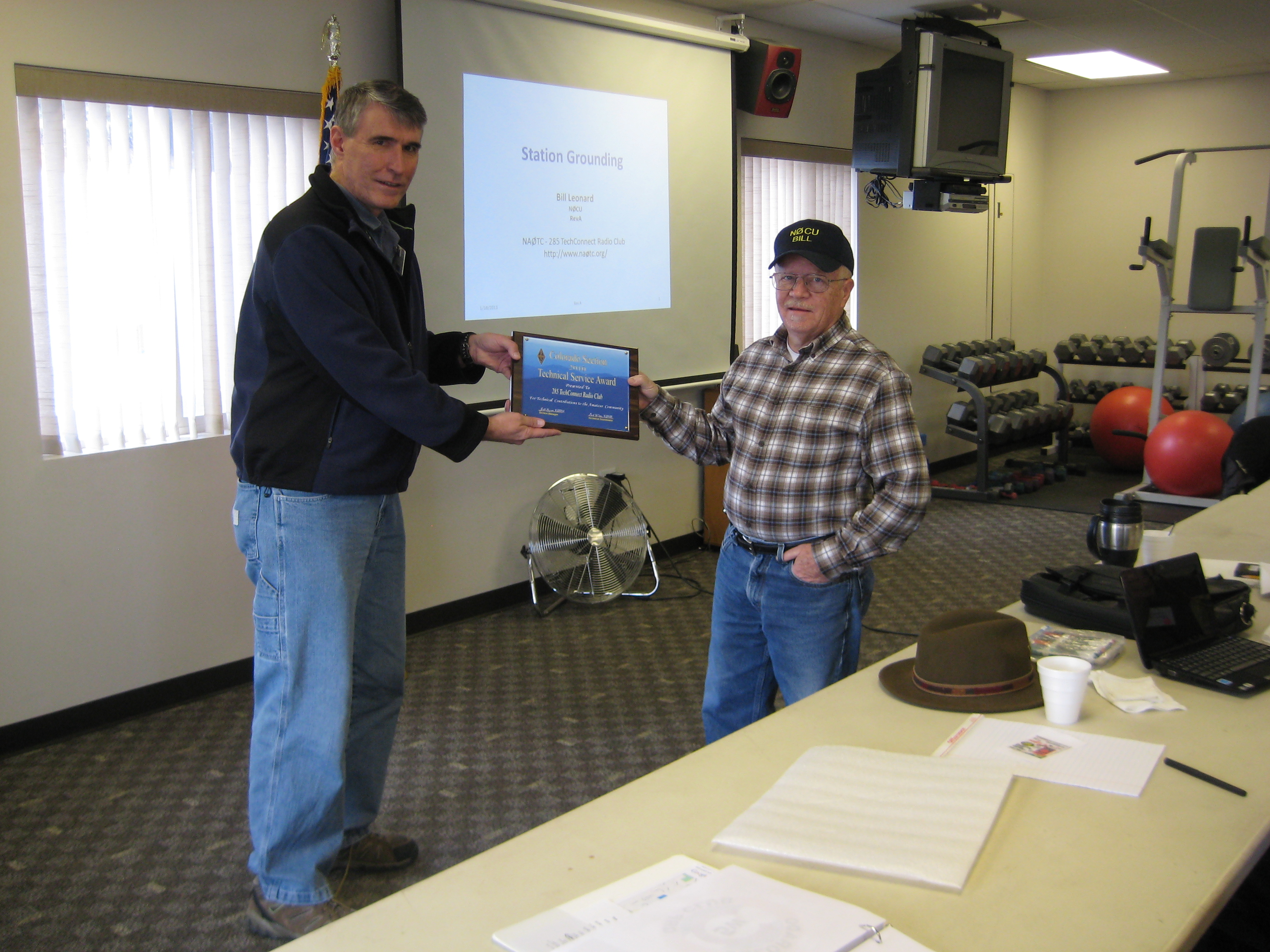
Bob K0NR presents award to Bill N0CU, President of the NA0TC club

At the meeting, Bill also did an excellent presentation on grounding issues in amateur radio stations. This is a complicated topic that Bill handled very well.
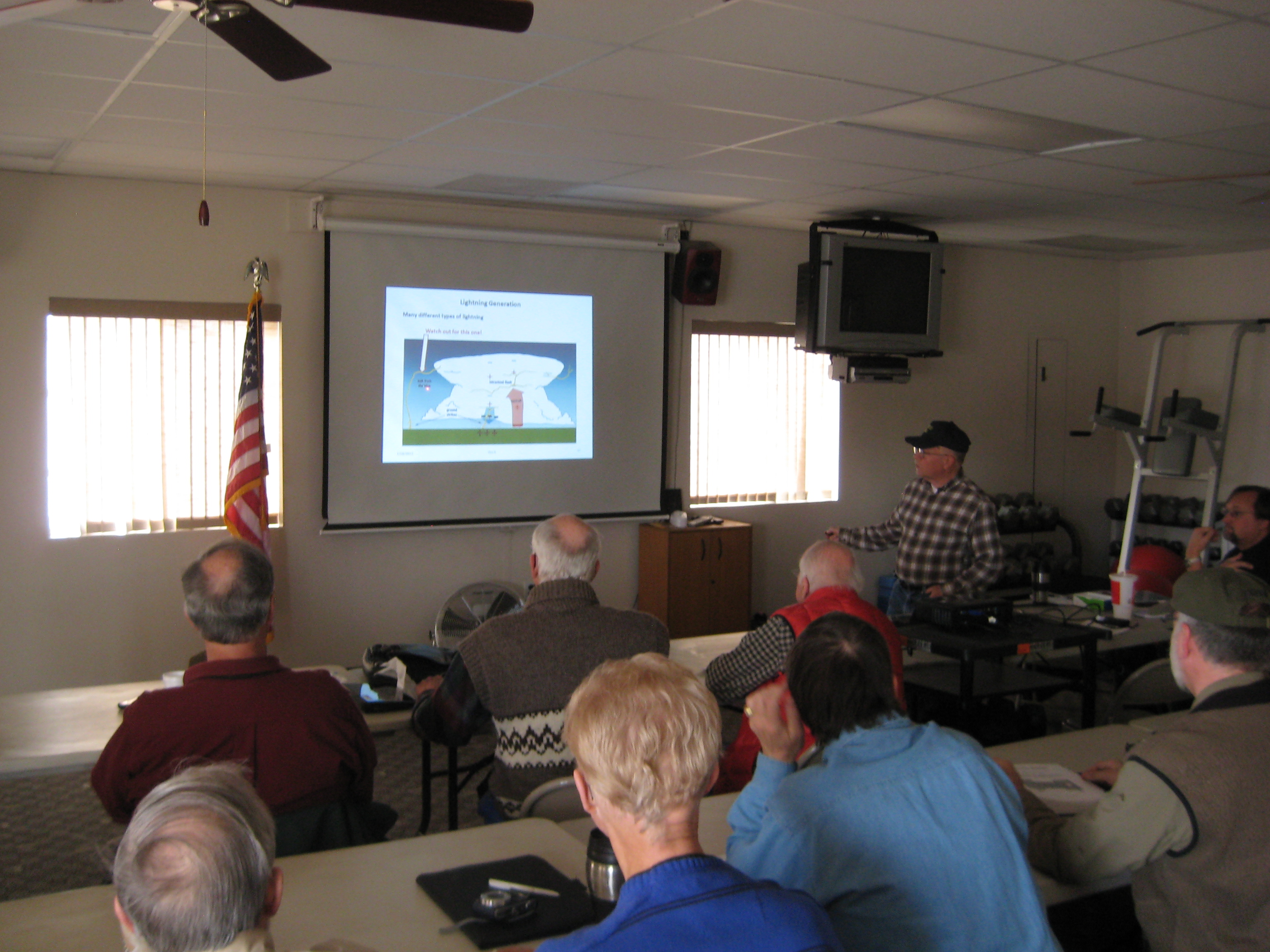
Presentation on station grounding by Bill N0CU

Here’s the announcement of the award:

We are pleased to announce that the 2010 Technical Service Award from the ARRL Colorado Section has been awarded to the 285 TechConnect Radio Club ( http://www.na0tc.org/ ). In past years, this award has been presented to individuals that have provided exceptional technical service to the amateur radio community. This year the award goes to the entire TechConnect club for their collective contribution to the Colorado amateur radio community. In particular, the club sponsored the all day “2010 Fall TechFest”, with a great line up of technical and operating presentations (http://www.na0tc.org/TechFest_2010_Workshop_Materials.htm ). The club also sponsors the TechNet that meets at 7 PM local on Tuesday nights on the Colorado Repeater Association 147.225 MHz repeater. These activities have made an important contribution to technical education in the Colorado section.

Our thanks and congratulations goes to the entire club with special thanks to Steve Finch, AI0W, Technical Specialist, Colorado Section for his personal leadership and contribution to this effort.

Jeff Ryan, K0RM
Section Manager, ARRL Colorado Section
http://www.k0rm.net/

Bob Witte, K0NR
Technical Coordinator, ARRL Colorado Section
http://www.k0nr.com/ts.html

VHF Sweepstakes on Mount Herman

For the 2011 ARRL January VHF Sweepstakes, I repeated the tradition of doing a winter assault on Mount Herman (DM79) on Saturday afternoon. As in past years, Joyce (K0JJW) joined me on the hike, but we also had some other folks along to make for quite a party on the summit this year.

James, Stu and Bob at the trailhead

Stu (W0STU) and I operated independent “Single Operator – Portable” stations from the summit. Stu conned convinced James (KD0MFO) to join him on this trek. We had hoped to get “Alpha Goat” Steve (WG0AT) to go with us, but he made some excuse about needing to prepare for an upcoming trip to Dominica (J7). (Instead of slogging through the snow, Steve wants to go to the Caribbean? Probably a good choice. See Steve”s video of his previous trip up Mt Herman here.) Dan (N0OLD) also hiked up a little later in the day to join us on the summit.

Bob K0NR setting up the Arrow II Yagi Antenna on the camera tripod

Trail conditions were good, with not much snow on the trail. There were definitely some icy spots such that we enjoyed the extra grippers attached to our boots. The weather forecast was a bit marginal, so we were prepared to deal with a snowstorm moving in on us. As I told Stu, the philosophy is “We’ll have a good hike and we might also have some fun working the radios.” In the end, the weather remained solid with only a few snow flakes and temperatures just above freezing. Dan and James built a small campfire (in an established fire ring) that really warmed us up.

Bob K0NR Operating the FT-817

My primary radio was the Yaesu FT-817, driving an ARROW II yagi on 2 Meters and 70 cm and a wire dipole in the trees for 6 Meters. I also had several handheld FM rigs along including one on 222 MHz. Overall, I made 83 contacts with 15 grids for a total score of 1725.

Group photo on the summit: Dan N0OLD, Bob K0NR, James KD0MFO, Joyce K0JJW and Stu W0STU

This may have been the most fun yet for the January VHF Sweepstakes. Of course, any day in the mountains playing with radios is a good day.

73, Bob K0NR

Announcing: Amateur Radio Technician Class – April 2 & 9

Ham Radio Two-Day License Class

Monument, Colorado

Saturday April 2 and Saturday April 9 (8 AM to 5 PM) 2011

Location: Tri-Lakes Monument Fire Station 1
Sponsored by the Tri-Lakes Monument Fire Radio Association

The Technician license is your gateway to the world-wide excitement of Amateur Radio …

  • Earn your ham radio Technician class radio privileges
  • Pass your FCC amateur radio license exam right in class on the second day
  • Multiple-choice exam, No Morse Code Required
  • Live equipment demonstrations
  • Learn to operate on the ham bands, 10 Meters and higher
  • Learn to use the many VHF/UHF FM repeaters in Colorado
  • Find out how to participate in emergency communications

There is no cost for the class (donations accepted)

However, students must have the required study guide:

Gordon West Technician Class guide, 7th Edition $20.95
And pay the FCC Exam Fee: $15.00

Advance registration is required (no later than March 25th, earlier is better!)

To register for the class, contact: Bob Witte KØNR

Email: bob@k0nr.com

For more information on amateur (ham) radio visit www.arrl.org
or www.wedothat-radio.org

Completing the 2010 Trip Around the Sun

As the year 2010 comes to an end, I feel compelled to write something really insightful and meaningful as we log another trip around the sun. Perhaps some brilliant insights for the coming year? Or predictions of future technology breakthroughs?

Instead, I am writing this.

This is a mishmash of my thoughts about amateur radio at the start of 2011:

  • Tech License Class: One of the most fun and rewarding ham radio things I did this year was help teach a couple of Technician License Classes. There is nothing like engaging with newbies to the hobby to give you a new perspective on how cool amateur radio really is! I have a great set of teammates that made this class fun and successful: Stu W0STU, Paul AA0K and Joyce K0JJW.
  • Next Challenge: The challenge we see right now is helping these newly licensed Techs get engaged with amateur radio, so they don’t drop out. My belief is that the Technician License is a beginners permit that only enables a person to get started in the hobby. We are cooking up some fun activities to keep them going.
  • Public Service: We have a good thing going with the local fire district and the RACES group in our county in terms of real engagement on emergency communications. This is fun, rewarding and a good thing for our local community.
  • Dayton Hamvention: I am going to skip Dayton (again) this year. Instead, I’ll attend the International Wireless Communications Expo (IWCE), a trade show centered on land mobile and mobile wireless communications. For me, it has an interesting mix of emergency communications, land mobile, data/voice convergence and test & measurement topics. Oh, did I mention that it is in Las Vegas?  I suspect that it will be a better venue than Hara Arena 🙂
  • ICOM IC-9100: I have been patiently waiting for this rig to move from vaporware status to reality. Maybe it will happen this year?
  • Keep On Writing: I find that writing is good therapy, so I will keep that on the list for 2011. Mostly it will be this blog and the FM column for CQ VHF magazine.
  • Operating: It seems I don’t actually get on the air as often as I’d like, certainly not for the casual ragchewing QSO. Operating events seem to be a good way for me to get some air time: VHF Contests, Colorado 14er event, Colorado QSO Party, maybe an HF contest or two.
  • D-STAR: I haven’t been spending much time with D-STAR lately and I want to increase the focus on it. D-STAR falls into that dorking around with new technology category where experimenting with it and learning about it is the main activity.  The technology continues to grow in adoption…arguably slow in real terms as the analog modes have such a huge installed base.
  • APRS: Oddly enough, I have been messing around with APRS again, mostly thinking of it as a tracking tool for hiking and other outdoor activities. Maybe we need to look at bridging APRS with D-STAR location data?

Amateur radio is clearly my #1 hobby interest, and by a wide margin. But it is primarily a hobby (yes, with a public service hook to it…at least for me). It is important to keep it in perspective and not let it turn into another job. I already have one of those.

What are you going to be doing in 2011?

73, Bob K0NR

Playing Around with APRS

In the past few weeks, I started playing around with APRS again. Interest in APRS seems to come and go for me over time. It has the technical intrigue of figuring out how it works and the fun of exploring radio propagation paths. (If you are not familiar with APRS, K9DCI has a good introduction to it.)

The web site aprs.fi has some interesting hooks built into it that maps the location of APRS stations. I embedded a map here on my weblog page that shows my home station position (K0NR) and other stations in the vicinity. I intentionally blocked stations that only exist via the internet (no RF).

This map is dynamic in that it will update to show the latest APRS activity. It is fun to try select different map styles (courtesy of Google maps). Also, you may want to look at the html code to see how this is done.

73, Bob K0NR


2010 Fall TechFest

Here is an excellent opportunity to build your ham radio knowledge and skill. The 285 TechConnect Radio Club (www.na0tc.org ) is once again sponsoring the Fall TechFest (Saturday November 6th). This educational event is aimed at the Tech advancing to General, with a good selection of workshop topics.

I often get new Technician licensees (or not so new licensees) asking for help on learning more about amateur radio. The 285 TechConnect Radio Club has taken this on and has created a super environment for technical training.

I will be presenting the VHF workshop for this event. I presented on a different topic last year and it was loads of fun, so I am looking forward to doing it again!

Schedule of Workshops
(order and topic may vary)
Time Topics
9:00 – 9:50 Contesting Using Wire Antennas and 100 Watt Rigs
10:00 – 10:50 DXing Using Wire Antennas and 100 watt Rigs
11:00 – 11:50 The Fun Of Using Classic Radios
12:00 – 12:50 Lunch (on your own) Question and Answer Session for those who stay to eat
1:00 – 1:50 QRP – Make Contacts Like the Big Boys with 5 Watts
2:00 – 2:50 VHF/UHF – Beyond FM
3:00 – 3:50 Audio Processing – Make That Difficult Contact

Registration
Space is limited! Please pre-register.
Cost $10.00 (cash only at the door).

Where
The Inter Canyon Fire Department Station #1. The address is 7939 South Turkey Creek Road, Morrison, Colorado OR check our website – www.na0tc.org.

NAØTC – 285 TechConnect Radio Club
2010 Fall TechFest
November 6, 2010

Be sure to visit the NA0TC web site for complete information.

73, Bob K0NR

Our First GeoFox Rally

Our local radio club (W0TLM) has been able to help a number of Scouts from the local Boy Scout troop get their Technician Class radio license. (See Results from the Second Technician Class.) The boys are having a lot of fun talking to each other on 2 Meters and using ham radio to support their troop activities.

We started thinking about some other fun activities we could do with them. Somehow the notion of combining some GPS (geocaching) work with transmitter (fox) hunting emerged. It turns out that we are not the first group to have this idea. The North Bay Amateur Radio Club in California had already tried this and named it GeoFox.

Our version of GeoFox,  crafted by Stu W0STU, resulted in a course that had three hidden transmitters  and three checkpoints defined by latitude/longitude, for a total of 6 checkpoints. The total course length was about 3.6 miles.

Using this as a learning opportunity, the Scouts built their own “tape measure” yagi antennas for use in direction finding.

The course was set up in a portion of Pike National Forest, near Woodland Park, Colorado. The Scout troop combined the GeoFox event with a weekend campout. The Scouts worked in teams of 4, with at least one licensed radio operator and a GPS operator. Each team started at 20 minute intervals with instructions to get them to the first checkpoint. At each checkpoint, they found the instructions that would get them to the next checkpoint. In addition to GPS and radio operating, the instructions required the use of some basic Morse code and traditional map/compass. The event crew was in radio contact with the teams as we tracked their progress throughout the course.

The Scouts plan their attack at the start of the course.

The course turned out to be more difficult than planned. Some of the teams got off track into difficult terrain (for one reason or another) and took a while to recover. A few of the teams did not finish the course in time.  Everyone left the event quite exhausted but full of stories to tell about their fun day.

A GeoFox team leaves the starting point, headed for the first transmitter

I think we have the start of a really fun activity for all ages that we will refine over time.

– 73, Bob K0NR

This Spewed Out of the Internet #17

The summer is flying by and it has been difficult to keep up with the blog. Here are a few things that just spewed out of the internet.

This week there is a nasty wildfire burning west of Boulder which has already consumed 92 structures. (Take a look at some of the photos here.) We have gotten used to the occasional wildfire in the west, some big, some small. This one seems to have spread rapidly and damaged many homes in a short time. And its not over yet. And yes, the local amateur radio community is actively helping out.

K3NG writes about a situation concerning a public service event. He makes some really good points about the amateur radio role in such events. Sometimes I see radio amateurs working events and not really providing much value. This gives us some on-the-air practice but that may not be enough to justify participating.

The Southgate ARC has an item about keeping the AM mode alive. To me, AM definitely means ancient modulation, clearly approaching the Duty-To-Die phase. Please end the life support on this mode and let it slip away. It really will be better for everyone.  (OK, I suppose these guys are just having fun…hard to knock that. But they could do it with half the bandwidth. )

Back to the future with a reworked Commodore 64. I could see getting one of these PCs.

Here’s a good article from unplggd on emergency preparedness from a tech point of view (but not necessarily amateur radio). It’s worth a read.

Those Compact Florescent Light (CFL) bulbs are gaining in popularity. I believe they are an ecological time bomb because of their mercury content. See this article for more information. Oh, and if they aren’t designed well, they tend to radiate radio frequency interference.

73, Bob K0NR

Ham Radio Two-Day License Class – October 16 & 23

Amateur Radio Technician License Class

Monument, Colorado
Saturday Oct 16 and Saturday Oct 23 (8 AM to 5 PM)

Location: Tri-Lakes Monument Fire Station 1
Sponsored by the Tri-Lakes Monument Fire Radio Association

The Technician license is your gateway to the world-wide excitement of Amateur Radio …

  • Earn your ham radio Technician class radio privileges
  • Pass your FCC amateur radio license exam right in class on the second day
  • Multiple-choice exam, No Morse Code Required
  • Live equipment demonstrations
  • Learn to operate on the ham bands, 10 Meters and higher
  • Learn to use the many VHF/UHF FM repeaters in Colorado
  • Find out how to participate in emergency communications

There is no cost for the class (donations accepted)

However, students must have the required study guide:

Gordon West Technician Class guide, 7th Edition $20.95

And pay the FCC Exam Fee: $15.00

Advance registration is required (no later than Oct 10th, earlier is better!)

To register for the class, contact: Bob Witte KØNR

For more information on amateur (ham) radio visit www.arrl.org or www.wedothat-radio.org

2010 Colorado 14er Event

The Colorado 14er Event will be held on August 8 this year. This is the premier mountaintopping event for amateur radio. The basic idea is to have fun making ham radio contacts from the 14,000 foot peaks in Colorado.

Actually, we’ve started to see some of the 14,000 ft peaks in California on the air, too! Very cool. Rumor has it that some of the New Mexico hams might be active on the highest summits in that state (none are above 14,000 feet though). I don’t know whether the Kansas folks are going to brave the extreme conditions on Mount Sunflower this year or not. (That’s the highest spot in Kansas.)

Some of these stations will be on HF, activating Summits On The Air (SOTA) peaks.

For more information see:

The 14er Event Web Site

The Ham14er Yahoo group

I hope to work you during the event.

73, Bob K0NR

ARRL Field Day in Monument

This weekend is the ARRL Field Day, the major ham radio operating event in North America. Here in Monument, the Pikes Peak Radio Amateur Association and the Tri-Lakes Monument Fire Radio Association will operate from TLMF Station 1. Details are on the PPRAA web site.

The “Get On the Air” station is perfect for new hams that want to try out HF. Everyone is welcome to stop by, operate, chat or just observe.

73, Bob K0NR

This Spewed Out of the Internet #15

It’s time to do one of those miscellaneous collections of drivel that spews forth from the interwebnet pipes. Some of this might even be important!

Some upcoming events: ARRL June VHF QSO Party and the Colorado FM Sprint, on the weekend of June 12th. The FM Sprint runs concurrently with the ARRL contest but only on Sunday afternoon. This is a good chance to get on the air with very basic equipment and have some fun.

The ARRL Field Day is coming up on June 26th and 27th. This is arguably the biggest on-the-air amateur radio event in North America.

I was playing around with setting up an SMS text messaging system for callsign lookup. The idea is that you send a text message (containing an amateur call sign) with your mobile phone and get the FCC or QRZ info back. In the meantime, I found that this problem has been solved by Callsign By Text. Very nice, check it out.

Female radio amateurs should check out Chick Factor International. It looks like a fun group.

I picked up a DV Access Point (DVAP) for D-STAR. This is a neat little device that provides flea-powered D-STAR access on 2 Meters by plugging it into a PC with internet connection. The South Yorkshire Repeater Group has a good description of the product. So far, this thing works really well.

By the way, the South Yorkshire group has a really good web site…interesting and timely information. Although they are in the UK, I find it relevant to US ham radio activity, too.

The Technician Class License question pool will be updated as of July 1, 2010. Our next Tech Class in Monument will be in October, so we’ll be updating the classroom material before teaching that class. It is clear that more technical content is being added to the question pool, which I think is a good thing. See KB6NU’s posting on the topic.

From The Complete Waste of Time Department, the FCC once again dismissed a petition from K9STH to change the amateur radio station identification requirements. Look, the FCC doesn’t see a problem here (and neither do I) so save yourself the trouble.

The FCC is seeking comments on the proposed new rules concerning emergency communications.  I took the time to file a short comment, basically saying that the FCC is on the right track but they should remove the reference to “government-sponsored drills”. Any legitimate emergency communications drill should be included, regardless of who sponsors it. The ARRL made similar but more detailed comments.

– 73, Bob K0NR

Announcing the Colorado FM Sprint

The Colorado FM Sprint is a short and simple VHF contest that runs in parallel with the ARRL June VHF QSO Party. Basically, it’s a chance to have some fun on the VHF bands for not-so-serious contesters.

Sponsored by:  Colorado ARES and the Colorado VHF Group (KØYB)
Direct any questions to k0yb@qsl.net

This contest is held concurrently with the ARRL June VHF QSO Party, with compatible rules and operating procedures. The purpose of this contest is to:

·        Promote the use of FM VHF/UHF simplex

·        Provide an opportunity for radio amateurs to test the limits of their stations using FM VHF/UHF and to experiment with ways to improve their stations

·        Practice deploying portable and mobile operation as a means of identifying effective locations for temporary relay stations

·        Provide a simple and enjoyable radio contest experience (“Have fun!”)

Time:

Sunday, June 13, 2010; 1200 to 1600 Mountain Time (1800 to 2200 UTC)

Objective:

To work as many stations as possible using FM simplex on the 146 MHz, 222 MHz and 440 MHz bands in as many different VHF grids as possible.

Frequencies:

Operate on FM simplex frequencies consistent with the Colorado Council of Amateur Radio Clubs (CCARC) band plans with special emphasis on using ARES designated frequencies.

(Consistent with the ARRL Rules, 146.52 MHz is not allowed to be used in the contest.)

Suggested Frequencies:

2 Meters: 146.58, 146.55, 146.49 MHz

222 MHz: 223.5 MHz

440 MHz: 446.0, 446.025, 446.100 MHz

Do not operate on repeater frequencies or 146.52 MHz, the National Simplex Calling Frequency.

Remember to be a considerate operator and share the frequency with other operators.

Contest Exchange

To complete a contest QSO, you and the other station must copy each other’s callsign and 4-digit Grid Locator. You may optionally exchange Name and ARES District.

Note: These are an abbreviated set of rules…the complete rules and FAQ are at http://www.qsl.net/k0yb/Colorado_FM_Sprint.html

73, Bob K0NR

2009 June VHF QSO Party Results

arrlnewlogo-transThe results of the June VHF contest have been published online and in the December issue of QST. I operated from our cabin in DM78, near Trout Creek Pass with temporary antennas up for 50 MHz and 144 MHz (3-element Cushcraft Yagi on 50MHz and a 2M9 on 144 MHz)  It was mostly a two band effort in the low power single operator category, with a few additional contacts on 440 MHz FM.

VHF contests are mostly a regional competition since the scores depend so much on adjacent operating activity. Here’s the scores for the Colorado Single Operator Low Power category:

# Call Score QSOs Mult Class Section
1 N0POH 73,225 419 145 A CO
2 K0COM 38,532 322 114 A CO
3 N0HF 29,718 254 117 A CO
4 K0NR 28,197 238 117 A CO
5 N0YE 14,112 154 56 A CO
6 KB0YH 13,855 163 85 A CO
7 W0EPC 7,812 126 62 A CO
8 WB5PJB 6,050 97 55 A CO
9 K0CS 4,928 88 56 A CO
10 K0UK 1,316 47 28 A CO
11 KC0VFO 1,140 53 19 A CO
12 W0PSS 621 26 23 A CO
13 AB0SF 440 22 20 A CO
14 N0HIO 352 22 16 A CO


Congrats to Wayne N0POH for leading the Colorado Section (and the Rocky Mt Division).

My 28k score is less than the 39k I scored in 2008 (See Awesome June VHF Contest).  I have shifted my focus in the contest to picking up new grids, especially on 144 MHz. I qualified for VUCC on 6M, 10 GHz and Satellite years ago but have never confirmed the required 100 grids on 2 Meters. If I was after the best contest score, I’d be trying to add higher bands to the portfolio, especially 1.2 GHz.

73, Bob K0NR

Colorado QSO Party Results

colorado-flagThe results of the Colorado QSO Party have been posted on the PPRAA web site. I had previously written about this, but I never got around to posting my score after the contest.

Here’s the email I sent to the various club email lists:

The CO QSO Party succeeded in getting me back on the HF bands. I operated from our cabin in Park County with 100 Watts to a half-size G5RV in the trees. I also had 50W to a 2M yagi (2M9) antenna. Only worked WA7KYM in Wyoming on 2M SSB and he was not working the contest. I did pick up a few contacts on 2M FM, which was fun. All contacts were on phone.

I spent a considerable amount of time on 40M but it did not yield much. The exchange of “name” was quite natural on phone and added to the laid back flavor of a state QSO party. All in all, a very fun time.

At times, there were 4 contests running near 14.250 MHz: CoQP, Hiram 140, All Asean DX and another one I did not identify. Lots of “CQ Contest” and lots of confusion 🙂

Band    QSOs    Pts  Sec   Mul
   7       3      6    1    1
   7       1      2    1    0
  14      70    152   31    0
 144       5     10    3    1
 144       1      2    1    0
 420       1      2    0    0
Total      81    174   37   2
Score: 6,786


I placed 3rd in the In-State Low Power Phone – Single Operator category, behind Dan W0RO and Brian N5ZGT. A highlight during the contest was working my good friend Denny KB9DPF in Fort Wayne on 20 Meters. It has been years since we had made contact on the HF bands.

Thanks to the Pikes Peak Radio Amateur Association for sponsoring this contest.

  • 73, Bob K0NR

D-STAR Presentation at MARC

dstarThe interest in D-STAR continues to grow in Colorado. I have responded to a request to talk about D-STAR at the Mountain Amateur Radio Club (MARC) meeting on Wednesday night. It will be a basic introduction to the mode/technology along with a demo of D-RATS. I don’t think I am an expert on the topic so I asked Elliot KB0RFC to assist. Between the two of us, we have enough experience with D-STAR to handle the topic well.

The MARC club is a fun group, so stop by if you get a chance!

Bob Witte (KØNR) and Elliot Linke (KBØRFC) will be presenting a program and demonstrating the basics of D-Star, the new amateur radio digital mode that can be used for both voice and data, at our MARC Meeting at 7 pm this Wednesday, Sept. 16th, at the Woodland Park Library. I hope you will make plans to attend!

See you then!!!

73 Wes KØHBZ

Mountains, Radios and the Goats

Steve (WG0AT) has done it again with a great video of the Colorado 14er Event. Take a look at the saga of two guys and two goats scrambling their way to the top of Mount Humboldt (with the exclusive GoatCam technology). This new adventure features Peanut and Rooster, the brain power behind the Old Goats Hiking Team. This video captures the spirit of the 14er event, the premier mountaintop radio event.

For more goat hiking videos, see http://n0b-14er.blogspot.com/

73, Bob K0NR

D-STAR is On Line in Monument

One of our local radio groups has put a 70 cm D-STAR repeater on the air here in Monument. Here’s the announcement from Elliot KB0RFC:

The W0TLM B repeater and gateway are on the air in their new PERMANENT home in monument near hwy 105 and I 25, coverage reports are needed. All gateway functions are operating please feel free to link to the repeater, or just call around.

The repeater is a joint effort between the Tri-Lakes Monument Fire radio association, the Tri-Lakes Monument Fire Department Communications Auxilary, And the Tri-Lakes Monument Fire Protection District. The purpose of this repeater is  to support emergency communications in northern El-Paso County. we will do what we can to create an environment conducive to training and support for actual emergency events.

We run a net on 447.725- 100.0hz tone every Monday night except the last Monday of the month where we have our monthly meeting at Tri-Lakes Fire station 1. All are welcome We hope to be participating in the CO-D-STAR net soon. W0TLM++B and W0TLM++G are on 446.8875- please check it out!

Please email any questions to kb0rfc@arrl.net
Elliot Linke
KB0RFC

I got a chance to try D-STAR out from a remote perspective when I was out in the San Francisco Bay area. I got on the W6YYY repeater in Oakland on 440.03750MHz and chatted with Elliot KB0RFC back in Monument. This is way  cool!

OK, you may be thinking “I can do that with EchoLink or IRLP”, which is true (and that is also way cool). The benefits of D-STAR are still emerging, but one big difference is that each transmitted packet has callsign routing. One feature that I see as useful is the callsign squelch mode. I can keep my radio squelched expect for people specifically calling me. Other advantages of the “all digital” network are starting to surface, so stay tuned on that.

There are several D-STAR repeaters popping up in Colorado. The group leading the way is the Colorado D-STAR Association in the Denver area. The Cheyenne Mountain Repeater Group has a system on the air in Colorado Springs, currently in a test phase (limited coverage) on 446.9125 MHz (KC0CVU B). A group in Boulder is also working on a system but I am not sure of the status of that effort.

New technology, new learning, new fun.

73, Bob K0NR

Pikes Peak Operation – 2009 Colorado 14er Event

We rounded up the usual collection of suspects to operate from Pikes Peak in the Colorado 14er Event. Our crew included me, Joyce K0JJW, Ken WA6TTY, Stephen KZ0Q, Steve KD0BIM, Stan WA0Z and Matt KC0LBA.

Since Pikes is a “drive up” mountain in an event where most radio operators hike in, we tried to compensate by covering as many bands as possible. We had 4 stations on the air:

  • 2M FM
  • 50 MHz (mostly SSB, some FM)
  • 222 MHz FM, 440 MHz FM
  • HF (20 Meters – Mostly SSB, some CW)
Antenna tear down: Bob K0NR, Stephen KZ0Q and Steve KD0BIM

This had to be the best weather for the event in years, with no one reporting being chased off the summit by approaching storms. This is odd considering the stormy weather patterns we have seen this year.

Most of the 2M FM contacts used callsign KD0BIM, everything else used the club callsign K0YB.

Summary of Pikes Peak Log:

Band      QSOs    14ers          Comments
146 MHz    83       13    Best DX: K4S Mt Sunflower and N0KQY in Kansas
50 MHz     21        1    Only 14er: KQ6EE on Elbert
222 MHz     3        1    Only 14er: KQ6EE on Elbert
440 MHz     7        3
HF (20M)   17        1    Only 14er: N0B on Humboldt
Total:    131       13

We operated for about 4 hours, averaging about one QSO every 1.8 minutes. Pretty good rate for this event, based on past experience.

We clearly missed some of the 14ers that were on the air. Based on my count, there were 16 summits activated during the event:

Elbert, Massive, Grays, Antero, Torreys, Quandary, Evans, Princeton, Yale, Bross, Pikes, Humboldt, Bierstadt, Redcloud, San Luis, Huron

Thanks to everyone that came out for the event!

73, Bob K0NR