A Great Weekend on VHF

CQ VHFOne of the things that makes a VHF contest so much fun is that you never know how its going to play out. One of the major factors is sporadic-e propagation which is, well, sporadic. Sometimes we get rewarded with decent propagation and sometimes we get completely skunked.

In the morning, before the 2012 CQ World Wide VHF Contest started, the 6 Meter band was open from Colorado to the east. The band continued to be open to various locations for most of Saturday, even late into the evening. I made my last contact on 6 Meters to the Pacific Northwest after 10:30 PM local time.

On Sunday morning, 6 Meters gave us some more fun but it was not nearly as good as Saturday. Instead of strong signals and consistent runs, the signals were variable and QSOs were often a challenge. Sometimes it was like pulling teeth. This contest only uses two bands: 6 Meters (50 MHz) and 2 Meters (144 MHz).  As 6 Meters pooped out, the action moved to 2 Meters. Fortunately, we had a number of rovers out that helped activate some of the rarer grids. Thanks W3DHJ, AB0YM, KR5J and W0BL.

This is probably my best score ever in the CQ WW VHF Contest, due to the excellent propagation on Saturday and some station improvements I’ve made over the past couple of years.

     Band       QSOs X pt =  QSO pts.  X   Grids   =     Points
---------------------------------------------------------------
     50         337    1      337           130           43810
     144        34     2      68            13            884
---------------------------------------------------------------
     TOTALS     371           405           143           57915

                            Claimed score =  57915

All in all, a great weekend on the VHF bands.

73, Bob K0NR

SOTA Activation Without The Tears

I recently confessed blogged about a not-that-well-executed SOTA (Summits on The Air) activation, in How Not to Do a SOTA Activation. This past weekend, I made another run at it with much better results. Still, I did use a slacker low impact approach to the activation.

My hiking partner spouse and I decided to go for a hike on Sunday afternoon. It had been many years since we had climbed up to the fire lookout on Devils Head in Pike National Forest, so that sounded like a great destination. There is an excellent view at the top (fire lookouts tend to be like that) and the weather was awesome. I checked the SOTA list, and sure enough, Devils Head is a legitimate SOTA peak (W0/FR-051).

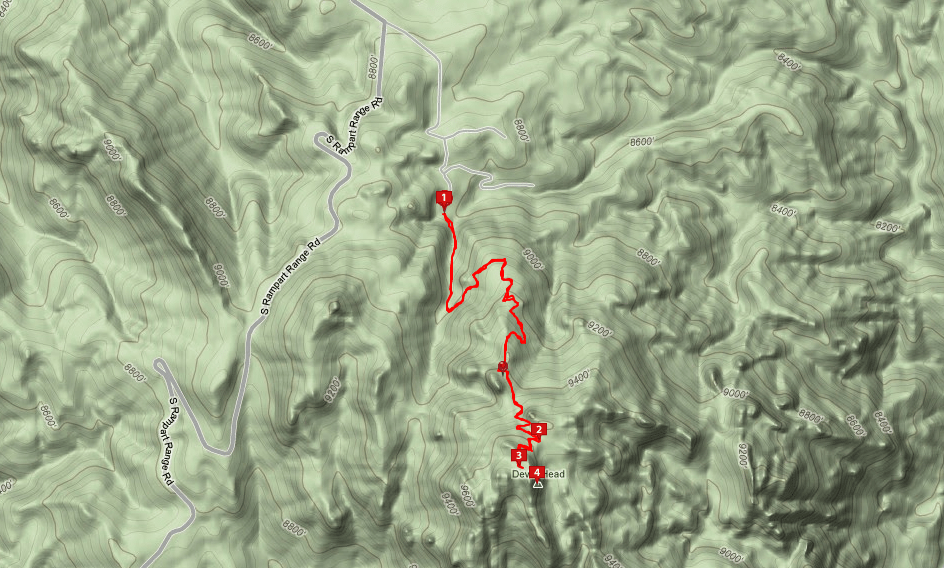
The hike is about 2.8 miles round trip with an elevation gain of 950 feet. I put this in the category of a good tourist hike…with just enough huffing and puffing to make you think you worked for it but not so much that it kills you. Here’s the topo map and route taken from everytrail.com

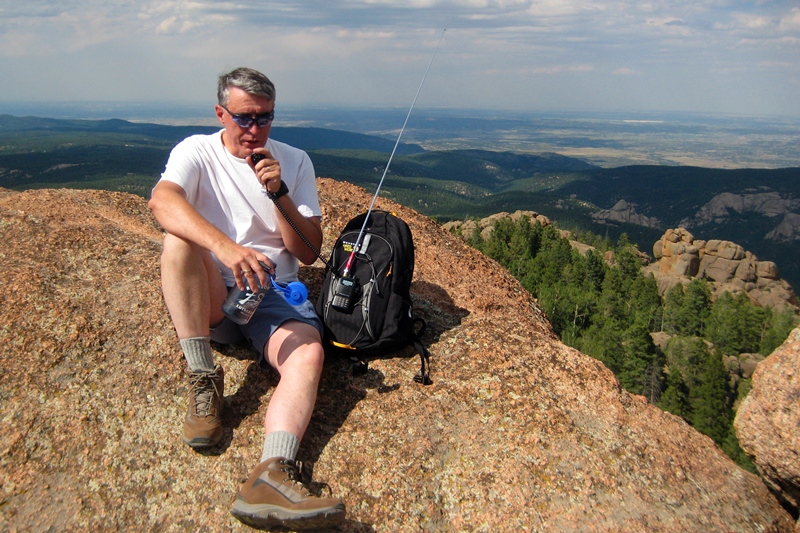
As I put together my daypack, I tossed in my Yaesu FT-60 handheld radio and a 1/2-wave vertical whip antenna. This was going to be a 2M FM operation only.  (I don’t have anything against HF, but there is something magic about VHF propagation with a little altitude.) Then I sent a quick message to a couple of the local email lists asking for people to try to work me on the summit. We drove to the trailhead and started our hike up the trail, which is heavily used but well maintained.

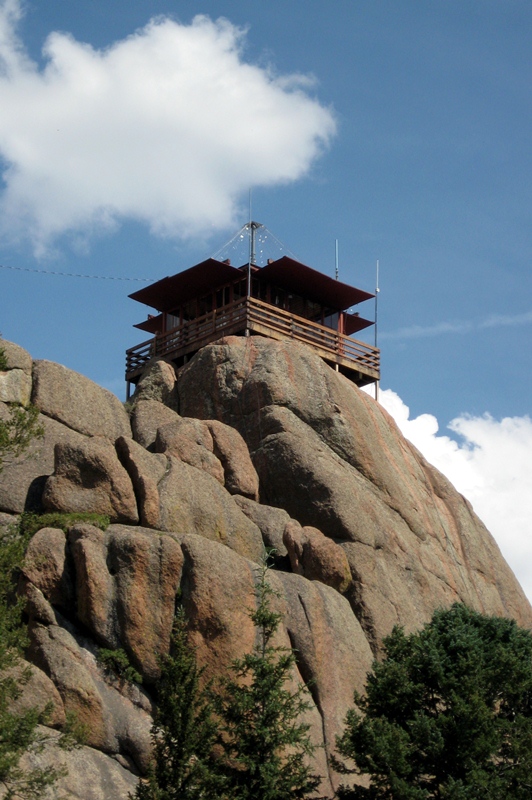
The fire lookout is not a tower. It sits on top of a large rock formation with stairs leading up the side of the rock.

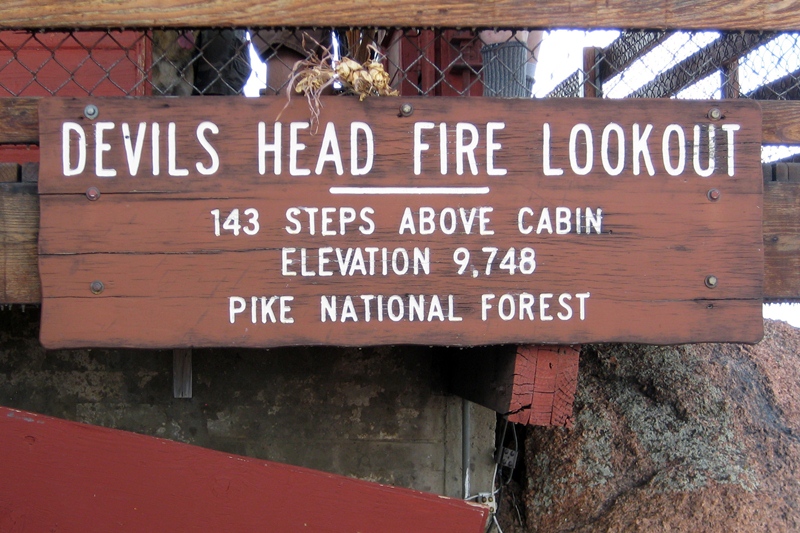
When we got to the top, we spent some time enjoying the view and catching our breath. As the sign says, the stairs have 143 steps which take you to an elevation of 9748 feet.

I got out the radio and started calling CQ on 146.52 MHz. Ted (NØNKG) came right back to me…I think he probably saw my email message. Over the next half hour, I worked a total of 7 contacts: NØNKG, N2RL, NØGWM, W7RTX, WB9QDL, KØDEN and WXØPIX. I even remembered to bring along a log book and a pen to write it all down.

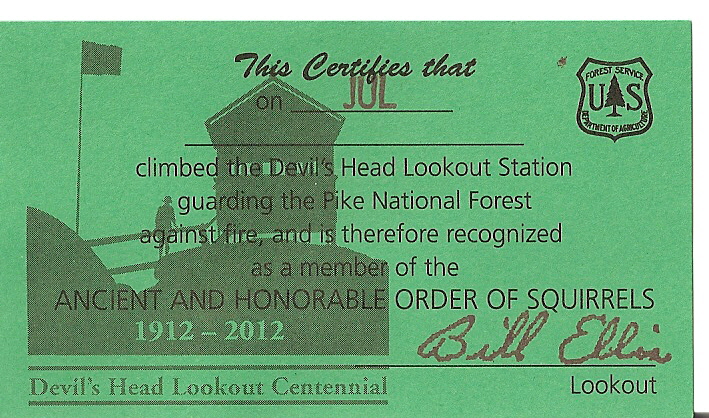
Bill Ellis staffs the fire lookout for the US Forest Service most of the time during the summer. He handed me a card that certifies that I climbed up to the lookout station. Note that this card indicates that it is the 100th anniversary of the fire lookout! And Bill’s been doing this for 26 years. Cool!

Various people have said that Devils Head is a must do hike in Colorado and I have to agree (whether you are doing a SOTA activation or not). It turns out that I was the second person to activate Devils Head as a SOTA summit, with Chuck (N6UHB) having done it in October 2011. I’ll probably do some more of this since it is a nice blend of ham radio, hiking and enjoying the view from a high spot.

   73, Bob K0NR

Waldo Canyon Wildfire in Colorado

You probably already heard about the terrible wildfire on the west side of Colorado Springs. The fire burned 18,247 acres, destroyed 346 homes and killed 2 people.

Here’s a map of how the fire progressed over time.

18,247 acres is a little more than 28 square miles of area burned. Think about a fire that consumes 28 square miles in your back yard. Pretty sobering.

Here’s a time lapse video that shows the fire from a distance.

The Denver Post has some of the best photos of the fire as it burned structures on the northwest side of Colorado Springs.

There were two major ham radio activities (that I am aware of) in response to the fire:

The RACES team (Special Communications Unit) attached to the El Paso County Sheriff’s office staffed the Emergency Operations Center in Colorado Springs. I did help out for one 12-hour shift, a relatively minor role.

Pikes Peak ARES  supported the Red Cross, who operated the emergency shelters for ~32,000 people that had to evacuate their homes. The Pueblo newspaper ran an article about this.

The real heroes are the firefighters that battled the blaze, especially on that terrible Tuesday night when so many houses were lost. Those guys and gals are awesome!

– 73, Bob K0NR

How Not to Do a SOTA Activation

This weekend my wife and I were out exploring the San Juan Mountains near Ouray, Colorado. We found ourselves on a Jeep road to Engineer Pass. When we got to the pass, we stopped to have lunch and I examined the high peaks nearby. I saw some people on the summit of one of the peaks, which I determined was Engineer Mountain by looking at a topo map.

Hmmm, I said to myself, Engineer Mountain is a valid peak (W0/SJ-011, 12968 feet elevation) for a Summits On the Air (SOTA) activation. The only portable radio I had with me was a Yaesu VX-8GR with the stock rubber duck antenna. Not a great SOTA station. But if I could whistle up 4 contacts on 2M FM simplex, I would have a legitimate activation. We had already decided to climb to the summit, so any radio activity was just icing on the cake.

So off we went up the mountain. I got to the top and started calling on 146.52 MHz FM. Now it hits me that we are in the middle of a national forest, away from population centers and, to top it off, no one is expecting a SOTA activation here today. This might be a bit of a challenge to make 4 contacts. Then Thomas, KRØNK, answered my CQ. OK, there’s one contact. A little bit later Dave, AKØMR, comes on frequency and gives me a second contact. Both of these guys were in Grand Junction, CO, which is about 100 miles from Engineer Mountain. Not bad for a peanut-whistle HT using a standard rubber duck antenna.

I needed two more contacts. I tuned around for a repeater in the area and came across the 147.27 MHz machine which turned out to be a stones throw away from my location. It requires a CTCSS tone, so I fumbled around until I figured that out. No, I did not have a repeater directory with me…that was safely stored in the Jeep at the bottom of the mountain. I gave a quick call with my location and Ben WB5ITS came back to me. We QSY’d over to 146.52 to make my third contact.  Anticipating a rough go of it, I asked my wife Joyce K0JJW to descend off the peak while I remained at the top, so she could be my fourth contact. (SOTA rules do not allow contacts between parties on the same peak.)

Somewhere along the way, I reach for a piece of paper to log the contacts, only to find that I did not have a writing utensil with me. Duh. I would have to remember the times and callsigns of the contacts and write them down later.

I completed the fourth contact and headed down. Later that evening I checked the ListsofJohn database and found that there are actually two peaks in the area called Engineer Mountain. Go figure. The SOTA database only recognizes one of them…of course, you guessed it, not the one I was on. It turns out that the Engineer Mountain I was on is subordinated by an adjacent peak: Darley Mountain (W0/RG-034, 13260 feet). However, since I operated from 13,218 feet on my Engineer Mountain, it is within the 75 foot vertical activation zone for Darley Mountain. So, this does count for a SOTA activation of Darley Mountain.

This is where I could claim that incredible skill, flexibility and a little luck ruled the day. I think a more appropriate analysis is to concede that a complete lack of planning and preparedness produced a marginal result.

What can we learn from this?

  • Do your homework concerning the SOTA peak that you intend to activate before you start the climb. Make sure you know where it is and that you are really on it.
  • Always keep a notepad and pen/ pencil in your backpack
  • Even for casual hikes, take along a decent antenna for the HT. A half-wave vertical is way better than a stock rubber duck.
  • Plan in advance so you can post your intended SOTA activation on sotawatch.org
  • Have a repeater directory (or equivalent) available to identify repeaters in the area.
  • And don’t forgot the normal hiking Ten Essentials

Beyond doing a SOTA activation, some of these items could be important if an emergency should occur. It runs out there was no mobile phone coverage in the area. I used to be pretty vigilant about taking an HT with spare batteries and extended antenna along on hikes but have gotten sloppy lately. See Rescue on Uncompahgre Peak, which describes an incident years ago when my radio turned out to be very useful during an emergency.

In the end, I did complete my first SOTA activation, so I can be happy about that. And it gave me the opportunity to relearn a few things about planning and being prepared.

73, Bob KØNR

P.S. The WØ SOTA guys recently created a great W0 SOTA page.

2 Oct 2013 Update:

Upon further review of the SOTA rules, this was not a valid activation of Darley Mountain. SOTA General Rule 3.7.1 includes this:

The Operating Position must be within the permitted Vertical Distance of the Summit, as defined in Rule 3.5. The terrain between the operating position and the actual Summit must not fall below the permitted Vertical Distance.

There is a significant saddle between Engineer Mountain and Darley Mountain that falls below the 75 foot vertical distance used in Colorado. I have deleted the activation from the SOTA database.

Which provides us with another lesson learned: Read and understand the SOTA rules.

Technician License Class – April 2012

Monument, Colorado
Saturday April 21 and Saturday April 28 (8 AM to 5 PM) 2012

Location: Tri-Lakes Monument Fire Station 1
Sponsored by the Tri-Lakes Monument Fire Radio Association

 The Technician license is your gateway to the world-wide excitement of Amateur Radio…

  • Earn your ham radio Technician class radio privileges
  • Pass your FCC amateur radio license exam right in class on the second day
  • Multiple-choice exam, No Morse Code Required
  • Live equipment demonstrations
  • Learn to operate on the ham bands, 10 Meters and higher
  • Learn to use the many VHF/UHF FM repeaters in Colorado
  • Find out how to participate in emergency communications

There is no cost for the class (donations accepted)
However, students must have the required study guide:
Gordon West Technician Class guide, 7th Edition $20.95
And pay the FCC Exam Fee: $15.00

Advance registration is required (no later than April 15th, earlier is better!)

To register for the class, contact: Bob Witte KØNR
Email: bob@k0nr.com  or Phone: 719 659-3727

For more information on amateur (ham) radio visit www.arrl.org or www.wedothat-radio.org

More Summits On The Air (SOTA) Info

I recently wrote about the Summits On The Air (SOTA) program gaining traction here in Colorado. Catching up on some of my podcast listening, I came across Jerry KD0BIK’s Practical Amateur Radio Podcast (PARP) on the topic of SOTA. It turns out that Jerry has gotten hooked on the SOTA program and has been out activating some of the Colorado peaks in December.

Operating a ham radio on top of a mountain during winter may seem like the act of a person with only one oar in the water (or shall we say one half of a dipole in the air?). But actually, we’ve had quite a few days of favorable weather that have been begging us to get outdoors in December. Still, I am on guard for an activation by Jerry in the middle of a blizzard, as he seems a bit smitten by this SOTA thing.

Episode 49 of PARP introduces the SOTA concept near the end of the episode, which is followed by a deeper SOTA discussion in Episode 50. These two episodes run about 25 minutes each, so take some time out to give them a listen.

73, Bob K0NR

Summits On the Air Taking Off in Colorado

The Summits On The Air (SOTA) program was launched in Europe in 2002 but is just now making its way to the United States. Recently, there has been a surge of activity in Colorado as the program gains traction here.

The basic concept of SOTA is an award program that rewards the radio operators that activate summits and the radio operators that chase summits. For those of us that enjoy the mountains and enjoy ham radio, this is a great fit. I won’t go into all of the rules here (Warning: There Are Lots of Them), so check out the SOTA web site for the complete details.

Steve WG0AT (World Famous Alpha Goat) just published another one of his Rooster and Peanut videos that capture his recent activation of Mount Herman. I managed to work Steve on 2 Meters and I make a cameo appearance in his video below as I make my first official SOTA contact.

Steve has been activating SOTA summits for a while now and others are joining in. Here’s a video from Pikes Peak with Mike, KD9KC and Ron,WT5RZ on North American Summits On the Air weekend.

Recently, Jerry KD0BIK succumbed to the SOTA addiction, activating Mount Herman and  Green Mountain (click on the mountain names to see his blog postings). Chris NW5W has also been active…check out his web site here.

There are numerous SOTA videos on youtube from all over the world.

The SOTAWatch web site is dedicated to posting future SOTA operating plans (Alerts) and SOTA activations in progress (Spots). The North American SOTA Yahoo! Group is another great source of information.

See you on a summit soon.

73, Bob K0NR

Results: 2011 Colorado FM Sprint

The logs have been sent in, the scores tabulated and awards issued for the 2nd running of the Colorado FM Sprint. See my previous post, announcing the contest. The competition was tough significant weak not too bad rather slim and the following awards have been issued:

Call sign Category Place
KDØLLG Single Operator 1st Place
KØJJW Single Operator 2nd Place
KØNR Rover 1st Place

Come on out and play next year!

73, Bob K0NR

Tech License Class – Final Call

We have a few seats open for the Technician License Class. Pass this along to anyone interested in getting their ham radio license.   – Bob K0NR

Monument, Colorado
Saturday Oct 15 and Saturday Oct 22 (8 AM to 5 PM) 2011

Location: Tri-Lakes Monument Fire Station 1
Sponsored by the Tri-Lakes Monument Fire Radio Association

 The Technician license is your gateway to the world-wide excitement of Amateur Radio …

  • Earn your ham radio Technician class radio privileges
  • Pass your FCC amateur radio license exam right in class on the second day
  • Multiple-choice exam, No Morse Code Required
  • Live equipment demonstrations
  • Learn to operate on the ham bands, 10 Meters and higher
  • Learn to use the many VHF/UHF FM repeaters in Colorado
  • Find out how to participate in emergency communications

There is no cost for the class (donations accepted)
However, students must have the required study guide:
Gordon West Technician Class guide, 7th Edition $20.95
And pay the FCC Exam Fee: $15.00

Advance registration is required (no later than October 8th, earlier is better!)

To register for the class, contact: Bob Witte KØNR
Email: bob@k0nr.com  or Phone: 719 659-3727

For more information on amateur (ham) radio visit www.arrl.org or www.wedothat-radio.org   

2011 Fall TechFest

Announcing the 2011 Fall TechFest

Sponsored by the 285 TechConnect Club

Saturday, Nov. 5, 2011: 9:00 a.m. – 3:00 p.m.
Check in: 8:00 – 8:45 a.m.

Schedule of Workshops
(order and topic may vary)

9:00 – 9:50 Amateur Digital TV – Dr. Glenn Adams, NØGNR
10:00 – 10:50 DX-pedition : Zimbabwe – Roger Krautkremer, KØYY
11:00 – 11:50 VHF Contesting – Bob Witte, KØNR
12:00 – 12:50 Lunch (on your own)
1:00 – 1:50 SDRs as Panadapters – Frank Ivan, KØFEI
2:00 – 2:50 Antenna Tuners – Larry Benko, WØQE

Registration
Space is limited! Please e-mail k0nnc@arrl.net to pre-register.
Cost $10.00 (cash only at the door).
Includes 2012 membership dues for 285 TechConnect Radio Club, NAØTC

Where
The Inter Canyon Fire Department Station #1.
The address is 7939 South Turkey Creek Road, Morrison, Colorado
For complete info, download the TechFest flyer from the NA0TC web site.

73, Bob K0NR

Great Time with the Colorado QSO Party

I had a great time working the Colorado QSO Party ham radio contest on Saturday.  This is your typical state QSO party where the rules favor working Colorado stations with an emphasis on activating Colorado counties.

I operated from our cabin located in the somewhat rare Park County, using my new FT-950. I am still getting used to the radio as it has more buttons and knobs than any other rig I have owned. I can tell that I am learning the radio as I was able to take more advantage of the contesting features.

Recently, I picked up a Heil Pro Set headset with the HC-4 mic element. I noticed that the serious contesters gravitate towards using a headset, logging computer and foot switch. This sets you up for a very focused operating setup with your hands on the keyboard and your foot pushing the transmit button. I was very pleased with how this worked out. I used N1MM software for logging and the antenna was a trap dipole in the trees.

I operated exclusively on phone as I don’t consider my CW skills up to the task of an HF contest. Maybe someday I’ll give that a try. Most of the time was spent on 20 Meters which produced contacts across North America. 40M was great for working stations around Colorado and picking up different counties.

Here’s my score:

 Band    QSOs    Pts  Sec   Mul
      7   81     162   30    1
     14  197     388   34    0
     21    8      26    2    0
    144    2       4    1    0
    420    2       4    1    0
  Total  290     584   68    1
Score: 40,296


Thanks to the Pikes Peak Radio Amateur Association for sponsoring this event.

73, Bob K0NR

Announcing: Colorado FM Sprint

The Colorado FM Sprint

Sponsored by:  The Colorado VHF Group (KØYB) and the Tri-Lakes Monument Fire Radio Association (WØTLM)
Direct any questions to k0yb@qsl.net

Rules and FAQ are posted on the KØYB web site.

Saturday – September 10, 2011

This contest is held concurrently with the ARRL September VHF QSO Party, with compatible rules and operating procedures. The purpose of this contest is to:

  • Promote the use of FM VHF/UHF simplex
  • Provide an opportunity for radio amateurs to test the limits of their stations using FM VHF/UHF and to experiment with ways to improve their stations
  • Practice deploying portable and mobile operation as a means of identifying effective locations for temporary relay stations
  • Provide a simple and enjoyable radio contest experience (“Have fun!”)

Time:

 Saturday, Sept 10, 2011; 1200 to 1700 Mountain Time (1800 to 2300 UTC)

Objective:

To work as many stations as possible using FM simplex on the 146 MHz, 222 MHz and 440 MHz bands in as many different VHF grids as possible.

Frequencies:

Operate on FM simplex frequencies consistent with the Colorado Council of Amateur Radio Clubs (CCARC) band plans

(Consistent with the ARRL Rules, 146.52 MHz is not allowed to be used in the contest.)

Suggested Frequencies:

2 Meters: 146.58, 146.55

222 MHz: 223.5 MHz

440 MHz: 446.0, 446.100 MHz

Do not operate on repeater frequencies or 146.52 MHz, the National Simplex Calling Frequency.

Remember to be a considerate operator and share the frequency with other operators.

Contest Exchange

To complete a contest QSO, you and the other station must copy each other’s callsign and 4-digit Grid Locator. You may optionally exchange Name and geographic location (city, landmark, etc).

Entry Categories:

The following entry categories are available for this contest, consistent with the entry categories for the ARRL September VHF QSO Party. All categories (excluding Single Operator Portable) operate within these power limits: (146 MHz–200 W PEP, 222 MHz 100 W PEP, 440 MHz 100 W PEP).

Single Operator – same as Single Operator Low Power in the ARRL rules

Single Operator Portable – power limit of 10 W PEP, operating from a fixed location using a portable power source, portable equipment and antennas

Rover – operates from 2 or more grid squares with 1 or 2 operators, same definition as Limited Rover in the ARRL rules. Rovers must sign “Rover” after their callsign.

Multioperator – operates with more than with operator from a fixed location

Scoring                     

QSO Points: Count one point for each 146 MHz QSO and two points for each 222 MHz and 440 MHz QSO.

Multiplier: The total number of different grid squares worked per band. Each grid counts as one multiplier on each band it is worked.

Final score: Multiply the total number of QSO points from all bands operated by the total number of multipliers for final score. 

Rovers only: The final score consists of the total number of QSO points from all bands times the sum of unique multipliers (grid squares) worked per band (regardless of which grid square they were made in) plus one additional multiplier for every grid square from which they successfully completed a contact.                         

Miscellaneous:

1.  Use only one call sign per entry per station, except family members who share a station.

2.  A rover station may use only one call sign.

3.  Soliciting contacts during the contest on repeaters, e-mail, telephone, etc. is not allowed.

4.  Final interpretation of these rules is the sole responsibility of the contest committee.

Awards:

Certificates will be issued to top scoring entrants in each category. Other certificates may be issued depending on the level of competition present in the contest. Results will be listed on the KØYB web site at http://www.qsl.net/k0yb

Log Entry:

1.  Log entries must be received by September 30, 2011.

2.  A log entry contains the following for each contact completed:  Date; Time (Universal Coordinated Time); Station Worked; Grid Locator

3.  A summary contains:  Your name, call, and address; entry category; grid locator; score calculation; and this statement:  “I have observed all rules of the contest and have operated my station in accordance with FCC rules.”

4.  Entrants are strongly encouraged to submit an electronic log in Cabrillo format, using commonly available logging programs (configured for ARRL September VHF QSO Party). Send electronic logs to k0yb@qsl.net, with Cabrillo file attached and subject line containing your call sign and the words “FM Sprint”.

5.  Paper logs may be sent to:  K0YB – Contest Logs, 21060 Capella Drive, Monument, CO 80132

Grid Locator Information:

Grids are 2° longitude x 1° latitude squares designated with 2-letters and 2-numbers, such as DM78. To determine which grid you are operating from, refer to this web page: http://www.k0nr.com/rwitte/vhf_grids.html or use a GPS receiver that displays the location in Maidenhead (vhf grid) format.

Here are some general guidelines that may help in case you work someone who does not know their grid square:

  • Greater Denver is in grid DM79
  • Boulder is split between grids DM79 and DN70, so check the location carefully.
  • Colorado Springs and Pueblo are in grid DM78
  • Fort Collins, Loveland and Longmont are in grid DN70.


Radio Fun on Mt Antero

My favorite radio partner (and wife), Joyce K0JJW, and I climbed up Mt Antero for the Colorado 14er Event.  See my post announcing the event here.

We got up at O’Dark thirty on the morning of the event and drove the Jeep Wrangler up the 4WD road to Mt Antero. This road got us to within 1000 vertical feet and maybe a mile from the summit, making the climb a lot easier. But it still was climbing over rocks at 14,000 feet (read: no oxygen to breathe).  The weather was outstanding…blue sky all around and none of those nasty thunderclouds anywhere in sight. (It turns out that lightning on an exposed mountaintop is not a good thing.)

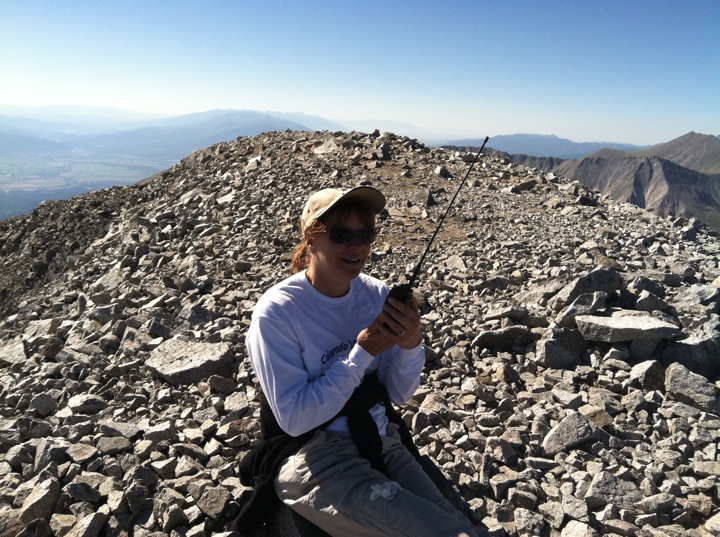
Here’s Joyce operating with a handheld transceiver.

 And here’s the view looking out to the west from the summit: 

We worked quite a few 14er stations, including the KBØSA crew on Pikes Peak and the Goathiker WGØAT on Handies Peak. All QSOs were made on 144 Mhz and 440 MHz FM using handheld transceivers. We were on the summit for almost 3 hours and then descended back down.

   73, Bob K0NR

Colorado 14er Event – Sunday!

I am getting ready for the Colorado 14er Event tomorrow morning. Here’s the brief description from the www.14er.org web site:

Amateur Radio Fun in the Colorado Mountains
Sunday, August 7, 2011

Amateur Radio operators from around Colorado will be climbing many of Colorado’s 14,000-foot mountains to set up amateur radio stations in an effort to communicate with other radio amateurs across the state and around the world. Join in on the fun on the Sunday of the first full weekend in August and see how many of the mountaintop stations you can contact. The prime operating hours are from approximately 9 AM to noon local time (1500 to 1800 UTC), but activity may occur at other times during the day. Most mountaintop stations will be running low power handheld radios. Stations running high power need to keep in mind that they can interfere with stations they cannot hear.

Radio operators with 14er climbing experience who plan to climb a 14er should log their name and intended peak at the HAM 14er Yahoo group.

Joyce K0JJW and I will be heading up Mount Antero, taking the Jeep as far as we can and then hiking the rest of the way. It should be fun!

There will be a crew of Boy Scouts on Pikes Peak, using club call sign KB0SA, so look for them.

You don’t have to be on a mountaintop to play in this event. Here are a few options:

  • See who you can work from home on 2 Meter FM and 70 cm Meter FM. The frequencies are listed on 14er.org.
  • Operate from a high spot that is line of site to the 14er summits. For example, Wilkerson Pass (west of Colorado Springs on Highway 24) is a great spot. Harder to get to but even better would be Mosquito Pass or Weston Pass. Trail Ridge Road in Rocky Mountain National Park is another great drive-to location.
  • Work the 14ers on HF. Many of the 14er stations will be up and running on HF and there is usually a pileup of stations wanting to work them. The Goat Hiker crew WG0AT will be out in full force  on Handies Peak, likely using N0B special event call sign.

See you on the air!

73, Bob K0NR

2011 Colorado 14er Event – August 7th

The Colorado 14er Event will be held on August 7 this year. This is the premier mountaintopping event for amateur radio. The basic idea is to have fun making ham radio contacts from the 14,000 foot peaks in Colorado.

Actually, we’ve started to see some of the 14,000 ft peaks in California on the air, too! Very cool. Rumor has it that some of the New Mexico hams might be active on the highest summits in that state (none are above 14,000 feet though). I don’t know whether the Kansas folks are going to brave the extreme conditions on Mount Sunflower this year or not. (That’s the highest spot in Kansas at 4039 feet, which makes it a “4er”.)

Some of these stations will be on HF, activating Summits On The Air (SOTA) peaks.

You don’t have to operate from a 14er to enjoy this event. Just get on the air and see who you can work. Being on a high spot always helps, of course!

For more information see:

The 14er Event Web Site

The Ham14er Yahoo group

I hope to work you during the event.

73, Bob K0NR

Want to Try Working the June VHF Contest?

Here’s a reminder that the ARRL June VHF QSO Party (AKA The June Contest) is coming up next weekend. This is a great opportunity to have fun operating the VHF and higher bands.

Here’s some info I sent out to our local club (sorry, it is a little specific to our area but you may find it useful anyway).

The ARRL June VHF QSO Party is next weekend (June 11, 12), which is The Big One in terms of VHF events. This is the best opportunity to try out VHF contesting!

Here are some practical thoughts on how you might start:

When Should I get on the Air?
The contest runs from 1800 UTC Saturday to 0259 Monday, which translates to 1200 Noon Mountain time on Saturday to 9 PM Sunday. (By the way, you should keep your log in UTC. You can always find the correct UTC time by going here: http://time.gov/timezone.cgi?UTC/s/0/java )
You can operate any time during the contest but I’d suggest focusing on noon to 6 pm Mountain time on Saturday.

What if I only have FM equipment?
Many of our new Technician licensees only have a dualband FM radio, often an HT. This will limit your activity in the contest but it doesn’t count you out. My suggestion is to get on the air on Saturday afternoon and try to contact as many stations as you can on 147.555 MHz and 446.000 simplex (Stu W0STU suggested 446.100 MHz which is also fine.) Stu W0STU and Steve WG0AT will be doing a portable operation from the top of Mt Herman on Saturday afternoon and they will be active on FM. I am sure they will appreciate a contact and a bunch of the Scouts are likely to be on the air. Don’t just work Stu and Steve….talk to everyone that you can.
I will be up in the mountains west of South Park and will also be listening on FM. I will be more difficult to reach but not impossible. Take that as a challenge! (Hint: it helps if you have a yagi antenna pointed West.)

Where Should I Go?
For starters, you don’t have to go anywhere, you can operate from home. But Height Above Average Terrain matters, so you might consider finding a “high spot” to operate from. Obviously, Stu and Steve are thinking Mt Herman is an excellent spot (which it is). There are other peaks along the Rampart Range (Raspberry Mt, Sundance Mt, etc.) that are just as good. The highest spot that is easy to get to is Pikes Peak (duh) and there is a road to the top! And Mount Evans is another option, west of Denver. If you are going to be out running around doing errands on Saturday, you can operate mobile from the car. In fact, you might want to be a “rover” and make contacts from multiple grids.

What about 6 Meters?
Six meters is usually the most fun band in the June contest. Normally, things are pretty quiet on 50 MHz and you work just the locals. But then the band opens with sporadic-e propagation and you’re working Florida, Texas, Wisconsin, Washington, California, Canada….almost anywhere in North America. For this, you’ll really want a SSB radio that can operate on 50.125 MHz USB (calling frequency) and move up from there as the band gets busy. Even a modest antenna, like a simple dipole, can work on 6 Meters. So don’t think you need something fancy to get started. There may be FM activity as well, which would be on 52.525 MHz.

Set a Goal
The basic idea is to see how many stations you can work on each band. You can also set a goal such as trying to get the Worked Colorado Award  ( http://rmvhf.org/Certs/Award.html ) which is achieved by working 6 different grids on any VHF/UHF band.

What Else Do I need to Do?
Read the rules, which are available here: http://www.arrl.org/june-vhf-qso-party
Make sure you know your grid. The Monument area and all of metro Denver is in DM79. Colorado Springs and Pueblo are DM78. The dividing line runs east/west roughly at Black Forest and the USAFA stadium.

Here’s some more VHF information on my web site:

How To Work A VHF Contest

Getting Started on 2-Meter SSB

So You Want to Be a Rover

And don’t forget to have fun!!!!

73, Bob K0NR


Six Excellent Summertime Radio Activities

Next weekend is Memorial Day in the US, which means it is time to get serious about summer activities.  Here’s what I am plugging into my calendar. You will note a clear emphasis on activities here in Colorado but most of these events are nationwide:

ARRL June VHF QSO Party (June 11-12) This is the best VHF/UHF/Microwave contest of the year, because we almost always have some nice openings on 50 MHz. I think of this as “VHF activity weekend” that happens to be a contest. My favorite amateur radio event of the year.

ARRL Field Day (June 25-26) This is arguably the most popular ham radio event in North America. The great thing about FD is that you can make it whatever you want it to be: make it a contest, use it for public relations, just go camping, etc.

CQ Worldwide VHF Contest (July 16-17) This is the only Real VHF Contest, since it is limited to the 6 Meter and 2 Meter bands. (The ARRL contests include the UHF and higher bands and the scoring emphasizes these bands.) We usually get some 6 Meter openings on this weekend, as well, making it a lot of fun.

Colorado 14er Event (August 7) The Premier Mountaintop Ham Radio Event, with a Colorado emphasis. The concept is simple: activate the 14,000 foot mountains and have fun working everyone you can.

Colorado QSO Party (Sept 3-4) A state QSO party focused on working stations in Colorado. There will be lots of mobile and portable operators out to activate Colorado counties. Contacts are valid on HF, VHF and higher.

Colorado FM Sprint (Sept 10) This FM-only contest runs concurrently with the ARRL September VHF QSO Party. The FM Sprint runs for 5 hours on Saturday afternoon, so it is another great opportunity for some mountaintop operating. The Sprint rules are compatible with the ARRL contest, so you can always work both of them!

I hope to work you during these events.

– 73, Bob K0NR

VHF Distance From Pikes Peak?

I recently received this question via email from Dave N0MUA:

Bob, I ran across your pictures mountain topping on Colorado peaks, thought if anyone could answer this it would be you and your group.  We run on 146.52 here in Coffeyville KS.  and a group of us have brought up the question how far east can a mobile atop Pikes Peak be heard on 146.52 FM? The mobile would be mine running a Icom V8000 into a Tokyo HI power amp at 375 watts  LMR 400 coax to a Cushcraft 13B2 beam pointing to the east.

This is one of those how far will my signal go? questions that always gets my attention. Other folks may find this interesting, so I decided to spend some time on the topic and post it here. I am assuming we are talking about tropospheric propagation and not something more exotic such as meteor scatter or sporadic-e skip.

The (incorrect) conventional wisdom is that VHF propagation is “line of sight”, extending a bit beyond the optical horizon. From Wikipedia, we find that the distance to the optical horizon can be approximated by:

d = √(1.5 h)

where d is the distance to horizon in miles, h is the height of the observer above ground in feet

Pikes Peak reaches to 14,110 feet above sea level. The elevation of the surrounding area varies but since Dave is asking about propagation into Kansas, let’s use a typical elevation of eastern Colorado (4500 feet). This gives us an optical horizon equal to the square root of (1.5 x 9610) = 120 miles. Yes, this is an approximation, so feel free to knock yourself out with a more precise calculation.

It is interesting to note that there is a community 30 miles west of the Kansas border called Firstview, CO that is supposed to provide the first opportunity to see Pikes Peak when traveling from the east on Highway 40. Firstview is about 135 miles east of Pikes Peak, so the 120 mile calculation is in the right ballpark.

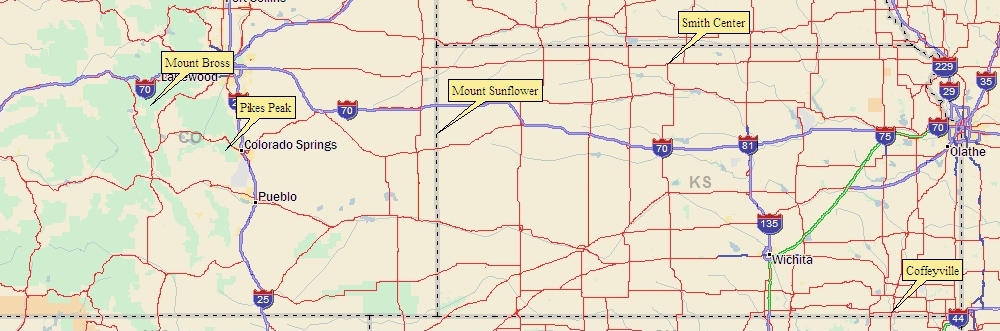
The ARRL web site says that the radio horizon is about 15% longer than the optical horizon, so that means our line-of-sight radio horizon is about 1.15 x 120 = 138 miles. I’ve operated from the summit of Pikes during the ARRL June VHF QSO Party and the Colorado 14er Event and working stations on 2 Meters at this distance is not difficult. To be more specific, I worked the Mt Sunflower crew (highest point in Kansas, 160 miles) from Pikes Peak on 2 Meter FM using a 25 Watt mobile and a not-very-well-positioned 1/4-wave antenna on the SUV fender.

I pulled up the distance records for the Colorado 14er Event and found that the best DX using 2 Meter FM is when Phil N0KE on Mount Bross worked Larry N0LL in Smith Center, KS at a distance of 375 Miles! Clearly, we are well beyond line of sight for this radio contact. N0LL has a very capable VHF station on his end and I believe N0KE was using a decent Yagi antenna and was running some power(~200W?). Still, this contact was on FM which is not that great for weak signal work. While Pikes is on the Front Range of the Rockies, Mount Bross (14, 172 feet) sits back some distance, about 60 miles west of Pikes Peak. (I have also worked N0LL from Pikes using 50W and a single 2M9 yagi on SSB with no problem during VHF contests.)

Also during the Colorado 14er Event, Phil N0KE (and Jeff N0XDW) on Mount Bross worked W7XU in Parker, SD on 2 Meter CW at a distance of 551 miles.  Keep in mind that as the signal strength fades, SSB has a serious advantage over FM and CW is even better! So for squeaking out the marginal contacts, CW is the way to go.

Dave asked about working Pikes Peak from Coffeyville, KS using 2 Meter FM. I had to look up where Coffeyville is and discovered that it is way the heck over on the east side of Kansas, maybe 50 miles from Missouri. I estimate that Coffeyville is 525 miles from Pikes Peak. To get back to Dave’s question, making a contact from Pikes to Coffeyville on 146.52 MHz FM is not likely. Maybe if we got some exceptional tropospheric propagation…but I think even then it would be unlikely to complete the contact using FM.

But you never know what might happen on VHF. That’s what makes it fun.

73, Bob K0NR