I am a bit of a test equipment junkie….it has something to do with working in the electronic measurement business for most of my career. There are many great pieces of test equipment out there but every once in a while, one comes along that really captures the imagination. Over the weekend, I got my hands on the new FieldFox RF Analyzer from Agilent Technologies. This analyzer is a combination 2-port network analyzer, cable tester and spectrum analyzer in one compact package. Add in an external sensor and it measures RF power, too. [Disclosure: I am employed by Agilent.]
With a base price of $7600, this instrument is probably out of the price range of most radio amateurs. However, the RF engineers and technicians out there in the electronics industry will appreciate its measurement capability and value.
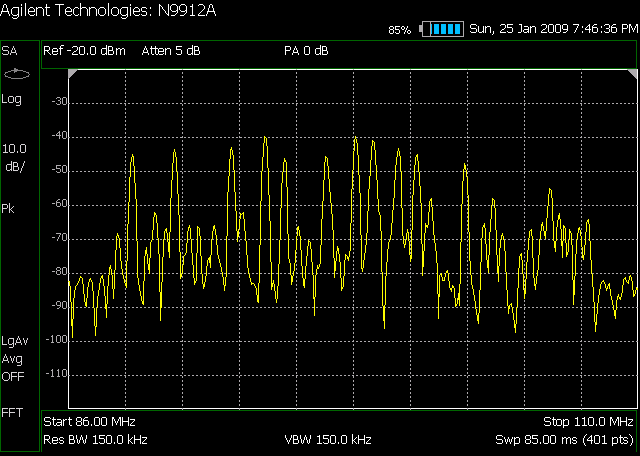
The first thing I did was connect it up to my vertical antenna used for 2 Meters and 70 centimeters. I was able to check a few things on the antenna system and monitor some signals. Funny thing, when I tuned to the 2 Meter ham band, I didn’t see any transmitters on the air <sigh>. So I switched over to the FM broadcast band and did a scan of 86 to 110 MHz. The spectral lines you see sticking up are the FM broadcast transmitters in my area.
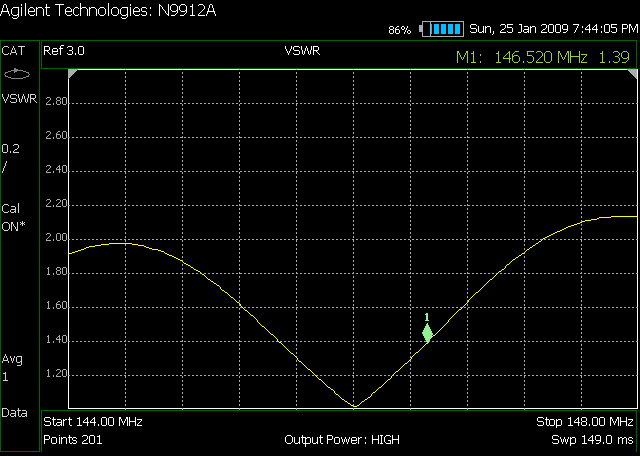
Then I checked the VSWR of the antenna system (as seen looking through the end of the cable). The sweep below shows the VSWR of the antenna system versus frequency. The center of screen is 146 MHz and the marker is set at 146.52 MHz. The VSWR doesn’t quite stay under 2.0 over the entire band.
Then I switched to the Cable Tester mode and displayed Distance to Fault (DTF). The DTF display shows the return loss of the cable as a function of the distance along the cable. (The FieldFox analyzer can correct for the propagation velocity but I did not have this feature turned on. So the distance shown is in error by that amount.)

The bump in the middle of the display is about 60 feet down the line, which corresponds to where an inline surge supressor is installed. Apparently, there is a small “impedance bump” in the line at that point. At the right hand side of the display, around 110 feet is an impedance change due to the antenna. If I had a good 50 ohm load on the end of the cable, we would not see this blip. The DTF measurement is a broadband measurement so anything that is not a good 50 ohms across all frequencyes (such as a high Q antenna) shows up as an impedance blip.
These results are not bad but I expected the impedance of the antenna system to be better than this. If I can hang onto the analyzer for a few more days, I’ll be sure to investigate the antenna system more carefully. Nothing like having the right test equipment to make useful and accurate measurements.
73, Bob K0NR