Yes, Band Plans Do Matter

There was an interesting exchange on the AMSAT-BB email list last week. Dave KB5WIA noted a strange signal on the AO-51 satellite:

I just thought I'd relay a bit of QRM I observed on AO-51 on this
morning's 3/16/2011 1322z pass. The bird was totally quiet (just a
nice carrier) for the first 5 minutes of the pass, but then it sounded
like a repeater was getting into the sat uplink:

3/16  1327z:  "Connected, KD7xxx repeater."
3/16  1328z:  "KD7xxx repeater disconnected."
3/16  1328z:  "hey Stacy did I see you at the corner there by Wendys?"
3/16  1330z:  "...repeater in Middleton, Idaho."

I obscured the KD7 call sign to protect the guilty innocent. A little searching on the internet by some of the AMSAT folks revealed that there was an EchoLink station that matched the KD7 call sign.

Patrick WD9EWK/VA7EWK wrote (again, I obscured the call signs):

And there is an Echolink system (KD7xxx-R).

What may be more interesting, after some Google searches,
is a series of references I saw where the KC0xxx-L system
had been linked to the KD7xxx-R system.
On http://www.echolink.org/logins.jsp now (1839 UTC), I saw
this for KC0xxx-L:

KC0xxx-L        Clay Cntr,KS 145.920 (1)        ON      01:27   367513

In the station description, it shows 145.920 along with the QTH
in Kansas.  This may be the system that's causing the QRM on
AO-51, and the other system is just linked to KC0xxx-L at that
time.

So it turns out that the KD7 call sign heard was linked to the KC0 EchoLink station which was operating on the uplink frequency of AO-51. George, KA3HSW, sent the KC0 operator an email and reported back that the KC0 station “has graciously changed frequencies.”

What can we learn from this?

  • Check the VHF band plans for your area before getting on the air. Be extra careful when setting up stations such as EchoLink or similar system that transmits frequently.
  • Be aware that there are amateur radio modes that you can interfere with even though you don’t hear anything on frequency. In the case of the AO-51 interference, the satellite hears the uplink frequency over a wide geography but never transmits on that frequency. The downlink is on the 70 cm band.
  • Note that the first call sign associated with the interference (KD7xxx) was not at fault. It would have been easy to jump on his case and chew him out for transmitting on the satellite uplink frequency. Showing good judgment, the satellite guys investigated further.
  • The issue was resolved by a polite (I assume) email to the offending radio amateur and he agreed to change the frequency of the EchoLink station. Nicely done.

So check the band plan for your area and follow it. And proceed with caution when interference does occur. It was a rookie error to put an EchoLink station in the satellite sub band and it was quickly resolved.

For more information on 2 Meter band usage, see this Choose your 2 Meter Frequency Wisely.

– 73, Bob K0NR

Reading the Fine Print in Part 97

The ARRL just filed a Petition for Rule Making with the FCC concerning a specific modulation format called TDMA (Time Division Multiple Access). This issue has been simmering in the community of repeater operators but I suspect that most hams have no idea what this is about. It so happens that the land mobile industry (most notably, Motorola) has developed a very efficient and cost-effective digital standard called DMR (Digital Mobile Radio). Motorola markets this technology under the name MOTOTRBO.

As often happens, some radio amateurs deployed this new Part 90 radio technology on the ham bands. Along the way, people started looking carefully at the emission designator that Motorola was using for MOTOTRBO and began to question whether it was allowed under Part 97. I won’t go into the gory details as it makes my head hurt :-). My brief look at this concluded that there is definitely an issue here but I am not completely convinced that DMR is illegal under Part 97. If you want to dig into this, read the petition in detail with a copy of Part 97 and a few aspirin in hand.

The ARRL probably did the right thing by requesting a very focused rule change which should remove any ambiguity from Part 97. (I know this will disappoint the arm-chair lawyers who make a so-called life out of debating these issues to death.) The ARRL also asked for an immediate temporary waiver from the FCC to allow for DMR operation while the rule making proceeds…another good move.

It is unfortunate that the FCC amateur rules were written in a way that (potentially) disallowed the use of the latest land mobile radio system. This is exactly what we don’t want to have happen in the Amateur Radio Service, as it should be a place for easy adoption of new technology. Future FCC rule making should keep this in mind, always erring on the side of flexibility.

– 73, Bob K0NR

Update on 25 Mar 2011:

The ARRL reports that the FCC is seeking comments on this petition, now designated RM-11625. Comments can be filed electronically here.

How Not to Elmer

Just this past week, I read the following exchange on one of the many ham radio email lists I subscribe to:

Greetings Group,
I have a rat shack universal DC adapter for my charger. It is rated at 12 volt 500 mA. On the bottom of the [radio brand] charger it specifies 450 mA. My question here, is will it be ok to use the RS adapter without causing damage to the [radio brand] charger cradle?

One person replied with this:

500 ma is the maximum the dc adapter will put out. 450 is the minimum that the charger wants to have available. 450<500.  with 10% to spare.

Not to pick on you, [name], but is there any requirement these days to have a basic knowledge of electricity and/or radios to get a ham license?

The good news is that the second ham provided a helpful answer. The bad news is that he felt it necessary to slam the questioner due to his limited knowledge. (Actually, I didn’t think the question was that naive.) Fortunately, a large number of subscribers jumped in and assisted the questioner and chastised the grumpus.

The truth is that it doesn’t take that much effort and knowledge to get a ham radio Technician license. I think of it as a beginner’s permit. The license exam attempts to enforce a basic set of knowledge required to get on the air. After that, it is up to us to Elmer these newbies as they learn more. When someone asks a question, no matter how basic, that is a good thing — an opportunity for learning.

After all, I really like new ham radio operators —- I used to be one!

73, Bob K0NR

IWCE 2011

This week I attended the International Wireless Communications Expo, a wireless radio conference centered on land mobile radio (LMR). While not an amateur radio event, it was three fun days totally immersed in radio technology. Being a professional show, not a hobby event, the emphasis was on modern and emerging technology in the industry. No boat anchor radios here.

Amateur radio often adopts and adapts technology from the LMR industry, especially for mobile operating on frequencies above 50 MHz. I guess we could call VHF FM amateur land mobile.

A few highlights from the show:

  • A large portion of LMR is Public Safety Radio: fire, police, ambulance, so emergency communications was inherent in many of the conference sessions.
  • There was quite a bit of analog FM equipment on display but LMR is clearly shifting to digital, with formats like APCO Project 25 leading the way. The FCC requirement to go narrowband by January 1, 2013.
  • Several vendors are familiar names in the amateur radio industry:  Kenwood, Vertex (Yaesu), ICOM and Alinco. Of course, Motorola had a major presence at the show.  I noticed that ICOM had a stack of amateur D-STAR equipment on display.
  • Historically, LMR radios covered only one band (VHF low, VHF high, UHF, 800 MHz), which matched the tendency for each organization to deploy channels in only one band. With an emphasis on interoperability, more organizations are finding the need to operate on multiple bands and the manufacturers are responding with multiband radios (see Motorola APX™ 7000, for example).
  • A number of radio manufacturers from China were present, generally with lower cost radios (Hytera, Kirisun).
  • The FCC recently announced that the frequency range known as Block D (two sections: 758–763 MHz and 788–793 MHz), dedicated to public safety broadband use, will use the LTE air interface standard. LTE is the dominate 4G mobile phone standard, just starting to be deployed. The conference had many sessions on the challenges of getting funding and actually making this work.
  • Since Block D will use LTE, it opens up the potential for public safety networks that also use commercial networks (e.g., Verizon) for extended coverage. These hybrid systems provide for tight control over the primary network while leveraging the infrastructure investments from commercial providers.
  • Quite a few sessions on the integration of IP-based networks into radio systems. The general trend is that the local “air interface” may be a specific radio technology (P25, LTE, …) but the network is always IP-based.

I was struck by the forward march of technology in the LMR industry. In the ham radio world, we often see strong opposition to adopting anything new. And we’re supposed to be the experimenters!

– 73, Bob K0NR

Last Launch of Shuttle Discovery

STS-133 launched from the Kennedy Space Center on Feb24th. This is the 35th shuttle mission to the International Space Station and the last <sob> flight for Discovery.

A few people were fortunate enough to see the launch from a passing commercial airliner. How lucky is that!

– 73, Bob K0NR

This Spewed Out of the Internet #18

Lots of stuff spewing forth that needs to be reported.

ARISSat-1 was supposed to be launched from the International Space Station this week, but it has been postponed. I have this vision of one of the astronauts rolling down the window on the station and chucking the satellite overboard. It probably doesn’t really work like that. 🙂

Astronaut Doug Wheelock KF5BOC will attend the Dayton Hamvention. as the guest of ARRL and AMSAT. Wheelock made a great video that highlighted his amateur radio activity on the ISS.

The ARRL reports that there is a Spectrum Management Bill being developed in the House Energy and Commerce Committee. H.R. 607 would reallocate existing amateur radio spectrum of 420-440 MHz  for other uses. It seems silly for Congress to put a specific frequency range into a bill as they are in no position to understand the impact.

One of our local Scouts, Jake W0JAK, is the star of a YouTube video on how to solder.

I just re-discovered the excellent ham radio videos by Randy K7AGE. These are great tutorials on various topics, so check them out here:  http://www.youtube.com/user/K7AGE

When I wasn’t looking Amateur Radio Newsline disappeared from my podcast feed. Apparently, they had to change servers to solve a technical problem. If you are missing ARN, go resubscribe using iTunes or other podcast software.

73, Bob K0NR

How Many Online Logbooks Do We Need?

I recently commented on the ARRL Log Book of the World when they turned on support for the VUCC Award. This was a long time in coming and is a great addition to the program.

About a week later, I was poking around my qrz.com page and found that there are 32 QSOs sitting there waiting for me to confirm them. What? QSOs on qrz.com? It seems that they have added a “logbook” feature which supports keeping a log of radio contacts and verifying these contacts with other radio amateurs. I participated in the ARRL January VHF Sweepstakes and some of the contest participants uploaded their log to qrz.com, which caused these QSOs to show up in my logbook.

So now there are at least 3 online amateur logbooks available: eQSL, LoTW and qrz.com. So far, I have only paid attention to LoTW, uploading all of my contacts made since 2002. I have ignored eQSL since these contacts do not count towards ARRL awards. Yes, that does mean I am old school and think that DXCC, VUCC and WAS from the ARRL are the real deal and anything else is an imitation. CQ Amateur Radio is accepting eQSL confirmations and has a decent awards program, but I haven’t focused on any of those yet.

You can see what is going to happen…the amateur population will split across these different logbooks and it will be difficult to transfer “credit” between them. You’ll have a mishmash of confirmed QSOs that include the good old paper variety and several different electronic logbooks.

I am not sure what to do about this but I’ll probably just focus on LoTW. What do you think?

73, Bob K0NR

VHF Distance From Pikes Peak?

I recently received this question via email from Dave N0MUA:

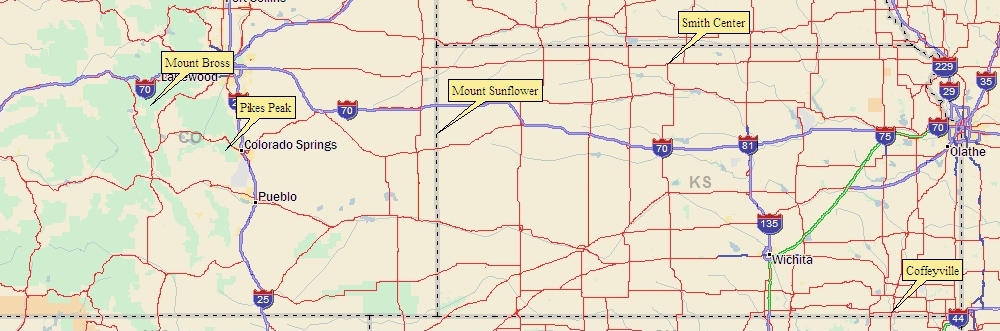
Bob, I ran across your pictures mountain topping on Colorado peaks, thought if anyone could answer this it would be you and your group.  We run on 146.52 here in Coffeyville KS.  and a group of us have brought up the question how far east can a mobile atop Pikes Peak be heard on 146.52 FM? The mobile would be mine running a Icom V8000 into a Tokyo HI power amp at 375 watts  LMR 400 coax to a Cushcraft 13B2 beam pointing to the east.

This is one of those how far will my signal go? questions that always gets my attention. Other folks may find this interesting, so I decided to spend some time on the topic and post it here. I am assuming we are talking about tropospheric propagation and not something more exotic such as meteor scatter or sporadic-e skip.

The (incorrect) conventional wisdom is that VHF propagation is “line of sight”, extending a bit beyond the optical horizon. From Wikipedia, we find that the distance to the optical horizon can be approximated by:

d = √(1.5 h)

where d is the distance to horizon in miles, h is the height of the observer above ground in feet

Pikes Peak reaches to 14,110 feet above sea level. The elevation of the surrounding area varies but since Dave is asking about propagation into Kansas, let’s use a typical elevation of eastern Colorado (4500 feet). This gives us an optical horizon equal to the square root of (1.5 x 9610) = 120 miles. Yes, this is an approximation, so feel free to knock yourself out with a more precise calculation.

It is interesting to note that there is a community 30 miles west of the Kansas border called Firstview, CO that is supposed to provide the first opportunity to see Pikes Peak when traveling from the east on Highway 40. Firstview is about 135 miles east of Pikes Peak, so the 120 mile calculation is in the right ballpark.

The ARRL web site says that the radio horizon is about 15% longer than the optical horizon, so that means our line-of-sight radio horizon is about 1.15 x 120 = 138 miles. I’ve operated from the summit of Pikes during the ARRL June VHF QSO Party and the Colorado 14er Event and working stations on 2 Meters at this distance is not difficult. To be more specific, I worked the Mt Sunflower crew (highest point in Kansas, 160 miles) from Pikes Peak on 2 Meter FM using a 25 Watt mobile and a not-very-well-positioned 1/4-wave antenna on the SUV fender.

I pulled up the distance records for the Colorado 14er Event and found that the best DX using 2 Meter FM is when Phil N0KE on Mount Bross worked Larry N0LL in Smith Center, KS at a distance of 375 Miles! Clearly, we are well beyond line of sight for this radio contact. N0LL has a very capable VHF station on his end and I believe N0KE was using a decent Yagi antenna and was running some power(~200W?). Still, this contact was on FM which is not that great for weak signal work. While Pikes is on the Front Range of the Rockies, Mount Bross (14, 172 feet) sits back some distance, about 60 miles west of Pikes Peak. (I have also worked N0LL from Pikes using 50W and a single 2M9 yagi on SSB with no problem during VHF contests.)

Also during the Colorado 14er Event, Phil N0KE (and Jeff N0XDW) on Mount Bross worked W7XU in Parker, SD on 2 Meter CW at a distance of 551 miles.  Keep in mind that as the signal strength fades, SSB has a serious advantage over FM and CW is even better! So for squeaking out the marginal contacts, CW is the way to go.

Dave asked about working Pikes Peak from Coffeyville, KS using 2 Meter FM. I had to look up where Coffeyville is and discovered that it is way the heck over on the east side of Kansas, maybe 50 miles from Missouri. I estimate that Coffeyville is 525 miles from Pikes Peak. To get back to Dave’s question, making a contact from Pikes to Coffeyville on 146.52 MHz FM is not likely. Maybe if we got some exceptional tropospheric propagation…but I think even then it would be unlikely to complete the contact using FM.

But you never know what might happen on VHF. That’s what makes it fun.

73, Bob K0NR

Congratulations: 285 TechConnect Radio Club

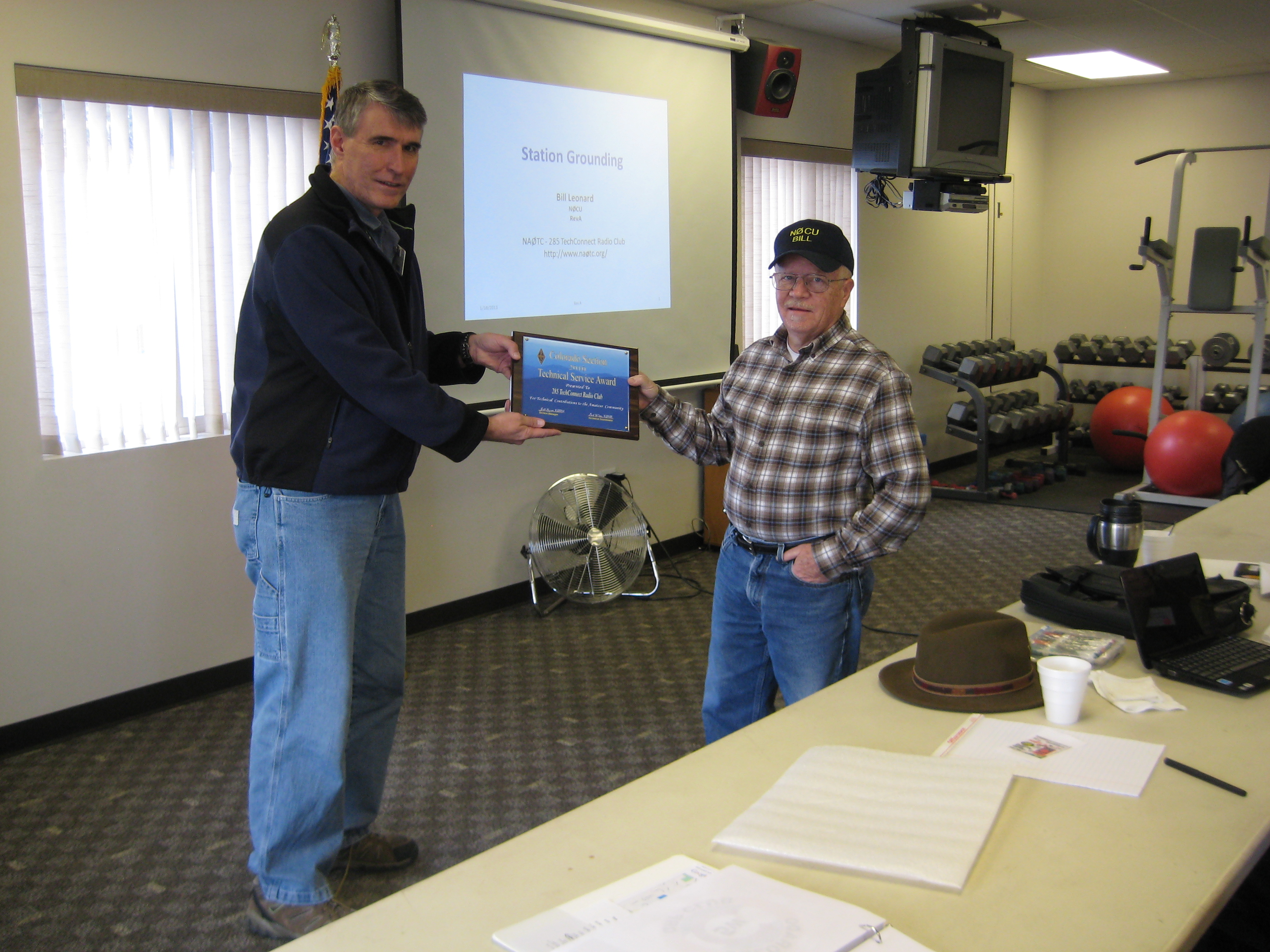
Today, I had the privilege of presenting the Technical Service Award (ARRL Colorado Section) to the 285 TechConnect Radio Club. I have to tell you…this club is an excellent example of how to advance the hobby of ham radio. They have figured out that providing technical education is a great way to attract members and assist the local amateur radio community.

Here’s a photo of me handing Bill N0CU, club president, the award:

Bob K0NR presents award to Bill N0CU, President of the NA0TC club

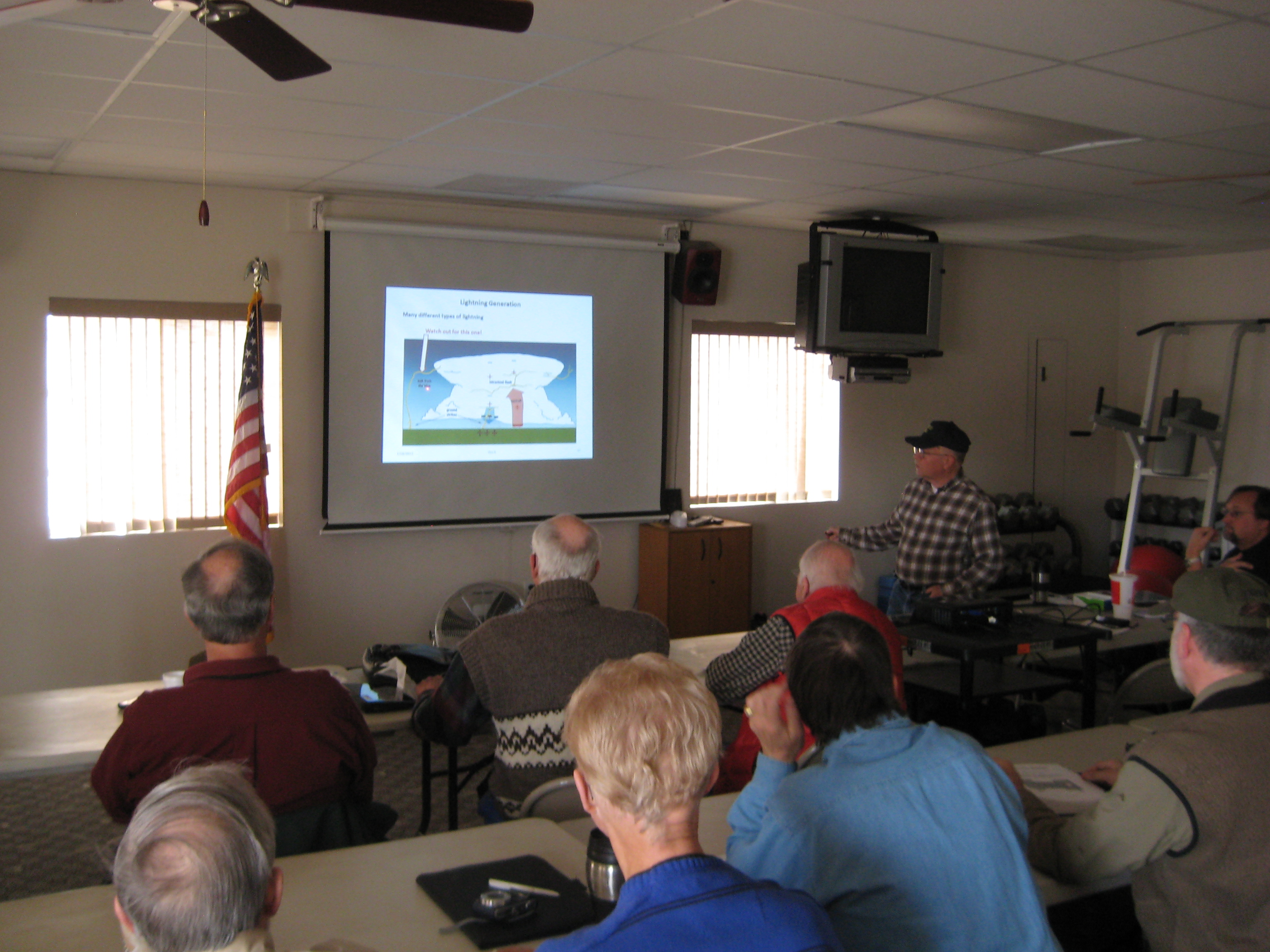
At the meeting, Bill also did an excellent presentation on grounding issues in amateur radio stations. This is a complicated topic that Bill handled very well.

Presentation on station grounding by Bill N0CU

Here’s the announcement of the award:

We are pleased to announce that the 2010 Technical Service Award from the ARRL Colorado Section has been awarded to the 285 TechConnect Radio Club ( http://www.na0tc.org/ ). In past years, this award has been presented to individuals that have provided exceptional technical service to the amateur radio community. This year the award goes to the entire TechConnect club for their collective contribution to the Colorado amateur radio community. In particular, the club sponsored the all day “2010 Fall TechFest”, with a great line up of technical and operating presentations (http://www.na0tc.org/TechFest_2010_Workshop_Materials.htm ). The club also sponsors the TechNet that meets at 7 PM local on Tuesday nights on the Colorado Repeater Association 147.225 MHz repeater. These activities have made an important contribution to technical education in the Colorado section.

Our thanks and congratulations goes to the entire club with special thanks to Steve Finch, AI0W, Technical Specialist, Colorado Section for his personal leadership and contribution to this effort.

Jeff Ryan, K0RM
Section Manager, ARRL Colorado Section
http://www.k0rm.net/

Bob Witte, K0NR
Technical Coordinator, ARRL Colorado Section
http://www.k0nr.com/ts.html

VHF Sweepstakes on Mount Herman

For the 2011 ARRL January VHF Sweepstakes, I repeated the tradition of doing a winter assault on Mount Herman (DM79) on Saturday afternoon. As in past years, Joyce (K0JJW) joined me on the hike, but we also had some other folks along to make for quite a party on the summit this year.

James, Stu and Bob at the trailhead

Stu (W0STU) and I operated independent “Single Operator – Portable” stations from the summit. Stu conned convinced James (KD0MFO) to join him on this trek. We had hoped to get “Alpha Goat” Steve (WG0AT) to go with us, but he made some excuse about needing to prepare for an upcoming trip to Dominica (J7). (Instead of slogging through the snow, Steve wants to go to the Caribbean? Probably a good choice. See Steve”s video of his previous trip up Mt Herman here.) Dan (N0OLD) also hiked up a little later in the day to join us on the summit.

Bob K0NR setting up the Arrow II Yagi Antenna on the camera tripod

Trail conditions were good, with not much snow on the trail. There were definitely some icy spots such that we enjoyed the extra grippers attached to our boots. The weather forecast was a bit marginal, so we were prepared to deal with a snowstorm moving in on us. As I told Stu, the philosophy is “We’ll have a good hike and we might also have some fun working the radios.” In the end, the weather remained solid with only a few snow flakes and temperatures just above freezing. Dan and James built a small campfire (in an established fire ring) that really warmed us up.

Bob K0NR Operating the FT-817

My primary radio was the Yaesu FT-817, driving an ARROW II yagi on 2 Meters and 70 cm and a wire dipole in the trees for 6 Meters. I also had several handheld FM rigs along including one on 222 MHz. Overall, I made 83 contacts with 15 grids for a total score of 1725.

Group photo on the summit: Dan N0OLD, Bob K0NR, James KD0MFO, Joyce K0JJW and Stu W0STU

This may have been the most fun yet for the January VHF Sweepstakes. Of course, any day in the mountains playing with radios is a good day.

73, Bob K0NR

Logbook of the World – What Next?

ARRL’s Logbook of the World has gotten mixed reviews from the ham community. KB6NU asks Is it more trouble than its worth?, while VE3OIJ says he will probably never use it. On the other hand, K2DBK says you really should use it. The biggest beef seems to be around the level of security (and hassle) built into the logbook system. Someone said “LoTW has more security than my online bank.” Probably true.

I have been loading my ham radio log data into the Logbook of the World for QSOs back to 2002. Although I’ve seen quite a few QSL matches via LoTW, it has not provided any real benefit to me.

Last week, that changed. The ARRL turned on support for the VUCC award. Lately, I have been on the air for most of the VHF contests and not much else. So when I logged into the LoTW web page, I found that I have 123 grids confirmed on 6 Meters, which would qualify me for 50 MHz VUCC. (Actually, I had already qualified for this award years ago, the hard way, with paper QSLs.)

I am still working towards 144 MHz VUCC and have been working on getting QSL cards for these contacts. To be honest, I have turned into a QSL Slacker. I manage to respond to every request for a QSL …eventually, but I have been a slacker on pursuing QSLs that I need for awards. You know the reasons: it takes time, it costs postage, it is a hassle.

The answer is obvious: we need to confirm QSLs electronically. Push a button, upload your log and receive the instant gratification of a confirmed QSO. Life is too short to mess around with cards. Not that I don’t like getting The Real Thing in QSL cards…there is nothing like receiving a well-designed card and holding it in your hands.

The challenge is also obvious… the ARRL needs to turn on support for more awards (way beyond DXCC, WAS and VUCC) with the goal of providing a benefit back to the users of LoTW. Otherwise, the number of people bothering to submit logs will remain low, limiting the success of LoTW.

73, Bob K0NR

Freedom of Speech?

There are many email lists devoted to amateur radio topics, in particular on Yahoo Groups. These email forums are a great way to learn and exchange information. Usually these lists are created to hit a particular topic of interest. Over time, people stray off into other areas and start posting topics that are not appropriate for the forum. Eventually, the moderator steps in and shuts down the off-topic conversation.

What can happen next is the off-topic posters claim their right of “freedom of speech” is being violated. “This is America, and we have freedom of speech.”  (Kind of an odd statement since the internet is worldwide, not just a US concern, but I’ll set that aside.) This just happened a few days ago on an email list I use.

It has become all too common to hear people claiming “rights” that don’t really exist. US citizens might want to read the US Constitution once in a while, so they know what it actually says about freedom of speech:

First Amendment: Congress shall make no law respecting an establishment of religion, or prohibiting the free exercise thereof; or abridging the freedom of speech, or of the press; or the right of the people peaceably to assemble, and to petition the Government for a redress of grievances.

The US Constitution basically says that Congress cannot establish laws that abridge (limit) the freedom of speech. The amendment focuses on what the government is allowed to do to restrict the citizens. It does not mean that a citizen has the right to have their speech published in the local newspaper, sent through an email list, or posted on another person’s web site, etc. Newspapers, web site owners and moderators of email lists make decisions every day on what type of “speech” they are going to allow in their communication forum.

73, Bob K0NR

Announcing: Amateur Radio Technician Class – April 2 & 9

Ham Radio Two-Day License Class

Monument, Colorado

Saturday April 2 and Saturday April 9 (8 AM to 5 PM) 2011

Location: Tri-Lakes Monument Fire Station 1
Sponsored by the Tri-Lakes Monument Fire Radio Association

The Technician license is your gateway to the world-wide excitement of Amateur Radio …

  • Earn your ham radio Technician class radio privileges
  • Pass your FCC amateur radio license exam right in class on the second day
  • Multiple-choice exam, No Morse Code Required
  • Live equipment demonstrations
  • Learn to operate on the ham bands, 10 Meters and higher
  • Learn to use the many VHF/UHF FM repeaters in Colorado
  • Find out how to participate in emergency communications

There is no cost for the class (donations accepted)

However, students must have the required study guide:

Gordon West Technician Class guide, 7th Edition $20.95
And pay the FCC Exam Fee: $15.00

Advance registration is required (no later than March 25th, earlier is better!)

To register for the class, contact: Bob Witte KØNR

Email: bob@k0nr.com

For more information on amateur (ham) radio visit www.arrl.org
or www.wedothat-radio.org

Completing the 2010 Trip Around the Sun

As the year 2010 comes to an end, I feel compelled to write something really insightful and meaningful as we log another trip around the sun. Perhaps some brilliant insights for the coming year? Or predictions of future technology breakthroughs?

Instead, I am writing this.

This is a mishmash of my thoughts about amateur radio at the start of 2011:

  • Tech License Class: One of the most fun and rewarding ham radio things I did this year was help teach a couple of Technician License Classes. There is nothing like engaging with newbies to the hobby to give you a new perspective on how cool amateur radio really is! I have a great set of teammates that made this class fun and successful: Stu W0STU, Paul AA0K and Joyce K0JJW.
  • Next Challenge: The challenge we see right now is helping these newly licensed Techs get engaged with amateur radio, so they don’t drop out. My belief is that the Technician License is a beginners permit that only enables a person to get started in the hobby. We are cooking up some fun activities to keep them going.
  • Public Service: We have a good thing going with the local fire district and the RACES group in our county in terms of real engagement on emergency communications. This is fun, rewarding and a good thing for our local community.
  • Dayton Hamvention: I am going to skip Dayton (again) this year. Instead, I’ll attend the International Wireless Communications Expo (IWCE), a trade show centered on land mobile and mobile wireless communications. For me, it has an interesting mix of emergency communications, land mobile, data/voice convergence and test & measurement topics. Oh, did I mention that it is in Las Vegas?  I suspect that it will be a better venue than Hara Arena 🙂
  • ICOM IC-9100: I have been patiently waiting for this rig to move from vaporware status to reality. Maybe it will happen this year?
  • Keep On Writing: I find that writing is good therapy, so I will keep that on the list for 2011. Mostly it will be this blog and the FM column for CQ VHF magazine.
  • Operating: It seems I don’t actually get on the air as often as I’d like, certainly not for the casual ragchewing QSO. Operating events seem to be a good way for me to get some air time: VHF Contests, Colorado 14er event, Colorado QSO Party, maybe an HF contest or two.
  • D-STAR: I haven’t been spending much time with D-STAR lately and I want to increase the focus on it. D-STAR falls into that dorking around with new technology category where experimenting with it and learning about it is the main activity.  The technology continues to grow in adoption…arguably slow in real terms as the analog modes have such a huge installed base.
  • APRS: Oddly enough, I have been messing around with APRS again, mostly thinking of it as a tracking tool for hiking and other outdoor activities. Maybe we need to look at bridging APRS with D-STAR location data?

Amateur radio is clearly my #1 hobby interest, and by a wide margin. But it is primarily a hobby (yes, with a public service hook to it…at least for me). It is important to keep it in perspective and not let it turn into another job. I already have one of those.

What are you going to be doing in 2011?

73, Bob K0NR

Playing Around with APRS

In the past few weeks, I started playing around with APRS again. Interest in APRS seems to come and go for me over time. It has the technical intrigue of figuring out how it works and the fun of exploring radio propagation paths. (If you are not familiar with APRS, K9DCI has a good introduction to it.)

The web site aprs.fi has some interesting hooks built into it that maps the location of APRS stations. I embedded a map here on my weblog page that shows my home station position (K0NR) and other stations in the vicinity. I intentionally blocked stations that only exist via the internet (no RF).

This map is dynamic in that it will update to show the latest APRS activity. It is fun to try select different map styles (courtesy of Google maps). Also, you may want to look at the html code to see how this is done.

73, Bob K0NR


TSA Travel Tips

I just completed my last business trip of the year. As I was standing in the line for the security screening I was pondering the various techniques I have adopted to smooth the process. Actually, I was just daydreaming since the line was moving pretty slow. It was the family of 5 in front of me that seemed to be clogging the system.

For the infrequent traveler, the most important thing is to read and follow the instructions from the TSA. The other day I saw a guy trying to take 6 quarts of bottled water through security. Then there was the guy with the GIANT belt buckle and a HUGE set of keys in his pocket. Not good.

Here are my tips for making it through TSA screening as easily as possible:

  • Before you enter the security line (or while you are waiting in line), clear your pockets of all things metal and put them into your carry on. Don’t dump all this stuff into the little bowls they have at the x-ray machine as it just slows you down.
  • Keep an eye on the various screening lines to see which ones are getting hosed up. In particular, look for infrequent travelers that don’t seem to know what they are doing and stay away from their line.
  • If you can, stay away from the new body scanners and steer towards the lines that have metal detectors. Be aware that the body scanners require you to take everything out of your pockets, not just metal objects.
  • If you have a jacket with you, there are two options: 1) before you get in line, stuff the jacket into your carry-on bag (one less thing to mess with) or 2) hang onto your jacket but put your metal items into a pocket (best if you have a zipper or other closure on the pocket so things don’t spill out). If you are really hardcore, check out the SCOTTEVEST products with a gazillion pockets.
  • Slip-on shoes are a little faster to get on and off.
  • The x-ray machines have a roller tray that feed carry-on items into the machines. Don’t be too quick to put your luggage onto this tray. First  focus on getting the special items into the tubs they provide. That is, pull your notebook computer, your 1 quart bag of fluids, your shoes, etc. and put them into a tub. Then, as you approach the x-ray machine plop your carry-on bag(s) onto the tray. This avoids juggling a cargo train of luggage on the tray.
  • What about ham radio gear you are carrying? (Yes, this is a ham radio blog.) Handheld transceivers are not much of an issue these days, since they look so much like mobile phones. Sometimes I will pull them out and put them in a tub for screening. For larger radios, treat them like a notebook computer….pull them out of the bag and put it in a tub so it is visible and can be easily x-ray’d.

Those are my thoughts….what do you say?

73, Bob K0NR

NASA Amateur Radio Video from ISS

Well, this one has actually been out on the web for several weeks, but I finally got around to viewing it. Col. Doug Wheeler Wheelock (KF5BOC) gives a short tour of the ISS and then demonstrates amateur radio operating (2 Meter FM) from the ISS. Col. Wheeler Wheelock was very active on the ham radio and I heard him on many passes but was not able to work him.

This is one of the best NASA videos concerning amateur radio on board the ISS, so don’t miss it!

This Spewed Out of the Internet #17

Just catching up on some of the fine information spewing forth from the Internetz.

I saw this video about a flying car. Yeah, I think I might need one, but only if I’m the only one. I don’t want the crummy drivers I see on the road flying around in the air.

See what happens when Hitler finds out he worked rare DX but did not show up in the log.

Here’s a higher quality ham radio video by my friend Steve, WG0AT. See Peanut, Rooster and the Alpha Goat operate from the summit of Mount Herman. It sounds like this may be the last Goathiker video for a while, so enjoy it.

Not to be left out, NASA posted this excellent video from the International Space Station (ISS). Colonel Doug Wheelock gives a fine explanation of what it is like on his end when working the earthbound pileup. Don’t miss this one!

Recreational Equipment Incorporated (REI) has updated the Ten Essentials for wilderness travel. Whether you use the old ones or the new ones, give this some thought.

The ICOM IC-9100 inches its way towards being available for sale in the US. At least, I think it is. A fairly detailed product brochure is available on ab4oj.com. The latest word is that the radio will be available “soon”.

Yawn, wake me when it shows up.

Electronic Design magazine has a good tutorial on digital communications, including bandwidth, data rate and various forms of modulation.

73, Bob K0NR

Has Amateur Radio Missed Out on Instant Messaging?

Earlier today, I was examining the various mobile phone service plans and “smart phones.” This caused me to reflect on how text messaging has become such a big deal in the mobile wireless world. Text messaging, more properly called  SMS (Short Message Service), supports simple text messages up to 160 characters. Even with a limited text length, much information gets passed using SMS, with usage rates exploding in recent years.

Twitter created a messaging system based on these short messages (actually limited to 140 characters to  fit into SMS with some margin). It wasn’t clear at first what the purpose of this system is, but people have figured out how to make use of it.

Other social networking systems, such as Facebook, have included SMS into their system, including sending status updates out via text messages. It turns out that you can do a lot with just 160 characters of plain text.

Ironically, amateur radio had the basic technology for a simple messaging system decades ago. This technology is packet radio or AX.25, a narrowband digital communications format that is ideal for sending short messages. This was a hot technology during the 1980’s and into the 1990’s. Later it faded into the background as the Internet delivered much faster digital pipes.  APRS (Amateur Packet Reporting System) revived interest in the mode in the past decade but remains a niche application in ham radio.

The APRS community has tried to take APRS main stream as a ubiquitous messaging system, but this has not gained wide adoption. Bob Bruninga WB4APR documented the Universal Text Messaging initiative on his web site. This is a nice piece of work. Bob argues correctly that we have quite a few different messaging formats that need to be tied together so they can be more effective.

What is standing in the way of a robust amateur radio messaging system? I think it  it is quite simple: the lack of a compelling mobile device for text messaging. While both Kenwood and Yaesu have incorporated APRS into their handheld radios (TH-D72, VX-8GR),  the emphasis seems to be on position reporting (GPS) and simple status messages. Neither of them have done anything innovative in the text message area, such as including a QWERTY keyboard or a touch screen user interface. Imagine a handheld radio based on the Android operating system…an open system that can be programmed by the amateur community. Being inherently digital, ICOM’s D-STAR radios had the opportunity to really nail this type of use but they have missed it so far.

There has been some fine work done using D-STAR to provide Instant Messaging (IM) capability. Most notably, the D-RATS software by Dan Smith KK7DS does a super job of integrating IM and email, using the ham bands along with the Internet. (D-RATS has many other features, too.) But to run D-RATS you need a computer attached to the radio….appropriate in some applications but missing the portability associated with the conventional HT or mobile phone.

A valid question is whether this really matters at all. Do we even need a ham radio instant messaging system? If we did, what would we use it for?  Applications that come to mind are: position reports, event announcements, DX spots, emergency pages, callsign lookup, repeater directory and, of course, casual chatting.  I suspect that once the capability is available the software gurus among us would apply it to applications that are beyond our current thinking. Actually, we know what hams like to “tweet” about…just monitor the high level of ham activity on Twitter. To really make this work, we’ll need some action from the equipment manufacturers.

That’s my thinking….what do you say?

73, Bob K0NR

QST Announcement of January VHF Contest

While I was traveling on business, I started getting emails about my photo in QST. When I got home I took a look and found this announcement for the upcoming January VHF Contest.

I had posted this photo in my soapbox comments for the 2010 contest. Sean KX9X dropped me an email a few months ago asking if they could use it for publication. Of course, I said “sure!”

See you on the air in January!

73, Bob K0NR